
Academic Trajectory & Spatial Research
Fri, July 24 2026 /Mpelembe Media/ — Born on February 21, 1984, in Harlow, Essex, Hannah Fry completed her undergraduate and doctoral work at UCL. Her 2011 PhD thesis, A Study of Droplet Deformation, analyzed interfacial viscous boundary layers using the incompressible Navier-Stokes equations. Following a brief stint in motorsport, she returned to UCL CASA as a lecturer in 2012. Over the next decade, she pioneered interdisciplinary research utilizing spatial urban data, networks, and statistical models to analyze human behaviors in cities. Her notable research contributions include modeling the spatial propagation of urban riots, adapting criminological geographic profiling tools to locate pathological origins in epidemiologic outbreaks, and modeling burglary distribution hotspots using Hawkes self-exciting point processes.
Science Communication & Public Engagement
Fry has developed an unparalleled media and publishing footprint designed to overturn the stereotype that mathematics is dry or inaccessible. She has authored several bestselling books: her debut monograph, The Mathematics of Love (2015), The Indisputable Existence of Santa Claus (2017), the critically acclaimed Hello World: How to Be Human in the Age of the Machine (2018), which won the 2020 Asimov Prize and explored the ethics of AI governance, and Rutherford & Fry’s Complete Guide to Absolutely Everything (Abridged) (2021/2022).
Her broadcasting career features numerous prime-time TV series and documentaries, including BBC’s The Secret Genius of Modern Life, the deeply personal and Grierson-Award winning Making Sense of Cancer, National Geographic’s The Infinite Explorer, and the BBC series AI Confidential. Her popular BBC Radio 4 show The Curious Cases of Rutherford & Fry (latterly co-hosted with Dara Ó Briain) draws over a million listeners per episode.
Pedagogical Philosophy & Educational Leadership
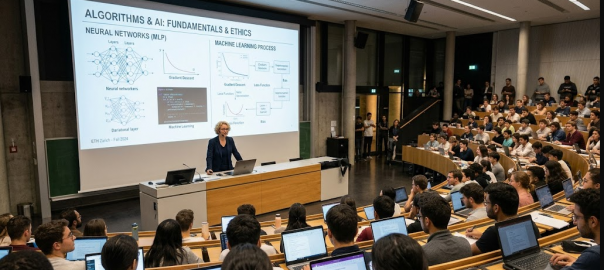
In her role at Cambridge, Fry balances public scholarship with mentoring masters and PhD students. She has championed a creative, “audience-first” pedagogical style, asserting that the limit to public mathematical understanding is not capability, but rather a lack of motivation to care. She advocates for a “hybrid machine-human” approach to AI and automated decision systems, cautioning policy leaders and the public against uncritical reliance on data-driven algorithms while embracing their quantitative strengths. Her visible academic and media leadership serves as a crucial role model in breaking down environmental barriers and gender disparities in higher mathematics.
The Needle, the Gas, and the Soulmate: Why 2026 is the Year Mathematics Finally Got Real
Mathematics is often unfairly characterized as a cold, static landscape of chalk dust and impenetrable symbols. To the uninitiated, it looks like a graveyard of solved puzzles. But the announcement of the 2026 Fields Medals—and the honoring of Dr. Hannah Fry with the Leelavati Prize—reminds us that math is less a collection of answers and more the hidden pulse of our existence. It is the only language we have that can simultaneously describe the path of a riot, the collision of subatomic particles, and the agonizing decision of when to stop swiping on a dating app.Guided by the 2026 Fields Medalists—Yu Deng, John Pardon, Jacob Tsimerman, and Hong Wang—and the public-facing wisdom of Dr. Fry, we can begin to see the architecture behind the chaos. These are the guides who show us that the laws of the universe and the search for a soulmate are written in the same ink.
1. The “Needle Problem” and the Art of 3D Rotation
Imagine trying to turn a needle 360 degrees in your hand. Now, imagine trying to do it using the absolute minimum amount of space possible. For a century, mathematicians have wrestled with the “Kakeya problem,” a geometric riddle that asks: how small can the area be? In two dimensions, the answer is counter-intuitive: by cleverly sliding and rotating the needle, you can actually turn it in a set of points with an area of zero.But when you move into the third dimension, the needle doesn’t just slide; it dances through a multiscale thicket of possibilities. Hong Wang, a 2026 Fields Medalist, achieved a landmark breakthrough by proving the three-dimensional version of this problem. Using sophisticated multiscale and decoupling techniques, Wang showed that our spatial intuitions often fail when we look at the “fine-grained” level of geometric sets.Why does this matter to someone who isn’t a geometer? Because the Kakeya problem is a proxy for how waves—whether they are sound, heat, or light—behave when they interfere with one another. Wang’s work provides the foundational logic for partial differential equations, the very math we use to model everything from the vibration of a bridge to the propagation of a planar wave. It reminds us that simple geometric questions are often just the visible tips of deep, physical icebergs.
2. Taming the Ghost in the Machine: AI as a Collaborator
As we move through 2026, the conversation around Artificial Intelligence has finally matured. We have largely abandoned the “sentient takeover” tropes of Hollywood in favor of the pragmatic reality championed by Dr. Hannah Fry. As the inaugural Professor of the Public Understanding of Mathematics at Cambridge, Fry argues that the real risk of AI isn’t a robot rebellion, but our own tendency to treat black-box algorithms as infallible oracles.Fry’s work highlights that while algorithms excel at processing massive datasets, they stumble when faced with “edge cases” or nuanced human values. An algorithm can predict traffic flow, but it cannot understand the ethical weight of a sentencing recommendation or a medical diagnosis. The goal, she argues, is not to replace the human, but to build a better partnership. As she notes:”Their optimal use involves hybrid systems where human judgment supplements computational outputs to address ethical dilemmas and edge cases.”
3. The Boltzmann Breakthrough: Physics from First Principles
For over a century, a gap has existed in our understanding of the physical world. We know how individual particles move, and we have the “Boltzmann equation” to describe how gases behave en masse, but rigorously connecting the two has been a “holy grail” since David Hilbert posed it as one of his 23 problems in 1900.Yu Deng has finally bridged this divide. By deriving the Boltzmann equation directly from the dynamics of colliding “hard spheres,” Deng has provided a rigorous mathematical bridge from the microscopic to the macroscopic. This is “first principles” physics at its most elegant. His work doesn’t just stop at rarefied gases; it extends into the probabilistic territory of nonlinear Schrödinger dynamics. By finding the “logic in the chaos” of a gas cloud, Deng has brought us closer to a unified understanding of how the universe’s fundamental clockwork produces the fluid world we see every day.
4. Taming the Wild: Tsimerman and the Logic of Shapes
If Yu Deng found logic in physical chaos, Jacob Tsimerman found it in the “wild” structures of abstract geometry. Tsimerman was awarded the Fields Medal for his work in “o-minimality”—a logical framework used to tame mathematical structures that would otherwise be too complex or “infinite” to handle.Tsimerman’s genius lies in importing these abstract tools from model theory into the world of number theory and algebraic geometry. By proving Griffiths’ conjecture on the algebraicity of period maps, he has provided a new lens for viewing the Hodge conjecture, one of the million-dollar Millennium Prize Problems. Tsimerman’s work shows us that even the most abstract numbers have a “shape,” and by understanding those shapes, we can solve problems that have haunted number theorists for generations.
5. The 37% Rule: Can You Really Optimize Love?
Mathematics isn’t just for gas clouds and number theory; it’s also for the heart. Dr. Hannah Fry has famously popularized the “Secretary Problem,” or the “37% Rule,” as a strategy for dating. The math is simple: if you plan to date ten people in your life, you should reject the first 3.7 (let’s say three) to “calibrate” your expectations. After that, you commit to the very next person who is better than everyone you’ve seen before.It’s a mathematically sound strategy for sequential decision-making, but as any veteran of the dating apps will tell you, the “human variable” is a nightmare to model. The 37% rule assumes you can’t go back to an ex (no “option recall”) and that you have perfect information about your own preferences. It doesn’t account for the person who ghosts you, the “non-linear” surprise of a second chance, or the fact that human chemistry often defies sequential evaluation. It’s a witty reminder that while math can give you a compass, it can’t always save you from a bad date.
6. Shaping the Universe: Calabi-Yau 3-folds and String Theory
What is the actual “fabric” of our universe? John Pardon’s work in symplectic geometry has brought us closer to an answer. By proving the 20-year-old MNOP conjecture, Pardon created a mathematical “dictionary” that proved two entirely different ways of counting curves on complex shapes—known as Calabi-Yau 3-folds—were actually identical.This isn’t just academic bean-counting. In superstring theory, Calabi-Yau 3-folds are thought to be the models for the hidden dimensions of our universe. By refining how we “count” the curves on these shapes, Pardon is providing the architectural blueprints for quantum physics and representation theory. He is, quite literally, defining the geometry of the possible.
7. Closing the Gender Gap: It’s Mindset, Not Biology
Perhaps the most human insight of 2026 comes from Dr. Fry’s analysis of the persistent gender gap in mathematics. Looking at the 2015 TIMSS assessment and a decade-long Danish study, Fry highlights a startling behavioral divide: when faced with a difficult math problem, boys tend to “externalize” failure (blaming the task), while girls tend to “internalize” it (blaming themselves).This internalized sense of “not belonging” creates an environmental barrier that has nothing to do with biological aptitude. The Danish study found that simply providing targeted encouragement regarding a student’s aptitude could halve the gap in degree attainment. The disparity isn’t a matter of brains; it’s a matter of culture. As Fry poignantly observes:”Disparities arise from environmental barriers rather than innate deficits.”
Conclusion: The Infinite Explorer
From the rigorous derivations of Yu Deng to the public advocacy of Hannah Fry, 2026 has revealed mathematics as a “vitality-filled” lens. It is not a spectator sport for the few, but a toolkit for the many. Whether we are rotating a needle in three dimensions, taming the algorithms that curate our newsfeeds, or deciding whether to go on a second date, we are all infinite explorers in a world of hidden patterns.As you navigate your own life today, take a moment to look past the surface. What are the “hidden numbers” guiding your next big decision? The answer might be more beautiful than you imagine.