
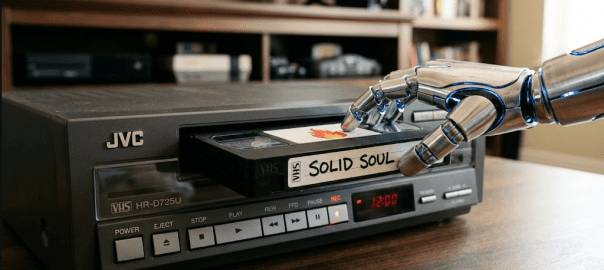
This analysis broadly explores the cultural legacy, archival importance, and modern resurgence of VHS tapes.
The VHS Era as a “Labour of Love” Before frictionless, on-demand streaming, recording television onto blank cassettes—such as the iconic TDK E-180, known for its dolphin cover art—was a highly involved creative process. Home viewers painstakingly curated their own physical media libraries, which required intense focus to manually pause recordings during commercial breaks and handwritten labels for the spines. This effort transformed VHS tapes into a “physical CV” of a person’s tastes, creating a cherished, tactile media experience that modern streaming platforms struggle to replicate.
VHS Tapes as Accidental Time Capsules Because original television networks frequently wiped their own broadcast archives to save money, home-recorded VHS tapes have become vital pieces of historical preservation. A dedicated modern community of amateur archivists and “tape diggers” now scour eBay, Freegle, and charity shops to salvage these forgotten collections. By digitizing these tapes, they unearth lost media, including early 1980s television, rare regional commercials, channel idents, and long-lost music performances. The archival value of VHS is so significant that even some official, label-sourced music videos on YouTube rely on glitchy dubs salvaged from old VHS tapes.
The 2026 VHS Rental Resurgence By 2026, North America is experiencing a cultural revival of the VHS format, with physical video rental shops opening up in various cities. This resurgence is driven by older generations seeking the nostalgia of weekend video rentals and Gen Z users wanting to experience physical media firsthand. Ultimately, the revival represents a societal pushback against digital isolation, fueled by a desire for analog aesthetics, tactile media, and real-world community building.
Jonathan Ross and British Television History The sources also chronicle the extensive career of British broadcaster Jonathan Ross, who became a major figure on the BBC and ITV. His early career is rooted in the classic era of 1980s television; he worked as a researcher and producer on the Channel 4 program Solid Soul, a show designed to highlight emerging British and Caribbean soul music. Ross himself shares the archivist spirit seen in the VHS community; as a massive pop-culture collector, he recently allowed video game archivists to access his personal collection to preserve a rare, thought-to-be-lost Um Jammer Lammy arcade cabinet.
From “Pause Button Ninjas” to Arcade Saviors: 5 Surprising Lessons from the Analogue Era
1. The Paradox of Frictionless Choice
In 2026, the modern media consumer is drowning in an ocean of convenience. We open our streaming services to be met with 40,000 choices—a monolithic wall of algorithm-approved “Suggestions For You” that frequently results in twenty minutes of paralyzed scrolling and a lingering, low-level anxiety. This “frictionless” abundance, while technically impressive, often leaves us feeling bloated and dissatisfied. We have everything, which in the economy of attention, often feels like having nothing.This stands in stark contrast to the deliberate, high-stakes curation of the VHS era. In the 1980s and 90s, media was not a utility like water from a tap; it was something we had to hunt, capture, and maintain. That effort—the analogue “faff”—is exactly what gave the content its soul.
2. The Magnetic Archaeology of the “Pause Button Ninja”
Recording television in the analogue era was not a passive act of consumption; it was a high-stakes performance where the viewer functioned as both audience and editor. To capture a film off-air was an act of magnetic archaeology. It required the physical mastery of a concert pianist and a specific ritual of tools: a fresh TDK E-180, a VCR with a clock eternally flashing “12:00,” and the creative decision of whether to label the spine with a ballpoint pen (prone to smudging) or a felt-tip (destined to bleed into the cardboard).The true test of skill was the battle against the commercial break. To maintain a clean recording, viewers became “Pause Button Ninjas,” lunging toward the machine to hit pause within a 1.5-second window. This created a deep, tactile connection to the media. As the archives of the “Genology” historians remind us, these recordings were rarely perfect, but their imperfections were precisely what made them ours:”The second the film re-appeared—BAM!—you’d un-pause. You’d do this eight times… You’d always, always get a tiny sliver of an advert. The last half-second of the ‘R. White’s Lemonade’ song was a permanent fixture on my copy of Terminator… or the start of the ‘Shake ‘n’ Vac’ jingle.”
3. Jonathan Ross: From Researcher to Arcade Custodian
The career of Jonathan Ross offers a perfect study in “technological hauntology”—the way past formats continue to haunt and shape our present. Long before he was the host of Friday Night with Jonathan Ross , he was a researcher on shows like Loose Talk and the seminal Solid Soul . Ross didn’t just live through the era of physical media; he became one of its most dedicated custodians.Beyond his well-known television persona, Ross is a creator-archivist with a profound respect for the ephemeral. He is a prolific writer of comics like Turf , a massive collector of Hayao Miyazaki’s work (even providing a voice role in the Ghibli-related Ronja, the Robber’s Daughter ), and a man whose private toy collection rivals museums.In 2023, this passion for preservation turned into a vital service for digital history. The arcade version of the game Um Jammer Lammy was considered a lost relic until Ross allowed video game archivists access to his private arcade cabinet—one of the last surviving examples in the world. Ross represents the ultimate evolution of the Pause Button Ninja: a pop culture icon turned technical savior.
4. The Hauntology of the Official Music Video
There is a delicious irony buried in the “high-definition” libraries of modern streaming platforms. Many official, label-sourced music videos on Vevo are actually “glitchy dubs” harvested from ancient home-recorded tapes.This reliance on amateur recordings is a direct result of the “impermanence” of digital history. Because original studio masters were frequently lost or destroyed, labels have been forced to go hat-in-hand to the archives of home recorders.
- The Early YouTube Era: Populated by “flickery” user uploads from personal VHS collections.
- The Vevo Era: Attempted to standardize quality, but often simply upscaled those same “magnetic ghosts.”Today, when you watch a crisp 80s hit, you are often seeing the flickering tracking lines of a TDK tape recorded decades ago. The “official” version is a copy of a copy, haunted by its own analogue origins.
5. 2026: The Year the Tactile Returned
The year 2026 has witnessed a startling resurgence of VHS rentals across North America. This isn’t merely a mid-life crisis for those in their 50s; it is a radical rejection of “isolated lives” by younger generations who find social media disconnect increasingly intolerable. In an era of digital ghosts, there is a yearning for the “analog purity” of something you can hold.However, the “Tech Review Guy” archives provide a necessary reality check regarding rumors that Sony or Panasonic are remanufacturing VCRs. While the cultural interest is high, the financial logic is absent. The costs of spinning up mass production lines for complex mechanical hardware cannot be recuperated by a niche audience, no matter how vocal. As one observer noted:”There’s a certain aesthetic… people want to experience that sort of analog purity… people want to experience tactile things, they want to actually see and feel and hold VHS tapes. That sort of tactile media, physical media, has definitely been making a comeback.”
6. Hunting the “Holy Grail” of Wiped History
While the masses scroll through Netflix, a dedicated group of “tapeographers” like Greg Molloy and Neil Miles engage in a different kind of scrolling—wading through miles of mouldy magnetic tape. They hunt for footage “wiped” by broadcasters who once viewed their archives as disposable. Irish broadcaster RTE, for instance, had a ruthless wiping policy until the mid-90s, making home recordings the only extant evidence of entire cultural eras.These archivists search for “Holy Grails” that represent cultural badges of honor:
- Jools Holland’s 1987 Tube Promo: Infamous for the moment he swore at unsuspecting CITV viewers.
- Regional ITV Franchises: Continuity and idents from Southern, Westward, or ATV—lost to time at the end of 1981.
- Smithy’s Kaff: Bizarre local ads that remain legendary for their sheer enthusiastic weirdness.For the tapeographer, a hand-labeled E-180 containing a “dodgy copy” of a regional news broadcast isn’t junk; it’s a fragment of a lost civilization.
Conclusion: The Value of the Faff
The overarching lesson of the analogue era is that the “faff”—the struggle, the timing, the smudged labels—is exactly what gave our media meaning. Our frictionless present offers unparalleled convenience, but it has traded the soul of our cultural memory for the convenience of an expiration date.As we look toward a future where “official” masters vanish and algorithms dictate our tastes, we must ask ourselves: In our rush to remove all friction from our lives, have we accidentally made our own history disposable? Perhaps there was more value in the struggle of the Pause Button Ninja than we ever cared to admit.