
Beyond the Pass: Character Growth, Kitchen Politics, and Technical Craftsmanship in The Bear
Wed Sep 09 2026 /Mpelembe Media/ — The Bear is confirmed to end with its fifth season. While FX and Hulu set an official premiere date for the final installment on June 25, the fourth season is highlighted as a critical return to form that balanced emotional depth with much-needed humor. Key narrative milestones include a significant wedding episode titled “Bears,” which utilized complex audio techniques to capture a pivotal group scene under a table. Audience reactions are mixed, with some viewers praising the character growth and performances while others feel the show has become repetitive or overly dramatic for its genre. Additionally, broader industry changes are noted, such as Disney+ implementing new terms to strictly prohibit password sharing outside of primary households.
The Narrative Arc and Character Evolution Across Five Seasons
FX’s The Bear chronicles the dramatic evolution of Carmen “Carmy” Berzatto, an award-winning fine-dining chef de cuisine who returns home to Chicago following the tragic suicide of his older brother, Michael. Inheriting Mikey’s failing, debt-ridden sandwich shop, The Original Beef of Chicagoland, Carmy fights to modernize the kitchen alongside his deceased brother’s best friend, Richard “Richie” Jerimovich, and newly hired sous-chef Sydney Adamu. As Carmy transforms the shop into a fine-dining establishment called The Bear, his obsession with perfectionism and emotional avoidance culminates in him getting trapped in the walk-in refrigerator during soft opening. Pushing through burnout and daily menu changes in Seasons 3 and 4, Carmy ultimately realizes he is using cooking to escape his familial trauma and decides to retire from the culinary industry in the Season 4 finale, “Goodbye”. He entrusts full operational leadership to Sydney and grants Richie a formal co-partnership stake. Under Sydney’s command as head chef and Tina Marrero’s leadership as chef de cuisine, the crew unifies during a high-stakes, storm-plagued service in Season 5 to earn the restaurant two Michelin stars, allowing Carmy to step down with peace.
Kitchen Dynamics, Mentorship, and the Metaphor of Station Prep
Throughout the series, the daily physical work of station preparation serves as a central narrative metaphor for personal growth, patience, and team cohesion. In the show’s early days, legacy line cooks like Tina initially resist Sydney’s standardized brigade system and precise knife techniques before growing to take immense pride in their culinary craft. As Carmy’s self-imposed rule of changing the menu daily threatens to overwhelm the prep staff in Seasons 3 and 4, Tina and Sydney push him to recognize the human cost, convincing Carmy to adopt a simplified, set menu. This collaborative prep workflow proves vital during Season 5’s storm service, where ingredient shortages and equipment failures force the cooks to adapt in real time—substituting Tina’s perfected Brussels sprouts for a broken stove’s lamb dish to satisfy the Michelin inspector. Concurrently, team members like Marcus Brooks evolve from routine bread bakers into elite pastry chefs through mentorship and Denmark stages, illustrating how disciplined prep work transforms a chaotic line into a unified family.
Behind-the-Scenes Production Craft and Real-World Kitchen Engineering
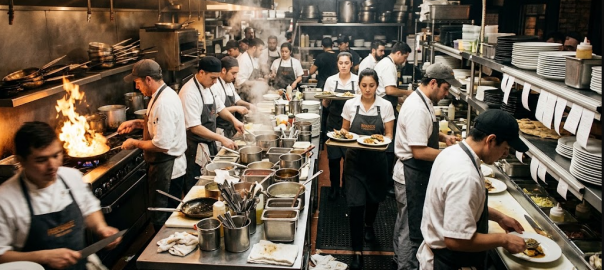
To authentically capture the kinetic pressure of a high-end restaurant, the production team combined meticulous culinary coordination with specialized set engineering. Culinary producer Courtney “Coco” Storer and culinary co-producer C.J. Capace collaborated with renowned real-world Chicago chefs, including Tim Flores and Genie Kwon of Kasama, to design and style authentic fine-dining dishes. Production designer Merje Veski and art director Lisa Korpan constructed a fully functional working kitchen set on a Chicago soundstage, equipped with working stoves, low-boy fridges, and a custom acoustic linear glass window that isolates noisy kitchen dialogue from the dining room while preserving line of sight. Cinematographer Andrew Wehde utilized digital ARRI Alexa Mini LF cameras with Panavision lenses, paired with an interactive RGB LED practical lighting rig built directly into the ceiling to allow continuous handheld long takes without C-stands or cables, while opting for 35mm film on flashback episodes like “Fishes” and “Gary”. Overseen by supervising sound editor Steve “Major” Giammaria and sound mixer Scott D. Smith, the show’s sound design layers overlapping dialogue and ambient kitchen noises to mirror the authentic adrenaline of a live service.
The $19 Sandwich: How “The Bear” and Disney+ Are Killing the Streaming Dream
As we sit in the early months of 2026, we are navigating the debris of the peak-content explosion. The industry has decisively transitioned from its growth-at-all-costs mandate to a cold, efficiency-first paradigm. We find ourselves at a strange crossroads: preparing for the final course of FX’s The Bear , perhaps the last true vestige of the prestige era, while the platform hosting it—Disney+—reaches a new zenith of corporate restriction.It is a fascinating, if cynical, irony. While the Berzatto family struggles to find soul in a sterile fine-dining world, the “Mouse” has successfully converted the wild frontier of streaming into a highly regulated, sanitized spreadsheet of “Extra Member” fees and Digital Rights Management (DRM) hurdles. As we look ahead to the series finale this June, here are the five takeaways that define our new reality.
TAKEAWAY 1: Every Second Counts—Literally. “The Bear” Sets a Hard Expiration Date
The kitchen is officially closing. FX has confirmed that The Bear will conclude its run with Season 5, set to premiere all eight episodes on June 25, 2026. For a show that redefined the “culinary dramedy” and propelled stars like Ayo Edebiri into the mainstream, the decision to end now is a bold attempt by showrunner Christopher Storer to preserve narrative integrity.Looking back, the reception to Season 4 (released in June 2025) was notably polarizing. While critics lauded its technical mastery, many viewers felt the story began to “disappear up its own ass,” trading the frantic energy of the original sandwich shop for a more self-indulgent, slow-burn pace. By setting a hard expiration date for 2026, the production is choosing to serve a final, curated course rather than letting the brand simmer until the flavor evaporates.”The first 2-3 seasons were so good… This show disappeared up its own ass so rapidly. They could’ve kept it lighter with occasional deep drama. It didn’t know what genre it was supposed to be.” — u/coverthetuba, r/popculturechat
TAKEAWAY 2: The 32-Microphone Symphony Under the Table
If we look back at the technical peak of the series, we have to talk about Season 4’s standout episode, “Bears.” Clocking in at a bloated but beautiful 70 minutes, the episode centered on a wedding that brought the extended Berzatto family together. It was a narrative remedy to the trauma of Season 2’s “Fishes,” punctuated by Richie’s poignant realization that he isn’t a solitary rock, but “the sand, connecting all these people.”The Micro-Symphony of Chaos To capture the raw, overlapping dialogue of the pivotal “under the table” scene—where the cast huddles in a cramped space to share their deepest fears—the audio team executed a feat of engineering that bordered on madness. They utilized a staggering 32 channels of recorded sound, a figure that dialogue editors noted was “well in excess of even the most complicated scenes” the series had ever attempted. The setup required 16 individual microphones to be drilled directly into the furniture to capture a soundscape so intimate it felt claustrophobic. It was chaos by design, a technical “sleight of hand” used to ground a high-concept found-family moment in absolute sonic reality.
TAKEAWAY 3: The “Household” Redefined—The Mouse is Watching Your Wi-Fi
In 2019, Disney+ was the family-friendly alternative to a tightening Netflix. By April 2026, that image is dead. The “Household” is no longer a concept of shared affinity; it is now a strict legal definition enforced by Wi-Fi tracking and device association.The New Rules of the Household
- The Primary Residence Mandate: A “Household” is now legally defined as the collection of devices associated with your primary personal residence and used only by the individuals who live there.
- The Verification Friction: Disney now employs a “One-Time Passcode” system. If you try to stream while traveling, you must request a code via the primary account’s email—a deliberate layer of friction designed to discourage long-term sharing.
- The “Extra Member” Tax: To add a user outside your residence, you must pay an additional $6.99/mo (Basic) or $9.99/mo (Premium).
- The One-Slot Limit: Unlike the early days of unlimited profiles, standard accounts are now restricted to a single “Extra Member” slot.
TAKEAWAY 4: The 4K Browser Betrayal
For the “Premium” subscriber paying the top-tier $19.00 monthly rate, there is a hidden technical ceiling that feels like a betrayal of the price tag. Despite paying for 4K UHD capability, subscribers streaming through computer browsers (Chrome, Safari, Edge, or Firefox) are blocked from accessing 4K resolution.Due to strict DRM restrictions imposed by studios to prevent piracy, browser-based streaming is capped at lower resolutions. To actually see the sweat on Carmy’s brow in 4K, you are forced away from your laptop and toward a native smart TV app, a 4K-capable streaming stick, or a game console. This limitation significantly erodes the perceived value of the “Premium” tier for students and professionals who rely on mobile PC setups, highlighting a growing gap between what we pay for and what the hardware is permitted to deliver.
TAKEAWAY 5: The “Bundle” is the New Cable (and it’s Actually Cheaper)
As a Senior Analyst, I look at the math and see a clear push toward higher Average Revenue Per User (ARPU) through “Subscription Sprawl.” Standalone prices for Disney+ Premium have hit a staggering $19.00 , making it more expensive than some of its competitors’ comparable tiers. However, the corporate strategy is clear: they don’t actually want you to buy a standalone subscription.The goal is aggregation. In a move that mirrors the return of the cable-style bundle, the Disney+/Hulu/Max bundle (with ads) is priced at just $16.99. Think about that: it is literally cheaper to have three streaming libraries with commercials than it is to have one “Premium” standalone service.The “Sweet Spot”: For those who refuse to tolerate ads, the Trio Premium bundle remains the industry’s most aggressive play. By consolidating Disney+, Hulu, and Max into a single $33 bill, power users are seeing 35%–42% savings compared to purchasing these services individually—an intentional nudge to keep you locked within the ecosystem.
CONCLUSION: A Thought-Provoking Final Course
As we await the June 25th premiere of the final season, the irony is thick enough to spread on a sandwich. The Bear succeeded because it captured the messy, disorderly, and deeply human heart of the Berzatto kitchen. But the platform that delivers it has become a “Sanitized Disney Spreadsheet,” defined by verification passcodes and calculated bundle math.We are moving out of the Golden Age of Content and into the Efficiency Age of Subscriptions. We are paying more for less quality on our browsers, and paying “Extra Member” fees to keep our families connected. It leaves us with one final question: as the costs rise and the restrictions tighten, would you rather stay in this complicated $19-a-month digital kitchen, or go back to the simplicity of a single “Bear” sandwich shop, where the rules were few and the passion was free?