
5 Radical Realities Reshaping the Middle East
The global order shifted fundamentally in February 2026, though the world is still struggling to reconcile two contradictory images. In Washington D.C., the newly minted “Board of Peace” (BoP) convened for an inaugural summit of “executive globalism,” pledging billions to transform the Gaza Strip into a high-end tourism and business frontier. Simultaneously, ten days later, the “Peace through Strength” paradigm reached its violent logical conclusion: the United States and Israel launched “Operation Epic Fury” and “Operation Roaring Lion,” a massive joint military campaign to raze the command nodes and nuclear infrastructure of the Islamic Republic of Iran.This is the central paradox of the new era: a “Peace Deal” is not merely coexisting with a regional war; it is the institutional framework that necessitates it. To the architects of this new order, the destruction of the “Axis of Resistance” is the security precondition for the luxury hotels of Gaza. We are witnessing the birth of a corporate-authoritarian fantasy where sovereignty is traded for stabilization. To understand this shift, we must look past the press releases and identify the five radical realities currently reshaping the Middle East.
The “Pay-to-Play” International Body
The Board of Peace is not a standard international organization; it is a radical departure from the consensus-based diplomacy of the 20th century. Established by executive authority rather than a traditional multilateral treaty, the BoP possesses its own “international legal personality”—a crucial distinction that allows it to change laws and enter diplomatic agreements independently of the United Nations.The structure is unapologetically transactional. While sixty nations were invited, core membership is a commodity. According to the board’s charter, permanent membership requires a $1 billion investment into a fund controlled by the Chairman. At the apex sits Donald J. Trump, designated as “Chairman for Life,” a position from which he can only be removed by a unanimous vote of the seven-person Executive Board. This grants the Chairman a permanent veto over all global decisions.The composition of this board signals the move toward “Executive Globalism.” The leadership includes figures like Tony Blair , Steve Witkoff , Marc Rowan , and Ajay Banga . Trump has positioned this “fledgling club of autocrats” as a nimble alternative to the UN, stating:”It will be the most consequential International Body in History… the greatest and most prestigious Board ever assembled, at any time, any place.”
The “Middle East Riviera” and Disaster Capitalism
The blueprint for Gaza’s future reimagines the war-torn enclave as a global investment frontier—a “$30 billion master plan” to create a “Middle East Riviera.” The vision features beachfront skyscrapers, special economic zones, and luxury hotels.This is “disaster capitalism” in its purest form: the use of a crisis to implement radical free-market policies. Critics note that the BoP functions as a “Coalition Provisional Authority 2.0,” a “Bremer-style” rule that prioritizes “accumulation by dispossession.” To facilitate this, the board has adopted the controversial legal framing of Gaza as terra nullius —”nobody’s land.” By treating the territory as a space without established sovereignty, the Board gains a “mandate for land-grabbing” that allows it to bypass Palestinian property deeds.Governance on the ground is delegated to the National Committee for the Administration of Gaza (NCAG) , led by technocrat Ali Sha’ath . While Sha’ath oversees the day-to-day restoration of utilities, the BoP and its billionaire investors retain absolute control over Gaza’s land and resources. It is, in the words of analysts, a “hostile takeover” masked as reconstruction.
The “Dual-Track” Paradox: Peace vs. Epic Fury
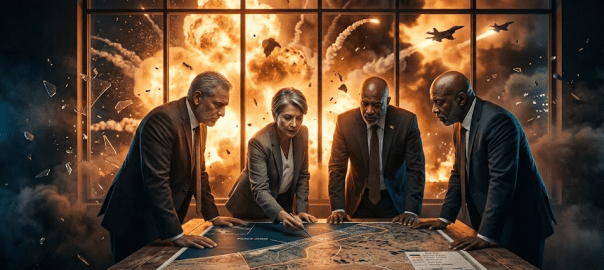
The BoP is institutionalizing peace in Gaza while its founders prosecute a high-stakes war in the Persian Gulf. The logic is simple: the “Middle East Riviera” cannot exist while Iran projects power. Thus, regional war is the “ultimate enforcement” of the peace vision.This military campaign— Operation Epic Fury (U.S.) and Operation Roaring Lion (Israel)—was preceded by a collapse of diplomacy in Geneva.
January 2026: Internal protests in Iran result in a violent crackdown and an internet blackout. Trump warns the IRGC that “help is on the way.”
February 24: In his State of the Union address, Trump warns of “bad things” if a “meaningful deal” is not reached on nuclear stockpiles.
February 28: Massive strikes begin, targeting 140 locations including the Supreme Leader’s compound and IRGC command nodes.Crucially, the IDF withdrawal within Gaza is strictly limited to the “Yellow Line,” a perimeter that keeps Israel in control of 53 percent of the enclave. The IDF will only hand over territory to the stabilization forces as demilitarization milestones are met, ensuring that the “peace” remains under the shadow of a gun.
A Private Security Force Answering to a Board, Not a Flag
To enforce this order, the Board has authorized the International Stabilization Force (ISF) , led by U.S. Major General Jasper Jeffers III. Unlike UN peacekeepers, the ISF does not answer to the Security Council; it answers to the Board of Peace.The ISF has a “robust” mandate to use all necessary measures to destroy militant infrastructure. It is a counterinsurgency operation rebranded as stabilization, operating out of a planned 5,000-person military base within Gaza. The ultimate goal is a force of 20,000 personnel and 12,000 police .Primary ISF Contributors & Roles:
Indonesia: Serving as Deputy Commander; committing up to 8,000 personnel.
Morocco & Kosovo: Contributing security forces for site protection units.
Albania: Providing infantry and stabilization units.
Egypt & Jordan: Tasked with training the 12,000-member vetted Palestinian police force.
The Explicit Sidelining of the United Nations
The Board of Peace is designed to rival, and eventually replace, the United Nations. By granting the BoP “international legal personality,” the administration has created a body that can rewrite regional law without the “obstruction” of the Security Council.This move has fractured traditional Western alliances. France, Germany, and the United Kingdom have declined to join, citing the lack of legal oversight and the “Chairman for Life” provision. The Trump administration responded with unipolar enforcement, threatening 200 percent tariffs on French wine for those who “declined the invitation.”A policy paper from the Security in Context network highlights the strategic objective of this transition:”The Comprehensive Plan… prioritizes and embeds Israel’s control over Palestinians, limiting UN involvement although window-dressing these limits by co-opting some UN officials.”
The Dawn of Executive Globalism
The emergence of the Board of Peace signals the end of post-Cold War multilateralism. We have entered an era where international organizations are formed by decree, membership is bought, and the “rules-based order” is replaced by the “transactional order.”As skyscrapers begin to rise in Gaza while smoke rises over Tehran, we are forced to confront a difficult question: Can the traditional concept of national sovereignty survive in an era where the highest bidder—at $1 billion a seat—can rewrite the maps of the Middle East? We may be witnessing not the arrival of peace, but the perfection of a new, globalized model of corporate-authoritarian control.