

28 Feb. 2026 /Mpelembe Media/ — In this analyis. James I. Porter argues that the modern pursuit of absolute personal autonomy is a flawed and dangerous illusion. He contends that influential figures in politics and technology have embraced the “sovereign individual” as an ideal, mistakenly believing that a person can exist entirely independent of social constraints. By drawing on various philosophers, Porter illustrates that human identity is actually formed through interdependence and friction with others rather than in isolation. He suggests that removing the resistance provided by a community does not grant freedom, but instead leads to a loss of meaning and the eventual destruction of the self. Ultimately, the text asserts that our inherent vulnerability and connection to one another are the essential foundations of a functional social existence.
The End of the Citizen, the Rise of the Customer: 5 Uncomfortable Truths About Our Digital Future
The Prophecy That Refused to Die
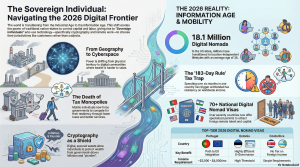
In 1997, James Dale Davidson and Lord William Rees-Mogg published The Sovereign Individual , a work of “stunning foresight” that many dismissed as the fever dream of investment advisors. They predicted a world where the nation-state would wither, and individuals would become “customers” of jurisdictions. Looking back from the vantage point of 2026, their words feel less like a prediction and more like a post-mortem of the old world.The transition we are witnessing is not merely a change in policy; it is the structural collapse of a system. To understand 2026, one must realize that the Information Revolution is to the Industrial Age what the Industrial Revolution was to the Medieval Church. Just as the printing press broke the Church’s monopoly on the soul, the microprocessor is breaking the state’s monopoly on the individual. We have moved from an era of centralized power to a fragmented reality where technology is actively rewiring the nature of sovereignty.2.
The.Death of the “Digital Nomad” and the Rise of the “Strategic Resident
“The “Digital Nomad” of 2020—the hyper-mobile freelancer fleeing lockdowns to work from a Balinese beach—is officially a relic of the past. In 2026, we have seen the emergence of the “Strategic Professional.” The shift is fundamental: we have moved from “border hopping” to “ecosystem choosing.”Governments have stopped treating remote work visas as mere lifestyle perks and started using them as high-stakes policy instruments. By 2026, countries are competing for foreign income to drive rural revitalization and stabilize economies during off-peak tourism seasons. These “Strategic Residents” don’t just want a beach; they want legal clarity, predictable infrastructure, and community integration. As strategist Andy Sto observes:”The digital nomad of 2020 was hyper-mobile. The remote professional of 2026 is strategic. We are seeing a shift from: Border hopping → Ecosystem choosing; Short stays → Seasonal living; Airbnb isolation → Community integration.”The nomad has matured into a semi-resident, treating jurisdictions not as identities to be inherited, but as service providers to be evaluated for their ROI.
Cybercash
The 11-Year Head Start on BitcoinPerhaps the most jarring aspect of the Davidson and Rees-Mogg prophecy was their prediction of “cybercash” eleven years before the first Bitcoin block was ever mined. They understood that a cryptographically secured digital currency would eventually liberate wealth from “government plunder.”At the core of this transformation is “The logic of violence.” In the Industrial Age, states maintained a monopoly on coercion because wealth was physical, stationary, and easily seized. Today, encrypted assets have fundamentally altered the return on state coercion. When wealth is a string of numbers in a private vault, the cost for a state to seize it rises exponentially, while the cost for an individual to protect it drops toward zero.However, the 2026 reality contains a nuance the original “prophecy” missed. Davidson and Rees-Mogg envisioned a “digital gold standard” where cryptography was used to track physical bars of gold. As critic E. Glen Weyl points out in Sovereign Nonsense , what we actually built was “consensus scarcity.” Bitcoin isn’t tied to any physical asset of underlying value; it is a social convention ungrounded in use-value. We didn’t get literal digital gold; we got a digital religion based on code.
The “Network State”
When Your Social Network Becomes Your Nation
If the traditional nation-state is a “land-first” institution, Balaji Srinivasan’s “Network State” is the “cloud-first” successor. In 2026, we see communities that begin as digital collectives and evolve into recognized sovereign entities.This transition follows a rigorous, multi-stage roadmap:
- Founding a Community:
A group unites online around a “one commandment”—a moral mission such as radical longevity or carbon negativity. - Building a Network Union:
The community organizes an internal economy using a native cryptocurrency and builds national consciousness. - Crowdfunding Physical Nodes:
The group acquires an “Archipelago of non-contiguous physical territories” (apartments, co-working spaces, and enclaves) across the globe. - Achieving Sovereignty:
The digitally connected, physically distributed nation petitions for diplomatic recognition as a sovereign peer.The shift represents a total reversal of the historical norm: - Land-First Revolutions:
Occupy territory, then attempt to build a culture. - Cloud-First Revolutions:
Build a digital culture, then acquire the Archipelago.5. The Taxman’s Digital Upgrade: The End of “Loophole Nomadism”While technology has empowered the Sovereign Individual, it has also provided the state with a massive digital upgrade. The era of “grey area” nomadism—where one could simply drift between borders to evade tax residency—has been systematically dismantled.According to the OECD’s International Migration Outlook 2025 , the population of mobile workers grew by 17% heading into 2026. In response, jurisdictions have tightened their grip. Data from Stripe shows that mandatory B2B e-invoicing is now the standard in Poland, Belgium, and France , effectively ending the ability to hide economic activity.The irony of 2026 is profound: the same digital tools that allow you to work from a villa in the Algarve allow the government to track your “economic interests” and “travel patterns” with surgical precision. The “183-day rule” is no longer a suggestion; it is a hard-coded reality enforced by international information exchange. Sovereignty is fragmenting, but for those who remain within the traditional system, the taxman has never been more omniscient.
The “Nerd Reich”: The Dark Side of Digital Autonomy
The rise of the Sovereign Individual has sparked a fierce backlash against what critics call the “Nerd Reich.” Analysts like Gil Duran point to a “Social Darwinism” embedded in the movement—a “complete lack of concern” for the “losers or left-behind” who lack the cognitive or financial capital to opt out of the system.This movement has taken on a strangely religious, almost “godless” quality. Peter Thiel’s recent lectures on “The Antichrist” and the “Satanic Panic” context of Silicon Valley suggest that the tech-elite see themselves in an existential battle against a “totalitarian one-world government.” Critics argue this is a move toward “techno-fascism,” where the social contract is replaced by private protection. As the Sovereign Nonsense review warns:”The idea that everyone can and should buy protection service from mafia bosses and warlords who sell it at the lowest price is absurd and dangerous. It also defies logic and history to suggest protection against violence would become more cost effective by simply unleashing competitions.”In this vision, the wealthy retreat into encrypted enclaves, leaving the rest of the world to navigate the ruins of a defunded state.
Conclusion: The Most Important Choice You’ll Ever Make
The roadmap of the Information Age has led us to a crossroads. We are witnessing the final transformation of the individual from a “subject” of a nation, bound by the accident of birth, to a “customer” of a jurisdiction, choosing residency based on service quality and tax efficiency.In 2026, you are forced to choose your side: will you prioritize the radical freedom of the individual or the precarious stability of the collective? The “new aristocracy” has already made its choice, migrating their assets and identities into the cloud. As the traditional state struggles to maintain its relevance, we must realize that the old borders are fading.In 2026, the ultimate border is no longer a line on a map, but the encryption key that separates the customer from the subject.
Source @LordSiliconAI