
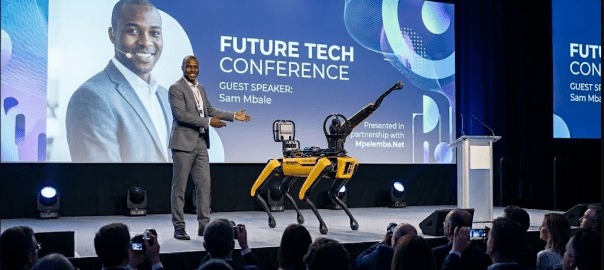
Beyond the Screen: 5 Surprising Realities Shaping the Future of AI and Robotics
March 9, 2026 /Mpelembe Media/ — For decades, the promise of the “robot age” has been stuck in an aggravating stalemate. We live in a world where an algorithm can compose a passable symphony or pass the bar exam, yet we still lack a machine that can reliably navigate a laundry room or patch a crumbling bridge. This is the “uncanny valley” of productivity: we have conquered the digital realm of symbols and logic, but the physical world—with its friction, gravity, and unpredictable messiness—remains stubbornly out of reach.But the screen is no longer a barrier; it is becoming a mirror. Recent breakthroughs presented by the world’s leading builders at ODSC 2026 and the Robotics and AI (RAI) Institute suggest we are finally witnessing the “tectonic shift” from artificial intelligence that merely thinks to intelligence that does . We are moving beyond the era of chatbots and into the era of embodied partners. Here are the five surprising realities defining this new frontier.
Takeaway 1: “Athletic Intelligence” is the New Deep Learning
In the previous decade, AI was essentially a brain in a jar. The RAI Institute is now pioneering a different path: “Athletic Intelligence.” This isn’t just about movement; it is about “dynamic whole-body manipulation.” It represents a shift from robots that follow rigid, pre-programmed scripts to machines that possess a fundamental, intuitive grasp of their own physical presence.Consider the “Spot” robot. Utilizing a combination of reinforcement learning and sampling-based optimization, Spot has demonstrated the ability to autonomously upright, roll, drag, and stack 15kg car tires. These are four distinct types of physical intelligence—locomotion, perception, balance, and manipulation—fused into a single, graceful act. This is how we redefine our relationship with matter: when a robot can solve the “tire problem” not through a line of code for every inch of movement, but through a learned sense of physics, it ceases to be a tool and becomes a physical actor.We need to make robots smarter, more agile and dexterous, and generally easier to use—more like people. Once we do that, robots and other types of intelligent systems will increase productivity, free people from dangerous work, care for the disabled, and help people live better lives. — Marc Raibert, Executive Director, RAI Institute
Takeaway 2: The Rise of the “Embodied” AI Open-Source Movement
For “Athletic Intelligence” to move from the research lab to our city streets, we must first dismantle the gated communities of proprietary hardware. This is the mission of Martino Russi and the LeRobot project at Hugging Face. In a counter-intuitive move for an industry often defined by high-cost secrecy, they are making advanced robotic hardware—including open-source humanoid arms and teleoperation devices—affordable and reproducible.By lowering the entry barrier, the LeRobot project is democratizing the “physical data” required to train the next generation of machines. This isn’t just a win for hobbyists; it’s a game-changer for the entire ecosystem. When a startup in Nairobi or a student in Berlin can access the same humanoid arm architecture as a Silicon Valley giant, the pace of innovation for embodied AI accelerates exponentially. We are witnessing the “GitHub-ification” of robotics.
Takeaway 3: AI is Finally Learning “Common Sense” Through Physics
Large Language Models (LLMs) are often criticized for being “stochastic parrots”—they know the word for “gravity” but have never felt its pull. To solve this, the RAI Institute is focusing on “Cognitive Intelligence,” the ability for a robot to generalize and use common sense by anchoring its decision-making in the laws of physics.A pivotal development in this space is the Diffuse-CLoC framework. Historically, robots suffered from being “hallucinating limbs”—they might plan a kinematic motion (the shape of a movement) that was physically impossible to execute because it ignored weight or resistance. Diffuse-CLoC bridges this gap, linking kinematic motion diffusion models with physics-based control policies. By forcing AI to “reason” through the lens of physical consequences, we ensure that a robot doesn’t just know how to reach for a glass, but understands the fragility of the glass and the gravity of the water within it.
Takeaway 4: Building the “India-Centric” AI Stack
As we move toward a global AI future, we must confront a visceral reality: an AI that only speaks English or understands Western urban contexts is a hollow victory. Chandra Khatri’s work with Krutrim is a necessary correction to this bias. Khatri is building a full-stack AI ecosystem—from custom silicon to multilingual foundation models—specifically for the “billion voices” of India.Krutrim is the world’s first India-centric multilingual LLM, and it notably outperforms several state-of-the-art foundation models when tested in the Indian context. This is more than a technical milestone; it is a global necessity for bridging the gap between urban centers and rural communities. Imagine the impact of an AI that speaks the specific dialect of a rural farmer, providing real-time agricultural advice or medical guidance. This “grassroots” AI ensures that the robotics revolution doesn’t just serve the few, but empowers the many.
Takeaway 5: The Goal is “Human-Compatible,” Not Just Capable
The final reality of this new era is a moral one. As robots gain the ability to perform physical labor, the conversation is shifting from “how capable is it?” to “how compatible is it?” This is the core philosophy of visionaries like Stuart Russell and Anthropic’s Benjamin Mann. The framework of the future is “helpful, harmless, and honest.”Manuela Veloso, Head of AI Research at JPMorganChase, advocates for “human-AI symbiotic interaction.” The goal isn’t a world of autonomous machines working instead of us, but a partnership where AI acts as a steward and collaborator. Whether it’s helping the disabled or managing complex financial systems, the machine must be designed with human values as its primary constraint.My research covers a wide range of topics in artificial intelligence, with a current emphasis on the long-term future of artificial intelligence and its relation to humanity. — Stuart Russell, Director, Center for Human-Compatible AI
Conclusion: The Proactive Future
We are standing at the precipice of a proactive future. The transition from digital screens to physical presence—enabled by the democratization of hardware and the “Athletic Intelligence” of systems that understand physics—promises to finally deliver on the decades-old hype. By grounding our machines in common sense, cultural diversity, and safety, we are building a world where robots can truly free people from dangerous work, repair our failing infrastructure, and care for those who cannot care for themselves.As robots gain “Athletic Intelligence” and “Common Sense,” how will our own roles in the workforce and society evolve to meet our new partners?