
The Agentic Evolution: Unifying Compute, Code, and Context in Zerve’s Data Workspace
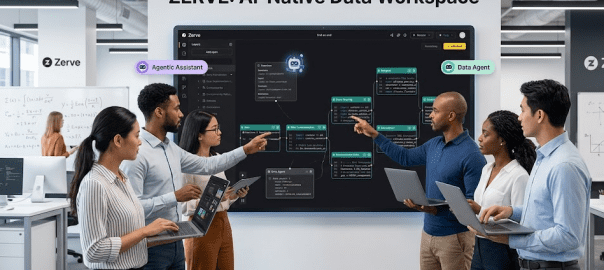
April 20, 2026 /Mpelembe Media/ — Zerve is an AI-native, agentic data workspace designed to unify data exploration, advanced analysis, team collaboration, and production deployment into a single, seamless environment.
At the center of the platform is an adaptive AI agent that functions as a reasoning partner rather than a simple coding assistant. The agent automatically maps data warehouses to understand context, writes and debugs multi-language code (Python, SQL, R), and builds complex data pipelines while keeping the user in full control. To solve the hidden-state issues of traditional computational notebooks, Zerve relies on a Directed Acyclic Graph (DAG) architecture. This guarantees that all execution cells start from a stable, reproducible state, preventing local environment drift and enabling real-time, conflict-free collaboration among multiple users.
For resource-intensive tasks, Zerve provides “The Fleet,” a built-in distributed computing engine that allows data scientists to parallelize massive workloads, run large-scale models, and bypass single-node memory limits effortlessly. Once an analysis is complete, Zerve eliminates the need for downstream engineering by allowing users to deploy their workflows directly as interactive conversational reports, web apps, or APIs.
Built for the enterprise, Zerve accommodates strict security and compliance standards, including SOC 2 and HIPAA. Organizations can deploy the platform in a managed cloud, a self-hosted VPC, on-premises, or in a completely air-gapped environment with zero outbound connections. It secures data via end-to-end encryption, Role-Based Access Control (RBAC), and allows companies to Bring Your Own Key (BYOK) to manage their own approved LLMs. This entire ecosystem is powered by a flexible, consumption-based pricing model using Zerve credits to meter orchestration and compute usage.
Beyond the Dashboard: 5 Hard Truths About the New Era of Agentic Data Workflows
Choosing a modern data stack has devolved into a high-stakes navigation of “marketing theater.” Every legacy vendor promises an “AI-powered” revolution, yet the industry remains haunted by a sobering reality: 73% of Business Intelligence (BI) implementations fail to deliver ROI in their first year.As a senior analyst, I see the same pattern across the enterprise: organizations are buying tools to solve visibility problems, but they are drowning in “vibe coding” and fragmented workflows. Moving toward an agentic era requires more than just a chatbot; it requires a fundamental shift in how we define “decision-grade” work. Here are five hard truths about the transition from static dashboards to agentic data workflows.
1. The Myth of the “Unified Platform” is Dead
The dream of a single, all-encompassing BI platform is over. The “Hard Truth” is that traditional enterprise tools are increasingly ill-equipped for the velocity of modern analysis. We must now distinguish between two fundamentally different activities:
- Reporting (The Governance Layer): Standard platforms like Power BI and Tableau are for the C-suite—stable, governed, and slow. However, for many, the reality is “The Ugly”: Power BI’s DAX remains notoriously non-intuitive, and technical friction—like the 1GB/10GB dataset caps—creates immediate bottlenecks. Even their AI integrations, like Copilot, are often technically present but deemed “unreliable in production.”
- Analysis (The Agentic Layer): For the “ad-hoc” world where non-technical users have 50 random questions a week, legacy BI fails. AI-native tools like BlazeSQL or ThoughtSpot are the new requirement. They don’t just bolt on a chatbot; they allow for genuine self-service by bypassing the analyst backlog.The Strategic Synthesis: Successful teams are abandoning the “one tool” mandate. They use traditional tools for stable reporting while deploying AI-native layers to handle the high-frequency, exploratory questions that otherwise bury data teams.
2. Agents are Orchestrators, Not Just Coding Assistants
The evolution of AI in data work has moved past simple code snippets. The industry is shifting from passive assistants to active “Agentic Notebooks” that understand the intersection of code, data, and infrastructure.While standard LLM assistants focus on syntax, a true data agent handles repetitive orchestration tasks. Using Zerve as the benchmark, we see agents that don’t just suggest a line of Python; they understand how data flows through a pipeline and can even spin up new infrastructure to support heavy workloads—all under the developer’s control.”This is not a chat window. It is a full developer that pair programs with you and integrates with your workflow. It supports Python, SQL, and other popular languages, fitting the way engineers and data scientists already work.” — Phily Hayes, CEO of ZerveThe Analyst Insight: This is a shift in Orchestration . An agent that can clean a customer data pipeline and manage the underlying compute environment transforms the human role from “coder” to “director.”
3. The “Broken Loop” is the Silent Productivity Killer
The greatest friction in modern data work is the “broken loop”—the cognitive tax of switching between a chatbot window, an IDE, and a CLI. This context switching is where focus dies and hallucinations go unnoticed.The antidote is the “Canvas” interface seen in modern platforms like Zerve, Deepnote, or Hex. By operating natively inside the environment, the agent offers visibility of the plan before execution .The Strategic Synthesis: Friction is the enemy of “decision-grade” results. When an agent operates in a shared interface, it isn’t a “black box” outputting code; it is a collaborator whose reasoning is visible at every step. This visibility is the only structural defense against the loss of developer focus.
4. The Semantic Layer is the Only Antidote to Hallucination
Natural language querying is dangerous without a structured foundation. For an AI assistant like Strategy AI’s “Auto” to reach a “decision-grade” level, it must rely exclusively on a trusted calculation engine —a semantic layer (like LookML or Strategy’s Semantic Graph).There is a vital technical distinction here:
- Structured Data: Handled via a Semantic Graph to ensure “Revenue” means the same thing across every department.
- Unstructured Data: Handled via Vector Embeddings for textual retrieval.The Analyst Insight: Hallucinations are a symptom of a missing semantic layer. Without these governance benchmarks to anchor the AI, natural language tools are simply guessing at business logic. Governance isn’t a “nice-to-have”; it is the requirement for trust.
5. Consumption Pricing: Transparency with a Markup
We are seeing a total departure from flat subscription fees in favor of usage-based models. Amazon QuickSight pioneered this with its $0.30 per-session pricing, and Zerve has followed with a credit system tied to compute and API calls.However, the “Hard Truth” of consumption models is the hidden cost of orchestration. Zerve, for example, bills the model’s API cost plus a 20% markup . While this aligns costs with actual value (compute hours and API calls), it shifts the burden of optimization from the vendor to the data lead.The Strategic Synthesis: While these models lower the entry barrier for small teams, they introduce the risk of “Bill Shock.” Organizations now need active usage monitoring and “cost governance” as a core competency.
Conclusion: The Future is Agentic
The transition from “watching dashboards” to “collaborating with agents” is the most significant shift in data strategy since the move to the cloud. The goal is no longer just visualization; it is reaching execution from idea without reinventing tools for every project. As you audit your current stack, ask yourself: Is your team trapped in a “broken loop” of marketing theater, or are you building a “decision-grade” engine that can actually move the needle?