
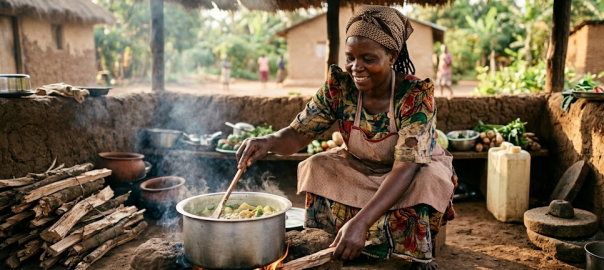
Fri, May 15 2026 /Mpelembe Media/ —The global reliance on traditional, polluting cooking fuels remains a critical health and environmental crisis, with over 2 billion people lacking access to clean alternatives like liquefied petroleum gas (LPG), biogas, and electricity. This dependence generates severe household air pollution (HAP), which is linked to nearly 3 million premature deaths annually and disproportionately impacts women and children, who also suffer the economic and educational toll of “time poverty” from daily fuel collection.
Despite the obvious need for a transition, recent evidence highlights unexpected complexities in achieving direct health outcomes. The landmark Household Air Pollution Intervention Network (HAPIN) trial, which provided free LPG to households across four countries, found that while the intervention significantly reduced indoor PM2.5 exposure, it failed to produce measurable short-term improvements in severe infant pneumonia, birth weight, stunting, or women’s blood pressure. Experts now hypothesize that achieving significant health gains may require longer-term exclusive use, interventions that begin prior to pregnancy, and community-wide transitions to mitigate the compounding effects of ambient “neighborhood” pollution.
Furthermore, the transition to modern cooking faces significant financial and structural barriers, requiring an estimated US$8 billion annually to achieve universal access by 2030—a massive jump from current investment levels. Innovative solutions are emerging to bridge the affordability gap, such as Pay-As-You-Go (PAYG) smart meters, which proved highly effective in sustaining clean fuel access for low-income households during the COVID-19 economic downturns.
Concurrently, carbon markets have become a vital financing mechanism, but the sector is undergoing intense reform following scrutiny over exaggerated emission reduction claims and inflated baseline calculations. To restore market confidence, organizations like Gold Standard and Verra are implementing rigorous new methodologies (such as the CLEAR and Metered and Measured protocols) that track actual stove usage and apply more conservative data models. Because these stricter standards will generate fewer credits per project, the market floor price for high-integrity cookstove carbon credits must rise—projected to sit between $15 and $39 per tonne—to keep projects financially viable.
To overcome these hurdles, experts urge policymakers to shift away from isolated technology roll-outs and instead fully integrate clean cooking into national electrification planning, climate action targets (NDCs), and high-integrity carbon market frameworks.
The Invisible Barriers to a Smoke-Free Kitchen: Why $8 Billion a Year Isn’t Clearing the Air for 2 Billion People
In the world’s most remote kitchens, poverty has a physical architecture. William Checkley, a pulmonary specialist at Johns Hopkins University, doesn’t just see blackened walls; he sees “stalactites of soot.” These are not the mineral formations of caves, but thick, oily deposits of carbonized history hanging from ceilings where smoke fills every lungful of air. “It is difficult to breathe—you cough, your eyes burn,” Checkley observes.This is the daily reality for 2.3 billion people—nearly a third of humanity—who cook over open fires or rudimentary biomass stoves fueled by wood, dung, or charcoal. The resulting Household Air Pollution (HAP) is a silent executioner, linked to 3.2 million premature deaths annually. To the global development community, the solution seems like a simple technological swap: replace dirty biomass with “Clean Cooking” solutions—sustainable fuels like liquefied petroleum gas (LPG), ethanol, or electricity.Yet, as we pour billions into this transition, we are discovering that technology is colliding with the bedrock of cultural habit and biological timing. Despite a required annual investment of $8 billion to meet universal access goals by 2030, the “simple” stove swap is proving to be one of the most complex puzzles in human development.
1. The Health Paradox: Why “Better” Air Is Too Little, Too Late
For decades, the scientific community operated under a logical assumption: if you reduce smoke, you improve health. However, the results of the Household Air Pollution Intervention Network (HAPIN) trial—a massive randomized controlled trial across Guatemala, India, Peru, and Rwanda—delivered a seismic shock to this consensus.The trial successfully slashed particulate exposure from a median of 100 μg m⁻³ to 35 μg m⁻³, meeting the World Health Organization’s intermediate target. To put that in perspective, raw biomass cooking can frequently top 1000 μg m⁻³—several-fold higher than the worst days of ambient smog in Delhi or Beijing. Yet, despite this massive reduction, the health improvements were “solidly inconclusive.” There were no significant gains in birth weight, pneumonia reduction, or childhood stunting.”All the health outcomes where we thought we could make a difference, they were all a ‘no’,” Checkley admits.The epiphany? Timing and environment. The data now suggests that for a child to benefit, the switch to clean fuel must happen before pregnancy, not during it. A technological fix delivered mid-gestation is, quite literally, too late. Furthermore, Tangchun Wu of Tongji Medical College points out a critical engineering oversight: ventilation. Even with clean LPG, poor ventilation can negate health gains. Wu’s research shows that without a range hood or adequate airflow, nitrogen dioxide and fine particulates still accumulate to dangerous levels. In the battle for health, the stove is only half the kit; the kitchen itself must breathe.
2. The “7.9% Multiplier”: The Internal Politics of the Hearth
If technology is the vehicle, gender dynamics are the engine. A meta-analysis of 50 studies by Rossana Tornel-Vázquez reveals that simply involving women in the design and implementation of cooking programs boosts adoption rates by 7.90% .This sounds intuitive, yet women—the primary users and the ones breathing the soot stalactites—are frequently sidelined in favor of the “household head.” This creates a friction point of “bargaining constraints.” In many cultures, the male head of the household controls the meager family budget and often views a clean stove as a “low-priority luxury” rather than a medical necessity.Women also face “Time Poverty,” spending up to 18 hours per week collecting fuel. This is labor that could be spent on education or income, yet because it carries no monetary price tag, it is often devalued in the family’s economic negotiations. Despite these high stakes, Tornel-Vázquez found that only 30% of studies explicitly include women in their methodology, leaving the primary decision-makers of the kitchen invisible to the very people trying to help them.
3. The Tragedy of the Commons and the Forest Paradox
The economic barrier to clean cooking is rooted in the perception of wood as “free.” This leads to a classic “Tragedy of the Commons”: because firewood is accessible to everyone, it is overexploited, driving 70% of deforestation in parts of Africa. However, when wood must be purchased, the cost of charcoal can consume a staggering 30% of a household’s monthly income.This financial pressure leads to “fuel stacking”—the practice of owning a clean LPG stove but using it only for quick tasks like tea, while reverting to biomass for long-boiling staples to save money. Interestingly, the data presents a “Forest Paradox”: a higher proportion of local forest area actually correlates with a greater likelihood of clean stove adoption. Researchers suggest this might be because trees are increasingly viewed as a “cash crop” to be sold rather than burned, or because communities living near disappearing forests have a heightened awareness of environmental collapse.
4. Why Word-of-Mouth Beats a Marketing Budget
When it comes to changing how a family eats, trust is a more valuable currency than education. The Tornel-Vázquez meta-analysis found that “Information” has a massive positive effect on adoption (coefficient 15.93), but surprisingly, the formal education level of the household head had no significant impact.Instead, the barrier is often age and traditionalism. The age of the household head has a significant negative effect (coefficient -1.19), suggesting that older generations are more likely to cling to the “smoky flavors” of tradition. To break this cycle, village-level social capital is essential. Local organizations and “word-of-mouth” are far more effective at overcoming skepticism than mass media. In Pakistan, local village groups were the only entities capable of convincing residents that LPG wasn’t just safe, but a fundamental upgrade to their quality of life.
5. The “Amazon Prime” Model for the Rural Poor (PAYGO)
The most elegant solution to the upfront cost barrier ( $50–$ 100 for an LPG setup) isn’t a subsidy—it’s fintech. Pay-As-You-Go (PAYGO) technology uses smart meters and the Internet of Things (IoT) to allow families to buy fuel in micro-installments via mobile phones, much like purchasing airtime.The resilience of this model was tested during the COVID-19 lockdowns in Nairobi. While 75% of families who bought gas in bulk cylinders were forced to switch back to wood or kerosene when their incomes dropped, 95% of PAYGO users maintained their clean fuel use. The ability to pay for only what you use that day kept the air clean when the economy went dark.Beyond affordability, PAYGO provides a suite of “Value Adds” that traditional models lack:
- Safety: Smart meters can detect leaks and provide automatic shut-offs.
- Convenience: IoT sensors alert suppliers when fuel is low, enabling direct home delivery.
- Utility: Systems often include double-burner stoves, allowing families to cook multiple dishes—a critical requirement for large households.
Conclusion: The Long Road to the Last Mile
The transition to clean cooking is not a race to deliver hardware; it is a long-distance effort to rewire the social and environmental fabric of the home. While the HAPIN trial’s inconclusive results were a sobering reality check, the stakes remain planetary.Eliminating biomass burning would slash global CO2-equivalent emissions by 1.5 Gt. To put that in context, that is roughly the same carbon footprint as the entire global aviation and shipping sectors combined. We are not just talking about a kitchen problem; we are talking about a planet problem.As we move toward the 2030 deadline for the Sustainable Development Goals, we must remember that a stove is just a tool. If we provide the hardware but ignore the ventilation, the timing of pregnancy, and the internal bargaining power of the women at the hearth, the soot stalactites will remain. The question for the next decade of development is simple: Are we ready to stop treating the kitchen as a technical site and start treating it as a human one?