
Algorithms vs. Humanity: Why Social Curation and Video Stores Still Matter
Sat, Aug 01 2026 /Mpelembe Media/ — The shift from physical media to digital streaming has fundamentally altered how we consume culture, trading the community-driven discovery of local video stores for the convenience of algorithms. While platforms like Netflix offer an unprecedented abundance of content, this infinite selection has triggered a psychological phenomenon known as “Netflix Syndrome” or the “Paradox of Choice.” In this state, users experience cognitive fatigue, stress, and a tendency to endlessly delay their viewing decisions because they are overwhelmed by the options. To combat this digital burnout and the isolation of private consumption, there is a growing movement to reclaim human-centric curation and revitalize “third places” like independent video rental stores. These spaces foster meaningful social connections, interpersonal trust, and shared cultural experiences that algorithmic curation simply cannot replicate.
Outline of the Analysis of Key Factors
Content Overload: The sheer volume of media available on streaming platforms acts as a primary catalyst for decision fatigue. Studies show that as the amount of available content increases, users are significantly more likely to defer their viewing choices, which directly elevates their reported stress levels.
Affective Ambivalence: When users experience conflicting emotions or mixed feelings about an overwhelming array of appealing options, their decision-making becomes paralyzed. This ambivalence is a major driver of choice deferral and heavily contributes to the psychological burden of “Netflix Syndrome”.
Algorithmic vs. Human Curation: The source of a media recommendation significantly dictates consumer trust and adoption. Research demonstrates that human recommendations—whether from friends, family, or knowledgeable video store clerks—consistently generate higher levels of trust and engagement than purely algorithmic suggestions. While algorithms optimize for engagement, they often fail to provide the social and emotional resonance that users crave.
Social Capital: Interpersonal connections, community networks, and social trust serve as a protective buffer against digital fatigue. High levels of social capital not only reduce a user’s likelihood of endlessly scrolling and deferring choices, but they also help alleviate the loneliness and stress associated with solitary digital streaming.
The Tyranny of the Infinite Scroll: Why Digital Abundance is Trading Culture for Cognitive Exhaustion
1. Introduction: The Infinite Scroll and the “Netflix Syndrome”
It is a recurring ritual of the modern evening: you sit down to watch a movie, only to find yourself forty minutes later still flicking through rows of digital posters. The internal friction of this experience—a mix of decision fatigue and a vague sense of dread that you might choose the “wrong” thing—is no longer just a personal annoyance; it is a documented sociological shift. This “Netflix Syndrome” represents a profound irony of the digital age: while we were promised that a limitless catalog would lead to ultimate freedom, the reality has been a paralyzing surplus.According to Nielsen (2022), a staggering 46% of streaming consumers report being overwhelmed by the ever-increasing number of platforms and programs. This psychological state, rooted in what Barry Schwartz famously termed the “Paradox of Choice,” suggests that the “fast food for the imagination” provided by streaming services has begun to taste like cognitive ash.This document explores the intersection of this psychological stress and the surprising revival of the tangible world. We will examine why the digital “more” has led to a cultural “less,” and why the physical video store—once considered an antiquated relic—is returning as an essential antidote to the ethereal, shallow nature of the algorithm.
2. The Choice Paradox: Why 40,000 Titles are Making You Stressed
Research published in the Asian Journal for Public Opinion Research (AJOPR) highlights a growing trend of “OTT viewing choice deferral.” In an environment where choices have become overloaded, the time spent thinking about content often eclipses the time spent actually watching it. This is not mere indecision; it is a psychological defense mechanism.At the heart of this deferral is “Affective Ambivalence” —a purchase avoidance emotion fueled by “risk-averse thoughts.” Users aren’t just bored; they are protecting themselves from a “failure experience,” the internal regret of wasting a finite evening on a subpar film. The mental labor required to filter through thousands of titles creates a heavy psychological weight that eventually leads to total decision paralysis.”Schwartz saw that if people had too many options to choose from, they would waste time trying to determine the optimal conditions and eventually increase stress.”The industry’s response to this anxiety is telling. Features like the “Play Something” button are essentially white flags of surrender. They represent a tacit admission that the recommendation algorithm has failed to solve the stress it created. When we click that button, we are asking the machine to end our choice-induced anxiety, trading our autonomy for the hope of a statistically probable distraction.
3. The Digital Loneliness Trap
The shift toward isolated, algorithmic consumption has broader implications for public health, as detailed in a recent Frontiers in Public Health study. The transition from the shared ritual of browsing to the solitary “infinite scroll” of short videos and streaming feeds has created a “Chain Mediating Role” that fuels an addiction loop.
- Loneliness: Acts as the primary driver, pushing individuals toward digital feeds to fill a social void.
- Decreased Social Support: As users retreat from real-world interactions, their perceived social support withers.
- Reduced Physical Activity: Sedentary digital consumption replaces active engagement, further lowering mood.
- The Ego Depletion Loop: Central to this is “ego depletion theory,” which suggests that our psychological energy is a finite resource. The exhaustion of modern life—and the stress of the paradox of choice—drains this energy, lowering our self-control and making us more susceptible to the instant, shallow rewards of the algorithm.This digital isolation stands in stark contrast to the “Third Place.” Coined by sociologist Ray Oldenburg, the Third Place represents the informal gathering points—like barber shops, diners, and video stores—that exist between the “First Place” (home) and the “Second Place” (work). These spaces were historically “crucibles of culture” because they fostered shared public ritual across social classes, a ritual that the private screen has almost entirely dismantled.
4. The “Third Place” Renaissance: Why the Video Store Never Truly Died
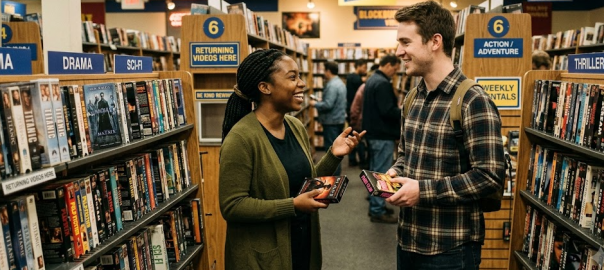
Sociologically, the video store provided a public service that streaming cannot replicate: it acted as an agora , a space for informal conversation and tactile discovery. We are currently witnessing an “unlikely return” of this model through localized boutique operations that prioritize community over convenience.Institutions like Scarecrow Video in Seattle and Snips Movies in Bebington, UK, are flourishing because they function as these essential Third Places. They turn media consumption back into a communal activity, offering a social and tactile weight that “ethereal” streaming platforms fundamentally lack
| Streaming Consumption | The Video Store Experience |
|---|---|
| Isolated: Conducted on private screens; solitary. | Social: Shared browsing; an IRL group activity. |
| Algorithmic: Directed by a “robot” nudging toward “slop.” | Curated: Directed by human taste and a library’s vision. |
| Ethereal: Content appears and vanishes without notice. | Tactile: Physical cases; handled with weight and intent. |
| Shallow: Missing vast swaths of niche film history. | Deep: Access to the “long tail” and archival rarities. |
| Platform-Dependent: Subject to shifting licensing deals. | Archival Integrity: Physical discs serve as a permanent archive. |
5. Robots vs. Clerks: The Power of Curation over Algorithms
The “infinite” catalogs of streaming services are a digital mirage. While Netflix and its peers offer a wide trough of content, they are often “horribly curated,” missing massive segments of film history. In a counter-intuitive twist, the “infinite” digital catalog is actually smaller than the physical archives it sought to replace.Seattle’s Scarecrow Video boasts over 147,000 unique titles —a collection objectively larger than all major streaming services combined. From the world’s largest bigfoot cinema collection to rare David Lynch follow-ups like On the Air , the video store preserves what the algorithm deems statistically irrelevant.The difference lies in human taste. An algorithm can only suggest what is statistically similar to your past behavior, effectively trapping you in a feedback loop of your own preferences. A human clerk, however, offers a vision.”While Netflix offers algorithmic recommendations, a video clerk offers personal taste. Whereas streaming isolates us on our private screens, the video store invites us to browse together and share opinions.” — Brian Niemeier, novelist and editor.Ultimately, a finite collection of 10,000 intentional titles provides more satisfaction than 40,000 pieces of algorithmic “slop” because each title in the store was chosen and displayed with intent.
6. The Value of the Tangible (Videoland)
In his work Videoland , Daniel Herbert discusses the “tangible phase” of movie culture. When movies became “material commodities”—plastic discs and magnetic tapes—film culture flowed out of the theater and “became conflated with shopping and salesmanship.” This materiality was not a drawback; it was the foundation of a localized movie culture.Physical media (DVD, Blu-ray, VHS) provides a level of archival integrity that digital subscriptions cannot guarantee. A film on the shelf at Snips Movies in Bebington is not subject to the whim of a corporate licensing deal that might see it vanish from a streaming service overnight. To bridge the gap between modern convenience and the need for archival access, Scarecrow’s “Rent-by-Mail” model has emerged, allowing cinephiles across the country to access physical discs that aren’t available anywhere else online. In an era where most entertainment is ethereal, the act of handles a disc and committing to a film sight-unseen carries surprising psychological weight.
7. Conclusion: Rewinding to Move Forward
The future of entertainment is not found in more data, but in a return to a more “lived” culture. The resurgence of boutique rental shops suggests a growing hunger for places where film is treated with continuity and intent rather than being a solitary drip-feed of content.As you look at your own relationship with media, ask yourself: Are you merely a consumer of algorithmic “slop,” or a participant in a lived culture? Does the infinite scroll leave you feeling satisfied, or are you suffering from the ego depletion of a thousand shallow choices?The success of the modern video store reminds us that film was always intended to be a social ritual. True discovery requires human interaction and the courage to make a finite, tactile choice. Sometimes, the only way to move the culture forward is to hit rewind.Final Takeaway: The way forward looks a lot like rewinding. True discovery isn’t found in the infinite; it’s found in the intentional.