Countering AI Ethics Dumping: African Nations Mobilize for True Digital Autonomy
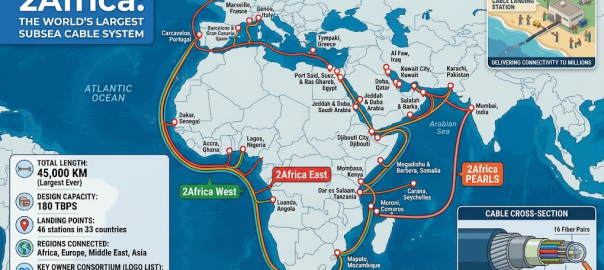
Sun, Aug 23 2026 /Mpelembe Media/ — Africa is undergoing a profound digital infrastructure revolution, shifting from historical neglect where international communications bypassed its coastlines to becoming a key hub of global data transit. This physical transformation is anchored by massive subsea cable projects driven by global technology giants. Foremost among these is Meta’s 2Africa cable system, the longest undersea telecommunications cable in the world at 45,000 kilometers, connecting 46 landing stations in 33 countries across Africa, Asia, and Europe. Boasting a design capacity of up to 180 Terabits per second, this project is expected to boost Africa’s cumulative GDP by $36.9 billion in its first few years of operation. Simultaneously, Google’s privately-funded Equiano cable runs along the western seaboard from Portugal to South South Africa, integrating space-division multiplexing to deliver 20 times the network capacity of previous regional cables. The economic impact of Equiano is massive, with projected GDP increases of $11.1 billion in Nigeria, $5.8 billion in South South Africa, and $290 million in Namibia.
While these physical networks expand connectivity, they have triggered a critical debate regarding a modern “digital scramble for Africa” and the rise of data colonialism. This concern stems from a stark structural imbalance in the African ICT stack, characterized by a complex dual dependency on foreign powers. While Chinese hardware giants like Transsion command 51% of the smartphone market and Huawei supplies 70% of 4G network components, American tech conglomerates maintain an absolute monopoly over the logical layer. Android controls 65.38% of the mobile operating system market, Google Search is a de facto monopoly at 95.63%, and U.S. giants dominate cloud computing. This creates a troubling “corridor versus platform” paradox. While subsea cables drastically lower transit costs, they do not dictate where data is processed or monetized. Critics argue that foreign hyperscalers act as physical gatekeepers, using tracking pixels to vacuum up vast amounts of local behavioral, biometric, and structural data—treating Africa as a “data goldmine” to train international AI models and fuel advertising profits that leave the continent. Consequently, local start-ups are kept in a perpetual catch-up state, lacking access to the very data their populations generate.
This asymmetric dynamic is further compounded by “AI ethics dumping,” where strict Northern regulations inadvertently push riskier tech practices onto the Global South. As the EU implements robust internal protections under the GDPR and the EU AI Act, international developers are increasingly incentivized to offshore data harvesting, content moderation, and algorithmic testing to African nations where legal frameworks and ethics compliance may be weaker. In response, African nations are actively mobilizing sovereign resistance. Governments in Ghana, Nigeria, and Zambia have recently rejected U.S.-linked health data-sharing agreements that would move citizen data beyond their borders. Furthermore, draft national AI strategies in Nigeria, Egypt, Kenya, and South Africa explicitly label over-reliance on foreign Big Tech as a threat to national security and digital sovereignty. Local enterprises are also stepping up to build independent capacity; for instance, Cassava Technologies partnered with NVIDIA to launch South Africa’s first dedicated AI factory, and Kenya’s iXAfrica is working with Oracle to deliver the nation’s first sovereign public cloud region. By combining native-language datasets, local data-processing hubs, and collective regulatory frameworks, African nations aim to transition from passive data sources into self-determined leaders of their digital future.
Beyond the Deep: 5 Surprising Truths About the World’s Longest Subsea Cable
The seamless convenience of the modern “cloud”—the 4K Netflix stream, the lag-free Zoom call, the instantaneous AI prompt—is a carefully maintained illusion. As a digital infrastructure strategist, I see the “cloud” for what it actually is: a massive, brutalist network of glass and steel buried miles beneath the crushing pressure of the ocean. For decades, Africa has existed on the periphery of this physical network, lagging behind in internet penetration and global bandwidth.The “2Africa” project, a 45,000 km subsea titan, was designed to rectify this digital isolation. As the core system reached completion in late 2025, it was hailed by its Big Tech backers as a landmark of philanthropic engineering. However, for technology ethicists, this infrastructure represents a double-edged sword. It is a miracle of connectivity that simultaneously risks becoming a high-speed conduit for a new era of digital extractivism.Here are five surprising truths about the infrastructure that is quietly rewriting the geopolitical digital footprint of three continents.
1. The 45,000 km Titan: Magnitude Beyond Imagination
The 2Africa system is not merely another cable; it is a geostrategic feat of future-proofing. By wrapping around the entire African continent and connecting 46 landing stations, the project aims to serve the surging digital demands of over 3 billion people. Navigating the regulatory landscape of 50 jurisdictions over eight years reveals the sheer scale of the administrative and technical coordination required to lay 45,000 kilometers of fiber.Technical and Physical Benchmarks:
- Total Length: 45,000 kilometers (the world’s longest subsea cable).
- Design Capacity: Up to 180 Terabits per second (Tbps).
- Fiber Architecture: 16 fiber pairs on key segments using Spatial Division Multiplexing (SDM).
- Scope: Connecting 33 countries across Africa, Asia, and Europe.To grasp the implications of this capacity, Najam Ahmad, Vice President of Network Infrastructure at Meta, framed the vision:”180 Tbps is enough to stream over 36 million HD movies simultaneously… It is a key pillar supporting this tremendous internet expansion as part of Africa’s surging digital economy.”
2. The “GDPR Trap”: Why Strict European Laws Move Data Collection South
From an ethical perspective, 2Africa represents a sophisticated “regulatory avoidance” strategy. While the EU’s General Data Protection Regulation (GDPR) and the 2024 AI Act provide robust safeguards for Europeans, they have inadvertently created a “GDPR Trap.”Within the EU, health data is classified as “sensitive” (Article 4(15) GDPR), and technical fragmentation—inconsistent EHR formats and high acquisition costs—makes training large-scale AI models prohibitively expensive. Conversely, Africa is viewed by developers as a “data goldmine.” By shifting data collection to jurisdictions with weaker legal frameworks, companies can bypass the high compliance costs of the EU’s Digital Single Market.AI Ethics Dumping: The practice of exporting data collection and processing activities that would be ethically or legally unacceptable in the Global North to Low- and Middle-Income Countries (LMICs), where oversight is lacking, to train systems intended for commercial use in High-Income Countries.This is a digital repetition of a dark historical pattern. As technology ethicist Hannah van Kolfschooten argues, this mirror’s the historical offshoring of clinical trials . Just as AstraZeneca conducted placebo trials for the drug Seroquel in LMICs to evade strict EU/US laws, or the IARC conducted cervical cancer screening trials in India without informed consent, Big Tech is now offshoring the “clinical trials” of AI training to Africa.
3. Navigating Underwater Hazards: From Brine Pools to the Congo Canyon
The seafloor is a hostile environment of “hot brine pools” and the “Congo Canyon turbidity currents”—massive underwater avalanches that can snap standard cables with ease. To ensure the survival of 2Africa, the consortium had to deploy more than just basic technical upgrades.The system utilizes undersea optical wavelength switching , a critical tool for flexible bandwidth management that allows the network to adapt to the volatile demands of AI and cloud applications in real-time. Furthermore, to combat physical hazards, the cable was buried 50% deeper than previous systems. This is not merely an engineering preference; it is a survival strategy against an environment that historically isolates the continent through frequent cable breaks.
4. Data Colonialism: The Price of “Free” Connectivity
We must look past the mirage of altruism. The narrative of “connectivity as a human right” often masks a system of “datafication” and extractivism. While free Wi-Fi hotspots and massive subsea links expand access, users frequently pay with their personal behavioral and health data.In many LMICs, there is a fundamental clash between Western-style privacy norms and the Ubuntu philosophy perspective , which emphasizes relationality and hospitality. Big Tech exploits this gap, treating African data as a raw resource to be harvested, refined in the Global North, and sold back as proprietary AI tools.”Tech companies collect personal data through online behavioural tracking technology—especially in countries in Africa with limited data protection legislation—and count on the relative lack of digital literacy… It is similar to historical colonial extractions of resources.” — Hannah van Kolfschooten et al., Accounting for EU External EffectsStated Philanthropic Goals vs. Actual Outcomes:
- Stated Goal: Promoting “Digital Inclusion” and bringing the “next billion users” online.
- Actual Outcome: Large-scale extraction of personal health and behavioral data to fuel lucrative AI markets in the Global North.
5. The $36.9 Billion GDP Question: Who Truly Benefits?
Projections suggest 2Africa will boost the continent’s GDP by $36.9 billion. To prevent monopolies, the system employs an Open Access Model , where landing station operators (like OADC in Durban) are mandated to provide non-discriminatory access. Failure to comply can lead to penalties or total disconnection from the 180 Tbps trunk.However, a GDP boost does not inherently equal local sovereignty. We face the risk of “Epistemic Injustice” —a form of technological dependency where local innovation is obstructed by imported AI tools designed for Western contexts. If the value generated by this $36.9 billion boost is immediately extracted and funneled back to Silicon Valley or Shenzhen, the infrastructure serves only to deepen the “AI divide” rather than bridge it.
Conclusion: A New Frontier for Digital Justice
The 2Africa subsea cable is an undeniable miracle of physical connectivity, a 45,000 km artery capable of linking billions. Yet, as a strategist, I must warn that physical infrastructure is only half the battle. Without a parallel evolution in digital rights, equitable benefit-sharing, and local control, we risk repeating the colonial patterns of the 19th century with 21st-century technology.Connectivity is the starting point, not the destination. If the infrastructure of the 21st century is built on the extraction of colonial-style data, can the result ever truly be “Digital Justice”?