

Decoding the Digital Heart: How AI is Quantifying Intimacy and Rewriting the Science of Connection
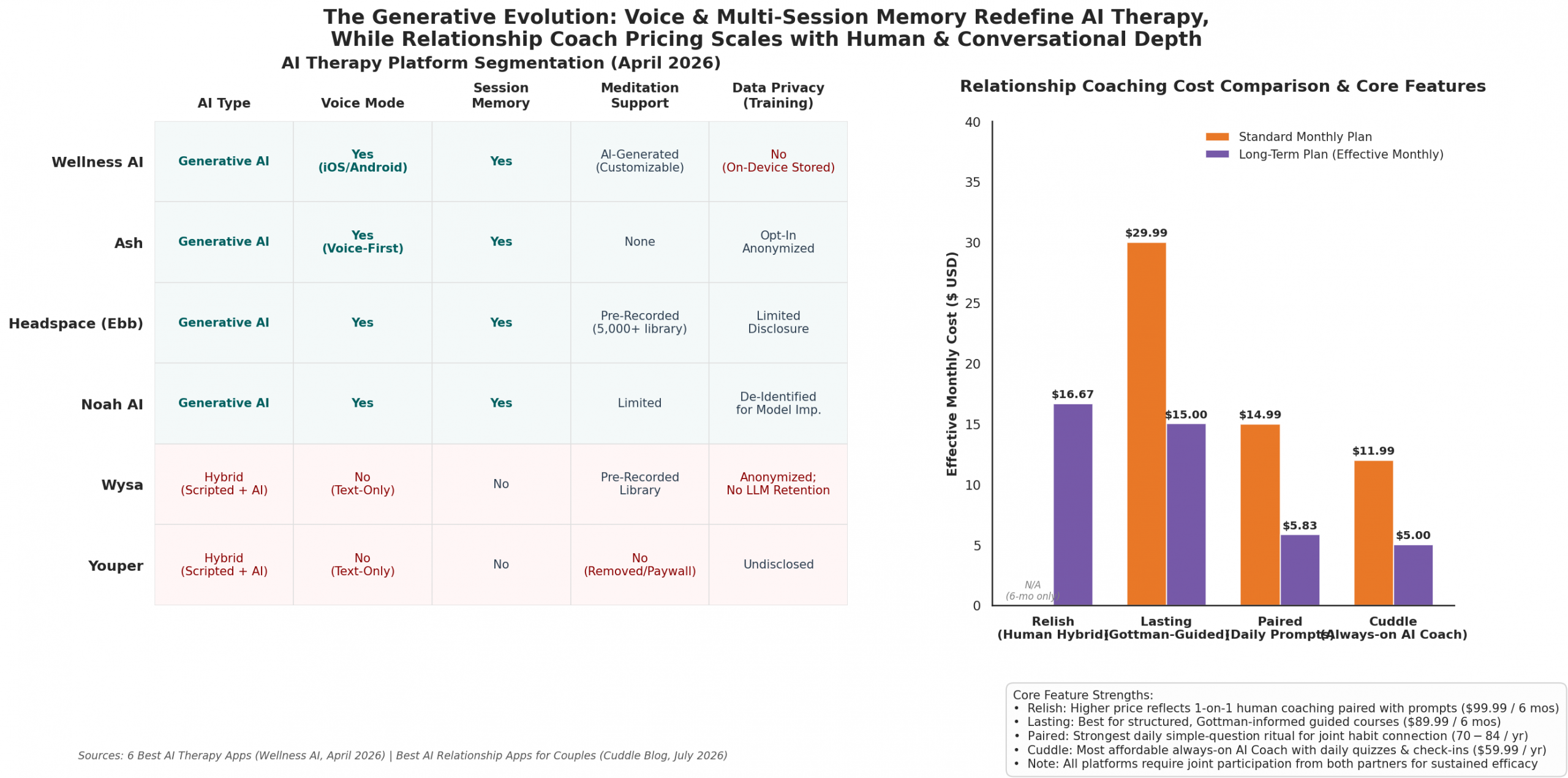
Sat, Aug 22 2026 /Mpelembe Media/ — The landscape of digital mental health is undergoing a profound shift, transitioning from rigid, scripted chatbots to highly conversational generative artificial intelligence systems powered by large language models. Modern therapy applications—such as Ash, Wellness AI, and Noah AI—can now engage in fluid, open-ended dialogues, retain conversational context across multiple sessions to reference long-term behavior patterns, and generate automated session summaries. Crucially, while some veteran platforms rely on highly structured clinical exercises—such as Wysa, which boasts an FDA Breakthrough Device designation and over 45 peer-reviewed studies—newer platforms focus on multimodal features like voice-first modes and custom guided meditations generated in real time directly from a user’s therapy discussion. This technological evolution offers unprecedented accessibility but also highlights clear differences in conversational depth, session memory, and data privacy policies between fully generative systems and traditional hybrid models.
Beyond individual therapeutic support, artificial intelligence has actively entered the realm of couples coaching, prompting daily habits of vulnerability and connection through specialized apps. Platforms like Cuddle, Paired, and Lasting provide structured opportunities for partners to complete daily check-ins, navigate communication exercises, and access coaching-in-the-moment sounding boards during high-tension scenarios. A systematic meta-analysis of digital interventions published in BMC Psychology confirms that these tools can yield a moderate, statistically significant improvement in relationship satisfaction that often sustains over time. While AI tools are highly effective for consistent relationship maintenance and low-stakes skill practice, therapists stress that human clinicians remain absolutely vital for navigating deep complex trauma, identifying non-verbal body language, and handling acute emotional crises.
The quantification of human intimacy is moving from retrospective self-reporting to real-time behavioral analytics. By applying Charles H. Green’s Trust Equation (\(T = \frac{C + R + I}{S}\)), systems can calculate a real-time trust index by breaking down communication into four key components: Credibility, Reliability, Intimacy, and Self-Orientation. Advanced engines process over fifty non-verbal, verbal, and vocal signals—including speaking-to-listening ratios, speech overlaps, response timing, and the frequency of inclusive pronouns—to analyze emotional synchronization and flag destructive dynamics like the “pursuer-avoider” loop. These analytical frameworks are used in personal tracking tools like RelatePulse as well as professional meeting platforms like Relate, where an emotionally aware AI coach named Sandi provides post-meeting feedback based on transcript metadata to build psychological safety and equal participation.
Building these highly responsive, secure relational platforms requires a complex microservices architecture and rigorous data policies. Low-latency audio streaming and capture are managed through voice frameworks like Pipecat, while tools like BAML translate raw, unstructured conversation data into structured JSON schemas for analysis. For visual elements, systems utilize 3D-to-AI workflows, such as Reallusion’s AI Studio, which pairs 3D viewport control over camera angles and poses with models like Seedance 2.0 to generate visually stable and consistent virtual coaching avatars. However, integrating these advanced capabilities brings critical security and psychological challenges, as therapists caution that open-ended virtual companion apps can trigger severe emotional dependency or panic attacks during downtime. To maintain trust, personal analytics platforms must utilize robust end-to-end encryption, adhere to strict no-retention data policies, and comply with regional privacy laws, such as the Illinois biometric laws that restrict platforms like Ash.
The emphasis on secure, private-by-default data environments is also central to institutional AI platforms. For instance, Penn State University’s enterprise platform, AI Studio, is designed specifically for academic, research, and administrative tasks, operating under strict policies that isolate user content. The platform’s user agreement guarantees that prompts and conversation histories are never actively monitored by IT staff, are excluded from academic integrity investigations, and are entirely isolated from model training. To maintain compliance and safe practices, users are prohibited from inputting highly sensitive Level 3 or Level 4 data—such as Social Security Numbers, protected health information (PHI), or financial records—while being provided monthly usage limits and diagnostic feedback on common thematic patterns.
The concept of measuring a physiological “pulse” has a long history in clinical medicine, but its principles are now directly mirroring emotional analytics. Historically, pulse analysis was confined to assessing physical health, such as G. H. Heidorn’s 1958 exercise stress test identifying ventricular efficiency and a “lag in response” in diseased myocardium, or modern clinical studies using SphygmoCor to analyze arterial stiffness and aortic compliance. In a notable clinical trial, SphygmoCor was utilized to measure the arterial compliance of patients treated with the traditional Unani herbal formulation UNIM-904, demonstrating that the safe herbal treatment reduced peripheral arterial stiffness by 34.9% and central systolic pressure, matching the effectiveness of the standard allopathic drug amlodipine. Just as clinicians analyze the reflection waveforms of physical arteries to assess cardiovascular durability, relational tracking software now decodes the conversational “wave reflections” of human dialogue to optimize interpersonal connection and cultivate psychological safety.
Beyond the Chatbot: 5 Surprising Truths About AI Therapy and Intimacy in 2026
The mental health landscape of 2026 has moved far beyond the rigid, button-based interfaces of the early 2020s. We have transitioned from the era of “scripted chatbots” into a world of sophisticated large language models capable of tracking our emotional rhythms with unsettling precision. While this evolution has provided a vital release valve for the global crisis of affordable care, it has also ushered in a new set of ethical and clinical complexities. As a strategist, I see a landscape caught between the promise of “always-on” support and the risk of reducing the human soul to a stream of telemetry.Here are five truths about the current state of AI therapy and digital intimacy that every user must navigate.
1. The “Memory” Divide is the New Clinical Standard
In 2026, the most significant rift in the industry is the “Memory Divide.” Users are now forced to choose between the Generative Newcomers and the Clinically Validated Stalwarts .Newer platforms like Ash and Wellness AI offer a “custom context layer” that maintains narrative continuity across sessions. This allows the AI to function as a digital practitioner rather than a search engine. However, these newcomers often lack the deep research pedigree of established players like Wysa or Youper. Wysa, for instance, remains a gold standard for many because of its FDA Breakthrough Device Designation and a library of over 45 peer-reviewed studies. The trade-off is stark: do you want a bot that remembers your childhood trauma (Ash), or one that is scientifically proven to treat your depression despite treating every session as a fresh start (Wysa)?”Apps with memory can reference your history, notice patterns, and build on what you’ve discussed before,” notes a recent comparison from Wellness AI.For the modern patient, this means the difference between a bot that notices your anxiety spikes every Sunday and a bot that asks you “how you’re feeling today” for the thousandth time.
2. Your AI Therapist Might Be Illegal in Your State
Technological innovation continues to outpace the slow grind of policy, leading to a fragmented legal map. The most prominent example is the app Ash . Despite being built on a proprietary foundation model specifically trained for psychological frameworks like CBT and DBT, it is currently unavailable to residents of Illinois.This isn’t a technical glitch, but a legal firewall. The state’s aggressive AI therapy legislation specifically prohibits platforms that engage in automated psychological profiling and the collection of biometric data. This tension highlights the primary ethical dilemma of 2026: the more effective a tool is at diagnosing our needs, the more it risks infringing on the privacy of our biological and psychological signatures.
3. Intimacy Has Been Reduced to a Mathematical Equation
We have officially moved from “passive self-reporting”—the manual mood logs of the past—to “active, real-time diagnostic systems.” Relationship platforms like RelatePulse now quantify human connection through the Trust Equation :$$T = \frac{C + R + I}{S}$$In this model, software analyzes over fifty behavioral signals to construct a trust index. As an analyst, I find the breakdown of variables both fascinating and chilling:
- Credibility ( $C$ ): Evaluated via semantic consistency and verbal clarity.
- Reliability ( $R$ ): Measured through longitudinal commitments and action follow-through.
- Intimacy ( $I$ ): Quantified via vulnerability markers and expressions of emotional safety.
- Self-Orientation ( $S$ ): Evaluated through “conversational dominance”—tracking speech overlap, interruptions, and self-referential language.While these telemetry-based intimacy metrics provide objective feedback, we must ask ourselves: is a connection truly “closeness” if it is optimized by an algorithm that views an interruption as a data error?
4. AI is Becoming the “Rehearsal Space” for Human Conflict
One of the most hopeful developments is the rise of the AI “rehearsal space.” Vulnerability is the currency of connection, but it is also terrifying. Platforms like Cuddle and Noah AI are now used as low-stakes environments where individuals can practice difficult interpersonal moments.Couples are increasingly using these tools for “rehearsing a vulnerable sentence” before a real-world confrontation. To ensure this practice translates to real growth, Noah AI generates “therapist-exportable summaries”—secure PDFs that map recurring themes and insights—designed to be shared with a human clinician. It bridges the gap between the safe digital vacuum and the messy reality of human therapy.”The app is the match; you are the fire,” according to the Cuddle editorial team.The technology is a catalyst for courage, not a replacement for the actual work of being human.
5. The Shift from Meditation Libraries to “Generative Zen”
The wellness industry has pivoted from “content selection” to “content generation.” Established giants like Headspace still maintain impressive libraries of over 5,000 pre-recorded meditations, but the market is moving toward Generative Zen .Wellness AI, for example, can now generate a custom meditation on-demand based on the actual transcript of a recent therapy session. This represents a level of hyper-personalization that pre-recorded audio cannot match. The voice, duration, background music, and specific thematic focus are all tailored to the user’s current state. If your morning session was about a specific workplace conflict, your evening meditation is built precisely to de-escalate that exact anxiety.
Conclusion: The Hybrid Future
As we navigate the remainder of 2026, the consensus among strategists is clear: the future is hybrid. AI is peerless for daily maintenance, the “daily reps” of communication, and habit tracking. However, human professionals remain the only safe harbor for the “heavy lifting”—trauma processing, crisis intervention, and the profound, unquantifiable experience of being truly seen by another person.The question for the modern user is no longer if you will let an algorithm track your life, but where you draw the line. Are you ready for a world where your “emotional synchronization” is a score on a dashboard, or are some parts of the human experience better left unmeasured?
Source: Relate Pulse