
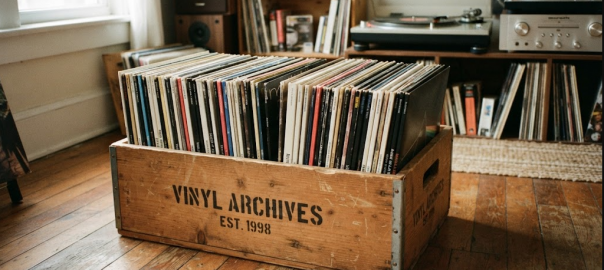
The Pulse of the Crate: How Live Community Feeds Transformed Vinyl Discovery
Mon, July 26 2026 /Mpelembe Media/ — The Live Vinyl Community Feed represents a structural shift in physical music discovery, transforming solitary record collecting into a real-time, interactive global network. Rather than relying on static catalogs or passive marketplace listings, the feed captures synchronous “Save to Crate” actions across diverse genres, broadcasting details such as album titles, release years, record labels, and physical store geolocations in real time. Collectors contribute enriched micro-metadata alongside acquisitions, attaching Goldmine condition grades, shop locations, and personal commentary on specific pressings or drum breaks. Advanced hardware protocols—including LiDAR groove depth mapping, acoustic scratch detection during playback, and NFC sleeve tagging—further standardize physical condition verification, bridging tactile playback with digital cataloging.
Architecturally, the system processes acquisition events through a four-stage pipeline moving from sensor ingestion (via manual entry, barcode scans, or optical recognition) to master release entity normalization, non-mutating instance enrichment, and live stream broadcasting. By measuring acquisition velocity and geographic dispersion rather than relying on historical cumulative ownership totals, the feed calculates dynamic momentum scores to detect emerging micro-trends and localized scene formations weeks before secondary sales or streaming algorithms capture them. This event-driven data model provides actionable telemetry for the broader physical music industry. Real-time demand velocity enables independent labels to size vinyl pressings accurately and mitigate manufacturing risks, while verified Goldmine grading stabilizes secondary market pricing and spatial store mapping drives foot traffic directly to brick-and-mortar record shops.
5 Mind-Bending Truths About the Modern Vinyl Resurgence and Digital Crate Digging
Music consumption has reached a point of absolute convenience. With over 100 million songs instantly accessible from the devices in our pockets, virtually any track in human history can be summoned in seconds. Yet, in an era defined by frictionless access, millions of music fans are deliberately taking the opposite path—flocking back to physical vinyl records, local record shops, and specialized direct-to-fan communities in record numbers.
This movement is far more than a simple wave of retro nostalgia. The resurgence of physical media and the rise of digital crate digging are driven by a complex interplay of shifting economic realities, technological innovations, and evolving listener behaviors.
Data across physical sales metrics, digital streaming payouts, and community platforms reveals a fundamental evolution in how listeners discover, value, and support music. Here are five counter-intuitive takeaways that explain the modern musical ecosystem.
1. The “Skip” Paradox: Why Spotify’s Most-Skipped Albums Top the Vinyl Charts
There is a profound disconnect between how people listen to music on digital streaming services versus how they interact with physical media. On platforms like Spotify, streaming is frequently used as passive background noise, where quick skips dictate an album’s algorithmic reach. On physical formats, however, engagement is active, intentional, and complete.
This divergence in listener mindset creates stark economic and behavioral contrasts:
The Streaming vs. Physical Divide
- Projected 2024 Vinyl Revenue: $5.2 Billion (following a 113% surge over three years)
- Streaming Royalty Reality: 250 Spotify streams = $1.00 (Source: Union of Musicians and Allied Workers)
According to data cited by Decoded Magazine , market projections indicate artists will earn $5.2 billion from vinyl sales in 2024, capping a 113% three-year revenue surge. Meanwhile, a study by the Union of Musicians and Allied Workers (UMAW) reveals the severe financial drag of digital streaming: it takes 250 streams on Spotify for an artist to generate just $1—requiring a massive 250,000 streams to earn a modest $1,000.
This economic contrast produced a striking behavioral paradox in 2023, when 70% of the most skipped albums on Spotify simultaneously topped vinyl charts. Listeners regularly brush tracks aside when streaming passively, but when seeking an active, focused listening experience, they buy those exact same albums on vinyl.
Peter Fealey, Founder of A2D2, highlighted this intentional pivot toward ethical artist support:
“Consumers love that they’re giving directly to the artist when buying vinyl compared to streaming music on Spotify. Vinyl also offers a more sustainable and ethical way to support artists, as it avoids the complex algorithms and low royalty payouts of streaming platforms.”
When music is consumed intentionally rather than passively, tracks that are buried by streaming algorithms transform into cherished physical media.
2. Tokyo Beats London and NYC as the Vinyl Capital of the World
While casual music fans might assume that Western cultural capitals like New York City or London dominate physical record collection, global mapping data paints a completely different geographic picture.
According to crowdsourced mapping data from VinylHub and Open Culture , Tokyo holds the highest density of brick-and-mortar record shops globally. London remains a powerhouse—with the United Kingdom placing second by country overall with 537 record shops—while New York City lands in a surprising 7th place in shop density.
Global Record Store Density Highlights
-
- Tokyo, Japan (Highest store density worldwide)
- United Kingdom (#2 country overall with 537 shops)
- New York City, USA
This global footprint of physical media retail extends to the most isolated corners of the earth. According to database entries, the world’s most remote record retail spot consists of a cluster of CD stalls located “Upstairs of wet market” in Nuku’alofa, within the Pacific Island Kingdom of Tonga. Other extreme geographical outposts include:
- Vinyl Run on the remote Indian Ocean island of Réunion.
- Alta in Norway (the northernmost documented store location).
- Invercargill in New Zealand (the southernmost documented store location).
Despite the ubiquity of digital files, physical record stores endure across the globe. Entering a thoughtful, well-curated record store still offers the timeless feel of walking into a “medieval apothecary” for the soul—a physical space where local scene lore and tangible media provide a lingering magic that two-dimensional digital feeds cannot replicate.
3. The Vinyl Boom is Leaving 87% of Independent Artists Behind
Despite record-breaking physical revenue and soaring vinyl sales in major markets, the modern vinyl gold rush has a severe structural downside for grassroots and independent creators.
Research conducted by Ditto Music revealed that despite the booming physical market, only 12.8% of independent artists have released their music on vinyl.
Independent Artist Vinyl Access
- 12.8% of independent artists have released music on vinyl.
- 87.2% remain locked out of physical manufacturing.
This disparity creates a financial double-whammy for emerging musicians: they suffer from suppressed digital streaming payouts where hundreds of plays yield pennies, while simultaneously being locked out of the lucrative $5.2 billion physical vinyl market.
To understand why this gap exists, one must look at the physical supply chain. Major record labels heavily monopolize pressing plant capacity for massive archival reissues and multi-variant pop releases. This concentration of production creates long manufacturing queues, exorbitant upfront costs, and a structural bottleneck that squeezes independent creators completely out of retail release windows. Trapped in low-margin streaming environments, grassroots artists are left without a viable physical alternative.
4. Modern Crate-Diggers Use AI Scanners and Real-Time Feeds to Find Barcode-Free Gold
Rather than replacing analog culture, modern computer vision and real-time data platforms are actively enhancing the tactile experience of crate digging, solving age-old collector frustrations without diluting the thrill of the hunt.
For catalogers and DJs, identifying white labels, test pressings, promos, and obscure underground releases has historically required tedious manual searches. Specialized software like CrateLog solves this metadata gap through “Smart Scan” computer vision technology. By analyzing album sleeves or center labels directly, CrateLog identifies LPs, 12″ singles, and CDs directly from visual cues—even when no barcode exists—and syncs them seamlessly into a Discogs collection.
Next-Gen Analog Tools
- CrateLog: “Smart Scan” computer vision identifies barcode-free center labels, promos, and sleeves.
- Live Vinyl Community Feed: Real-time global stream tracking “Save to Crate” actions across Soul, Funk, Jazz-Funk, and Rare Groove.
Simultaneously, platforms like the Live Vinyl Community Feed turn solo digging into a global, interactive experience. Instead of static database queries, diggers can watch a real-time feed of “Save to Crate” actions across specialized genres like Soul, Funk, Jazz-Funk, and Rare Groove.
These feeds broadcast rich contextual metadata, including:
- Specific record labels, release years, and geographic locations of diggers worldwide.
- Detailed condition grading standards (such as Goldmine VG+ media and sleeve grades).
- Personal collector notes, local shop lore, commentary on specific drum breaks, and vocal performance details.
These platforms succeed because they bridge the metadata gap of rare, non-barcoded underground pressings without relying on centralized corporate algorithms, effectively digitizing the communal counter talk of the classic brick-and-mortar record shop.
5. Superfans Deliver 4x to 8x More Revenue on Community Platforms Than Streaming
When it comes to sustainable music discovery and artist monetization, human curation and direct community spaces consistently outperform automated recommendation engines.
Data from industry analyst Chartlex demonstrates that independent artists with under 5,000 monthly listeners earn 4 to 8 times more revenue per superfan via Bandcamp than through self-hosted storefronts or standard streaming services. This discrepancy is driven by community discovery features and direct support initiatives like Bandcamp Fridays , which has funneled over $154 million directly to creators by waiving platform revenue fees.
Direct-to-Fan Unit Economics
- Standard Streaming: Pro-rata pool model prioritizing passive play volume over value.
- Bandcamp Superfan Model: Generates 4x to 8x higher revenue per fan via intentional, transactional support.
This revenue gap underscores a fundamental clash in economic models. Standard streaming operates on a pro-rata pool system that incentivizes passive volume and background listening. Direct-to-fan platforms thrive on transactional intensity, explicit valuation, and community validation.
Human-driven feedback networks act as crucial incubation spaces for pre-viral talent:
- RateYourMusic (RYM): Uses deep fan taxonomies and structured long-form reviews to surface obscure microgenres (such as “dungeon synth” or “fourth world”) that commercial algorithms ignore.
- SoundCloud: Leverages social repost chains where discovering tracks through a user’s “Liked By” list makes listeners over 3 times more likely to like, repost, or comment compared to standard browsing.
- Community Review Hubs: Dedicated spaces like Musicboard, Reddit genre communities, and Album of the Year (AOTY) offer contextual discussion and human reasoning that automated playlists cannot replicate.
By placing human passion, collector notes, and community engagement at the center of discovery, direct-to-fan platforms turn passive listeners into active, high-value superfans.
Conclusion & Final Thought
While the rise of digital streaming provided infinite convenience, it also flattened music into a utility, frequently reducing art to ambient background sound. The global surge in vinyl sales, the mapping of remote physical media havens, and the growth of live digital digging feeds demonstrate that fans crave something far deeper. Listeners are actively seeking tangible connection, transparent artist support, and rich cultural context.
As technology continues to bridge the gap between digital discovery and physical media, how do you plan to find your next favorite album? Are you ready to trade algorithmic convenience for a deeper physical and community connection?
source: https://soul-funk.ai.studio/