
Inside Google’s Centralized Learning Hub for Enterprise AI, Cloud Infrastructure, and Agentic Engineering
Thu, July 29 2026 /Mpelembe Media/ — Google Skills represents a strategic consolidation of Google’s educational ecosystem, consolidating nearly 3,000 courses, hands-on interactive labs, and professional credentials into a single unified platform. By merging content across Google Cloud, Google DeepMind, Grow with Google, and Google for Education, the platform establishes a continuous learning continuum serving all proficiency levels. Learners can progress seamlessly from foundational digital literacy to advanced large language model architectures and enterprise cloud infrastructure management. Prior to this unification, users across these individual properties completed over 26 million courses and credentials in a single year, highlighting the massive global demand for structured technical upskilling.
The platform integrates practical application directly into the learning process through interactive cloud environments equipped with Gemini Code Assist, allowing developers to write, debug, and optimize code in real time. Content modalities cater to various schedule constraints, ranging from ten-minute AI Boost Bites microlearning modules to multi-month professional certification paths and specialized Google DeepMind research curricula. Learning engagement is reinforced through gamified elements such as competitive Leagues, visual Achievements, and Learning Streaks with streak-freeze protections. To lower access barriers, registered members of the Google Developer Program receive 35 recurring monthly credits to run hands-on labs in live cloud sandboxes without incurring infrastructure costs, while Google Cloud enterprise customers receive full access to the complete catalog.
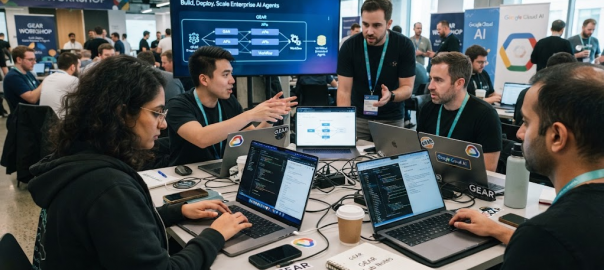
A focal point of the platform’s advanced ecosystem is the Gemini Enterprise Agent Ready (GEAR) initiative, an enterprise-focused program engineered to upskill one million developers in constructing, deploying, and governing production-grade AI agents. GEAR guides builders through a four-stage curriculum emphasizing open technical standards, including the Model Context Protocol (MCP), Agent Development Kit (ADK), and Agent-to-Agent (A2A) protocol. For commercial clients, GEAR includes guided Get Certified cohorts spanning up to nine weeks of instructor-led training, technical mentorship, and exam vouchers to validate enterprise readiness.
Beyond individual instruction, Google Skills acts as an enterprise workforce management system and a recruitment engine. Corporate administrators can assign targeted learning paths, monitor team progress through real-time reporting dashboards, and foster internal engagement with company-specific leaderboards. To connect trained talent with career opportunities, Google integrates a hiring consortium of over 150 commercial partners. Commercial partners like Jack Henry deploy custom simulation labs inside the platform to evaluate candidate skills in real-world environments, fast-tracking top performers directly into formal interview pipelines and creating a direct bridge between cloud education and workforce deployment.
The 2026 Upskilling Paradox: 6 Counter-Intuitive Truths About Learning AI and Cloud Computing
1. Introduction
In 2026, severe “credential inflation” has forced enterprise hiring managers to completely overhaul how they vet technical talent. With well over 100 recognized cloud and AI credentials flooding resumes, the sheer volume of digital badges has diluted their individual value, creating an overwhelming maze for career changers and tech professionals alike. Ambitious learners regularly burn months navigating relentless “AI noise” and high certification fees, only to realize they have studied retired exam outlines, locked themselves behind hidden paywalls, or acquired superficial credentials that corporate recruiters actively ignore.
Succeeding in today’s volatile market requires strategic precision rather than brute-force studying. Moving forward demands a clear-eyed understanding of platform monetization models, what engineering leaders actually prioritize in interviews, and where specialized technical skills yield true salary premiums. This article distills six counter-intuitive truths for navigating cloud and artificial intelligence education in 2026, equipping you to bypass marketing traps, focus your energy, and engineer an undeniable career advantage.
2. Takeaway 1: “Free” Tech Education Has 4 Hidden Flavors (And Most Paywall What You Actually Need)
“Free” in tech education rarely means zero financial commitment. Platforms construct their business models around four distinct tiers that dictate access to graded work, assignments, and digital credentials. To avoid wasting weeks on a path that fails to deliver your desired outcome, apply an “honest cost label” approach: audit the platform’s fine print, check the credential FAQ, and inspect the provider’s syllabus before watching lesson one.
The four primary models operating in 2026 include:
- Free to learn, no free certificate: Course lectures cost nothing, but the official credential carries a fee or does not exist (e.g., Hugging Face LLM Course, fast.ai, Microsoft Generative AI for Beginners).
- Free including the certificate: Complete access to learning materials and a shareable credential at zero cost (e.g., Scrimba’s free courses, Hugging Face Agents Course, Kaggle Learn, freeCodeCamp).
- Free audit, paid assignments: Video content is accessible for free, but graded assignments, quizzes, and official completion certificates are locked behind a monthly subscription (e.g., Coursera’s Machine Learning Specialization).
- Free training with paid proctored exam: Entire digital curricula and study pathways are completely free, but earning official vendor credentials requires paying for a proctored exam (e.g., AWS Skill Builder, Microsoft Learn for Azure AI Fundamentals).
“The question is never ‘is this course free.’ It is ‘which part of this course is free, and is the part I need one of them.'”
Spending weeks finishing a syllabus only to discover the required project submission or completion badge sits behind a $49/month paywall creates severe friction. Always verify the exact credential policy on the course FAQ page or credential column before writing a single line of code.
3. Takeaway 2: Certifications Open the Door, But “Proof of Real Work” Closes the Deal
The widespread availability of beginner badges has created hyper-inflated resume claims, leaving hiring managers skeptical of superficial credentials. While certifications from major providers like AWS, Microsoft, Google, or IBM serve an initial purpose by passing automated applicant filters and validating baseline terminology, engineering leads ultimately hire for production execution.
“Certifications open the door, but real project work is what closes the offer.”
Collecting digital credentials like trading cards is a critical strategic blunder. Candidates must convert theoretical knowledge into tangible evidence. Rather than listing ten entry-level badges on LinkedIn, present proof of real work: link a public GitHub repository with clean code, deploy a live web application link, or publish a 2-minute Loom video demo on LinkedIn breaking down an automated workflow or RAG pipeline case study. Documenting a single deployed project demonstrates practical troubleshooting, architectural reasoning, and real-world competency.
4. Takeaway 3: Trying to Learn AWS, Azure, and Google Cloud at the Same Time Is a Trap
A frequent trap for beginners is attempting to master Amazon Web Services, Microsoft Azure, and Google Cloud Platform simultaneously. Attempting to navigate three distinct cloud consoles at once causes severe cognitive overload, confusing vendor-specific interfaces, service naming conventions, and tooling options without solidifying core competencies.
The effective route begins by mastering foundational vendor-neutral principles—such as compute, storage, virtual networking, Identity and Access Management (IAM), and service models (IaaS, PaaS, SaaS). Introductory courses like DataCamp’s Understanding Cloud Computing or HCL GUVI’s Introduction to Cloud Computing provide ideal entry points to build this conceptual foundation before committing to a specific vendor. Once these core principles are established, focus exclusively on a single cloud ecosystem aligned with your target employer or regional job market. Depth in one cloud stack always trumps surface-level familiarity across three.
5. Takeaway 4: Non-Coders Can Now Earn High-Value, Recognized Cloud & AI Credentials
Tech literacy in 2026 is no longer restricted to software developers; it has evolved into a mandatory business competency across operations, marketing, management, and education. Today’s educational ecosystem provides streamlined pathways for non-technical professionals to validate AI and cloud fluency without learning complex programming languages or infrastructure scripting.
Recognized entry-level credentials include the BCS Essentials Certificate in AI, the free UK Government AI Foundations badge, Google Cloud Generative AI Leader, AWS Certified AI Practitioner, and DataCamp’s non-coding foundational tracks.
Target Non-Tech Role,Ideal Entry-Level Credential
Office Administrator / Operations,UK Government AI Foundations Badge / Google AI Professional Certificate
Marketer / Content Specialist,Google AI Professional Certificate / AWS Certified AI Practitioner
Educator / Trainer,BCS Essentials Certificate in AI / BCS Foundation Certificate in AI
Freelancer / Small-Business Owner,UK Government AI Foundations Badge / LearnDrive Complete AI Skills Bundle
Manager / Project Manager,Google Cloud Generative AI Leader / BCS Foundation Certificate in AI
Note: Non-technical professionals should distinguish between CPDQE-accredited completion certificates (such as the LearnDrive AI Skills Bundle), which verify continuous professional development and practical tool usage, and proctored vendor examinations (such as BCS, AWS, or Azure), which evaluate technical theory under monitored testing conditions.
6. Takeaway 5: The Highest Salary Premiums Belong to Agentic AI and RAG Engineering
The financial ROI of AI specializations has transformed rapidly. Classical machine learning and basic prompt engineering have ceded top salary tiers to engineers capable of architecting and deploying production-grade generative systems. Specialists in Autonomous AI Agents, Multi-Agent Architectures, Tool Use, and Retrieval-Augmented Generation (RAG) now command market salary premiums of $140,000–$ 220,000+ .
This massive pay premium reflects corporate maturation. Enterprise organizations are moving away from simple chat interfaces toward autonomous agent workflows integrated with private company data. To target these high-paying roles, specialized credentials like the IBM RAG and Agentic AI Professional Certificate have emerged as gold-standard benchmarks, validating a developer’s ability to build complex RAG architectures, connect LLMs to external APIs, and orchestrate multi-agent systems in production.
7. Takeaway 6: Beware the “Retired Exam Trap”—Tech Certifications Expire Fast
Cloud and AI certifications evolve on fast release cycles, making legacy study guides and outdated online repositories a major trap for learners. A prime example occurred on June 30, 2026, when Microsoft officially retired its widely taken Azure AI Fundamentals (AI-900) exam and replaced it with the AI-901 exam.
Crucially, this update catches many non-technical career changers off-guard because AI-901 introduces mandatory basic Python scripting requirements alongside Azure AI services, rendering older non-coding study guides obsolete. Additionally, most major vendor certifications expire every 2 to 3 years, requiring continuous renewal.
Warning: Always verify active exam codes, current syllabus requirements, and expiration rules directly on official vendor certification portals before buying third-party study materials or booking a test.
8. Conclusion & Strategic Next Steps
Navigating cloud and AI education in 2026 requires strict strategic focus rather than endless content consumption. To maximize your career ROI, start by auditing course fee structures to ensure the credential you need isn’t paywalled. Next, resist multi-cloud distraction by mastering core infrastructure concepts through introductory courses, then specializing deeply in a single cloud ecosystem. Finally, remember that while certifications pass automated ATS screeners, production-ready proof is what secures job offers. Shift your focus from collecting static badges to building, deploying, and publicly documenting real-world applications.
What is the single, documented project you will build this month to prove your applied skills to hiring managers?