
The 2026 Crypto Compliance Mandate: Navigating MiCA and the End of the Grandfathering Era
28 Feb. 2026 /Mpelembe Media/ — The July 2026 Deadline and “Passporting” The European Union is fundamentally restructuring its digital asset market through the Markets in Crypto-Assets Regulation (MiCA). By July 1, 2026, the transitional “grandfathering” phase will permanently close, meaning any Crypto-Asset Service Provider (CASP) operating without full MiCA authorization will be doing so illegally. While some member states, like the Netherlands and Sweden, opted for much shorter transition periods that have already expired, the July 2026 date is the absolute maximum limit across the EU. Securing this license grants firms EU-wide “passporting” rights, allowing them to serve clients across all 27 member states with a single authorization.
Strict Operational and Governance Standards MiCA eliminates “letter-box” setups, requiring CASPs to maintain a registered EU office with real decision-making power and at least one EU-resident director. Firms must implement robust cybersecurity measures, strictly segregate client assets from company funds, and conduct daily reconciliations. Depending on the scope of their services, CASPs must also meet minimum capital requirements ranging from €50,000 for basic advisory services to €150,000 for trading platforms. Additionally, crypto-asset offerings must be accompanied by detailed, standardized “white papers,” and retail buyers are granted a 14-day withdrawal right for certain purchases.
The Travel Rule and Enhanced Transparency Coinciding with MiCA is the enforcement of the Transfer of Funds Regulation (TFR), commonly known as the Travel Rule, which imposes a “Zero Threshold” policy for crypto transfers. Every transaction between CASPs must capture and transmit personally identifiable information for both the sender and the beneficiary, effectively ending anonymous instant settlements. Transfers over €1,000 to private, self-hosted wallets also require the CASP to verify the user’s ownership of that wallet.
Stablecoin Regulations MiCA places intense scrutiny on stablecoins, categorized as Asset-Referenced Tokens (ARTs) and E-Money Tokens (EMTs). Issuers are subject to strict liquidity and transparency rules, including maintaining 1:1 backed reserves and ensuring redemption at par. Algorithmic stablecoins do not qualify under this framework.
Market Consolidation and Penalties The heavy financial and technical burdens of implementing these compliance frameworks are creating high barriers to entry, leading to market consolidation as smaller firms merge or exit the EU. However, these stringent standards are actively boosting investor confidence and attracting traditional financial institutions into the space. Regulators wield expansive enforcement powers and can punish non-compliance with license revocation, asset freezing, personal liability for executives, and fines of up to €5 million or 12.5% of total annual turnover.
The “Trusted-by-Default” Fallacy
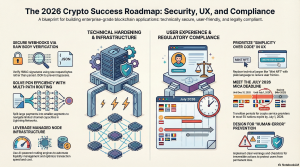
Modern architecture presents a striking irony: we build on the mathematical certainty of 256-bit encrypted blockchains, yet we often expose these fortresses via “naked” public endpoints. As we navigate the 2026 landscape, the entry point for decentralized integration is no longer just a technical vulnerability—it is a strategic liability. Many organizations fall into the “trusted-by-default” trap, assuming that because the backend is a secure, immutable ledger, the integration layer—the webhook—is inherently safe. Without aggressive threat modeling, the most advanced cryptographic systems fail at their simplest entry points, turning a “secure” stack into a target for sophisticated exploitation.
The “Original Sin” of Webhook Integration
In the world of webhooks, the “original sin” is payload canonicalization. Signature verification fails most often because development teams attempt to verify HMAC signatures against a parsed JSON body—using JSON.stringify(req.body), for instance. This is a critical architectural failure; re-serializing JSON can alter byte order or spacing, causing legitimate requests to fail verification.
To secure an integration, a lead engineer must ensure signature verification is performed against the raw request bytes. The recommended signing input is timestamp + “.” + rawBody. Furthermore, to prevent timing attacks, implementations must utilize constant-time comparisons (such as crypto.timingSafeEqual).
“When teams get breached through webhooks, it’s rarely ‘crypto broken.’ It’s usually implementation shortcuts.”
A robust defense against replay attacks requires more than a signature; it necessitates a timestamp window (typically ±5 minutes) to ensure freshness and the use of idempotency tokens (event IDs) stored in a durable store like Redis to reject duplicates before they trigger internal side effects.
The Illusion of Self-Custody Safety
Self-custody is a pillar of decentralization, but it often creates an “illusion of security.” The cryptographic robustness of a private key is irrelevant if the operational environment is compromised by real-world engineering threats. In the current threat landscape, we must distinguish between institutional failure and personal operational failure.
The strategic architect recognizes that the most pressing risks aren’t on-chain, but on the endpoint. Threats like clipboard-replacing malware—which swaps recipient addresses in real-time—and malicious browser extensions bypass the theoretical security of the blockchain. As specified in the source context, we must address two distinct categories of threat to the seed phrases:
Leakage: The phrase becomes known to unauthorized outsiders via phishing, unencrypted digital storage, or physical discovery.
Loss: The owner loses the ability to recall or recover the phrase, leading to the permanent, probabilistic finality of asset loss.
Scaling via the “Payment Channel Network” (PCN) Revolution
To reach a 100M+ customer scale, as seen with enterprise implementations like Lightspark and Coinbase, the industry has turned to the Lightning Network to solve the “Blockchain Trilemma” (Scalability, Decentralization, and Security). Bitcoin’s base layer, limited to roughly 7–10 transactions per second (tps), cannot support global commerce.
Payment Channel Networks (PCNs) solve this by “deporting” transaction processing outside the blockchain while inheriting its security and consensus. This mechanism functions by concatenating available channels to form indirect payment paths among participants. By splitting large amounts into smaller micropayments that move through these “multihop” paths, PCNs achieve high throughput and reduced confirmation delays without fundamentally amending the underlying blockchain infrastructure.
UX: The Final Frontier of Mass Adoption
In decentralized finance, usability is the deciding factor for trust. The paradox of Web3 is that simple is significantly harder than complex; you must “get your thinking clean” to hide the technical machinery.
“Design is not just what it looks like and feels like. Design is how it works.” — Steve Jobs
To win the next wave of users, crypto startups must adhere to these 7 UX best practices:
Plain Language: Replace “Merkle trees,” “gas fees,” and “function calls” with human-centric actions.
Design for Absolute Trust: Use checklists, confirmation prompts, and clear warnings before irreversible actions.
Mobile-First/Frictionless: Prioritize QR codes and accessible touch targets for on-the-go interactions.
Hiding Complexity: Focus on the result (e.g., “Mint NFT”) rather than the underlying smart contract steps.
Onboarding for Confidence: Use interactive walkthroughs and contextual animations to reduce setup anxiety.
Consistency is Comfort: Maintain uniform patterns and familiar design conventions to lower cognitive load.
Prioritize User Research: Use continuous feedback loops to align design decisions with the needs of everyday consumers.
The “Wrench Attack” and the Physicality of Digital Assets
Digital wealth increases physical risk. Unlike a traditional bank account with withdrawal limits, a compromised seed phrase allows for the instantaneous transfer of total wealth. This has birthed the “wrench attack”—physical extortion and kidnapping. In 2026, digital hygiene is physical safety. Strategic security must account for the risk of KYC leaks, where leaked personal data makes a holder a targeted physical target.
Emergency Physical Safety Checklist:
Duress Wallets: Maintain a secondary wallet with minimal funds to satisfy an immediate threat.
Splitting Seed Phrases: Never store a full seed phrase in a single physical location.
Hardware Tokens: Use physical security keys (e.g., YubiKeys) for authentication rather than vulnerable SMS-based 2FA.
The Impending Regulatory Wall: MiCA and the Travel Rule
The legal landscape in the European Economic Area (EEA) is shifting toward a strictly regulated environment. The Markets in Cryptoassets Regulation (MiCA) and the Transfer of Funds Regulation (Regulation EU 2023/1113)—often called the Travel Rule—now require CASPs to implement real-time screening and blocking capabilities.
A primary strategic risk is “operational disruption” caused by fragmented “grandfathering” periods. Firms passporting services must be wary of gaps between member state deadlines:
| Grandfathering Period | Impacted Countries (Examples) |
| 6 Months (Until June 30, 2025) | Netherlands, Latvia, Hungary, Slovenia, Finland |
| 12 Months (Until Dec 31, 2025) | Germany, Ireland, Spain, Austria, Norway, Greece, Lithuania, Slovakia, Liechtenstein |
| 18 Months (Until July 1, 2026) | France, Italy, Luxembourg, Bulgaria, Czechia, Denmark, Estonia, Croatia, Cyprus, Malta, Romania, Iceland, Poland |
From Experiment to Essential
Bitcoin is no longer a speculative toy; it has matured into a “brooding philosopher” of the financial world—a strategic store of value. As decentralized assets transition from experimental tech to essential financial infrastructure, the bridge to the next billion users will be built on the rigorous elimination of “naked” endpoints and the implementation of clean, secure design.
Final Thought: Is your organization building a bridge of trust, or just another ‘naked’ endpoint?