
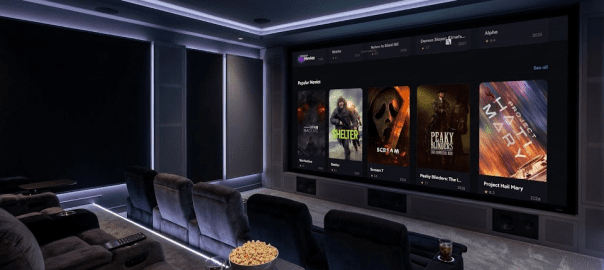
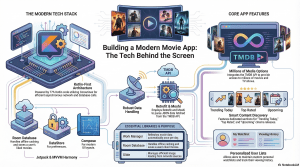
March 21, 2026 /Mpelembe Media/ — The Android app acts as a showcase for Modern Android Development (MAD) skills, built upon Clean Architecture and the MVVM (Model-View-ViewModel) pattern. It leverages a robust stack of Jetpack components and modern libraries. Network operations are managed asynchronously using Retrofit and Coroutines, while Moshi parses the JSON data. The app also utilizes Room and WorkManager for offline caching and daily background syncing, and is transitioning its UI layouts to Jetpack Compose. TMDB, which supplies the data for these apps, is a massive, community-driven database that allows users to search millions of titles, log their watched media, and build custom watchlists.
Beyond the Stream: 5 Surprising Ways Modern Apps are Reshaping Your Movie Night
We have all experienced the digital paralysis of the streaming age: sitting on the sofa, remote in hand, scrolling through endless rows of posters until the evening is gone and the popcorn is cold. With “millions of movies, TV shows and people to discover,” as The Movie Database (TMDB) illustrates, the volume of content has reached a breaking point. This “paradox of choice” is a psychological friction point that modern software is finally beginning to solve.To understand how, we have to look under the hood of the “Neon Horizon”—the sleek, crowd-fueled architecture defining the next wave of cinema apps like NeoMovies. By blending high-level engineering with human-centric design, the industry is moving discovery from a frustrating chore into a seamless, cinematic experience.
1. The “Once-a-Day” Rule: Pursuing Battery Parity
In a world of real-time “push” culture, it seems counter-intuitive to build an app that intentionally updates less frequently. However, the most sophisticated movie platforms are embracing an asynchronous strategy using a tool called Work Manager .Modern developers recognize that “Popular” or “Top Rated” lists don’t change by the minute. By scheduling data refreshes only once every 24 hours, apps achieve “Battery Parity”—the principle that a discovery tool shouldn’t be a power-hungry drain on your device. This data is then funneled into a Room database for offline caching. The result? When you open your app, the latest trending titles are instantly available without waiting for a network handshake, ensuring your search for a film doesn’t kill your phone’s battery before the opening credits roll.
2. Moving Beyond “Shared Preferences”: The Silent Tech Upgrade
If you have ever toggled an app to “Dark Mode” only to find it reverted back to a blinding white screen the next morning, you have seen the failure of old-school data storage. Modern Android Development (MAD) has largely deprecated the old “Shared Preferences” in favor of the Preferences DataStore .This isn’t just a name change; it’s a fundamental shift in reliability. DataStore utilizes Coroutines and Flow to handle data updates, which prevents the “UI stuttering” that occurs when an app tries to save your settings while simultaneously loading a high-res trailer. As the technical documentation for these modern movie platforms notes:”Popular movies app is built with TMDB API to promote MAD skills, Clean architecture and showcase modern android development techniques…”For the user, this means that whether you are saving a “darkmode preference” or a specific UI layout, the app responds with a level of stability that previous generations simply couldn’t match.
3. The “Neon Horizon”: Designing the Fluid Canvas
The aesthetic shift in movie discovery is moving toward what designers call the “Neon Horizon.” This philosophy seeks to make the interface feel like a “new dimension” of cinema itself. Rather than static grids, apps are now built on Jetpack Compose , a declarative toolkit that allows the UI to act as a fluid canvas.In this ecosystem, categories like “Upcoming,” “Popular,” and “Top Rated” aren’t just lists—they are curated gateways. To keep this experience immersive, developers employ Retrofit as a high-speed courier, fetching millions of data points from the cloud while Moshi parses the complex JSON data into readable information instantaneously. When paired with Glide for lightning-fast image loading, the result is a high-gloss, stutter-free journey that mimics the visual prestige of the theater.
4. The Human Backbone: The “Contribution Bible” in Action
While we often credit “the algorithm” for our recommendations, the true backbone of movie discovery is a massive, collaborative human effort. The “all-knowing” database is actually a “Contribution Bible” brought to life by a global community.On the TMDB leaderboard, users like Shei (with over 2.6 million edits) and RuiZafon (with over 2 million edits) act as the guardians of cinematic history. This isn’t just raw data; it’s a governed ecosystem that ensures accuracy across millions of titles. When you join this community, you aren’t just a user; you are a librarian of the digital front row, empowered to:
- Maintain custom personal lists tailored to your unique taste.
- Track what you’ve seen to avoid the “already watched it” scroll.
- Log movies and TV shows to build a permanent personal history.
- Search and filter for “what to watch next”— regardless if it’s in theaters or on TV.
5. The Death of “Where is it Streaming?”: The Aggregator’s Holy Grail
The most significant friction point today is content fragmentation. We no longer ask “What is good?” but rather “Where is it streaming?” Modern apps are solving this by placing the user’s specific subscriptions at the center of the search experience.By integrating deep-link filtering, these platforms allow you to search through the libraries of Netflix, Amazon Prime Video, Apple TV, Disney Plus, and Hulu simultaneously. This is the “aggregator’s holy grail”: a system that stops showing you what you can’t watch and starts prioritizing what you already pay for. This transition from a simple database to a true “streaming companion” is what finally ends the streaming shuffle.
The Future of the Digital Front Row
The shift from simple movie lists to applications built on “Clean architecture” and community-driven intelligence has fundamentally changed how we interact with media. We have moved into an era where high-level engineering meets human passion.The next time you find the perfect film in seconds, will you wonder about the “MAD” skills, the precision of the asynchronous code, or the thousands of community editors who put it right at your fingertips? In the digital front row, the best seat in the house is built on a foundation of clean code and human collaboration.
 Website https://neomovies.mpelembe.net/
Source https://github.com/smbale/Popular-Movies-App-using-Jepack-retrofit-coroutines-and-MVVM