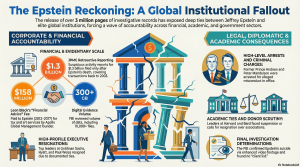

23 Feb. 2026 /Mpelembe Media — The provided sources detail the immense global fallout following a massive 2026 Department of Justice document release concerning deceased sex trafficker Jeffrey Epstein. Government investigations and news reports highlight how JPMorgan Chase executives reportedly ignored internal alarms to facilitate Epstein’s financial activities for nearly two decades. The materials reveal a vast network of enablers, leading to the arrest of Andrew Mountbatten-Windsor and the resignations of prominent figures like Goldman Sachs lawyer Kathryn Ruemmler and UK Ambassador Peter Mandelson. Academic institutions like Harvard, Columbia, and UCLA are also facing internal reckonings as files expose deep ties between Epstein and various professors or donors. While the FBI maintains there is no evidence of a specific “client list” or blackmail, the documents have sparked a wave of accountability across global politics, finance, and elite social circles. Ultimately, the sources illustrate a systemic failure of high-level oversight that allowed Epstein to maintain influence long after his initial criminal convictions.
Jeffrey Epstein leveraged a sophisticated web of complicit banks, elite legal fixers, and high-profile political connections to maintain his power and influence long after his 2008 conviction for soliciting prostitution from a minor. Despite his criminal record, he continued to act as a valuable connector, financial resource, and fixer for the global elite.
Exploiting Banking and Financial Institutions Epstein’s financial operations were heavily enabled by major institutions, most notably JPMorgan Chase (JPMC). Top executives at JPMC, who reported directly to the CEO, closely supervised their relationship with Epstein and treated him as part of an elite group known as the “Wall of Cash”. The bank protected his operations through massive compliance failures, drastically underreporting his suspicious financial activity. While Epstein was alive, the bank flagged only about $4.3 million in transactions, but after his death, they retroactively filed reports on nearly $1.3 billion dating back to 2003.
JPMC executives allegedly tuned out alarmed compliance officers and withheld evidence of potential money laundering. High-level figures were deeply involved: top executive Mary Erdoes was in constant contact with him, and the former CEO of Private Banking, John Duffy, allegedly coached Epstein on how to obscure suspiciously large cash withdrawals to avoid federal reporting requirements. Epstein’s accountant, Harry Beller, also held signatory authority over his accounts and was an integral part of this massive financial operation.
Lucrative “Advisory” Roles with Billionaires Epstein generated immense wealth by acting as an adviser to ultra-wealthy individuals. A prime example is Leon Black, the billionaire co-founder of Apollo Global Management. Black paid Epstein more than $158 million between 2012 and 2017 for financial advice and art-related services. This relationship was so lucrative that Black became Epstein’s biggest source of funds in his final years. In fact, JPMC executives actively maintained their relationship with Epstein after his conviction specifically because of his strong influence over Black.
Deploying Elite Legal Fixers Epstein utilized top-tier legal professionals to navigate his public image and assist his billionaire network. Kathryn Ruemmler, the former Chief Legal Officer at Goldman Sachs, exchanged gifts with Epstein and advised him on how to respond to media inquiries regarding his crimes, affectionately referring to him as “Uncle Jeffrey” in emails.
Furthermore, Brad Karp, the former chairman of the prestigious law firm Paul, Weiss, actively collaborated with Epstein to surveil a former mistress of Leon Black. In recently unsealed emails, Epstein and Karp even discussed the possibility of having the woman’s visa revoked, showcasing how Epstein used his legal connections to operate as a fixer for his wealthy friends.
Infiltrating Geopolitics and State Secrets Epstein’s influence incredibly extended into international diplomacy, where he functioned as a recipient of highly sensitive government information. Peter Mandelson, the former UK Ambassador to the US, leaked classified economic intelligence to Epstein regarding UK tax rule changes, asset sales, and EU bailouts, despite Epstein having no official clearance or role. In the 2000s, Epstein made tens of thousands of dollars in payments to Mandelson and his husband. Similarly, Andrew Mountbatten-Windsor (former Prince Andrew) was recently arrested on suspicion of sharing sensitive information with Epstein during his tenure as the UK’s trade envoy.
Philanthropy as a Networking Tool Finally, Epstein used his vast wealth to embed himself in prestigious academic circles. He donated heavily to universities, including $9.1 million to Harvard and funding to UCLA’s Institute for Music and Brain Science. He used these financial contributions to maintain regular contact with university presidents, deans, and professors, such as Bard College President Leon Botstein, who maintained a relationship with Epstein for the purpose of soliciting donations for the school.
Ultimately, Epstein’s immense wealth and utility to powerful people insulated him from the consequences of his conviction, allowing him to operate within a corporate and political system that prioritized his financial connections over his criminal conduct.
The 2026 release of the Jeffrey Epstein files has triggered a massive global fallout, leading to arrests, criminal charges, forced resignations, and internal investigations across multiple sectors. Here are the major consequences facing high-profile individuals:
Academia
Columbia University & Barnard College: Columbia disciplined two dental college affiliates—stripping Dr. Letty Moss-Salentijn of her vice-dean title and removing Dr. Thomas Magnani from his leadership and admissions roles—for helping Epstein’s girlfriend gain admission. At Barnard, faculty are demanding the school remove the name of prominent donor Francine LeFrak from a newly constructed campus center due to her correspondence with Epstein.
Harvard University: Former Harvard President and U.S. Treasury Secretary Larry Summers stepped down from his teaching position and is on leave while the university investigates his ties to Epstein.
Yale University: The school barred computer science professor David Gelernter from teaching while reviewing his connections to Epstein.
Bard College: President Leon Botstein is facing intense student pressure to resign, and the school’s board of trustees has retained an external law firm to independently investigate his communications and financial relationship with Epstein.
UCLA: Dr. Mark Tramo had his profile page removed from the university’s website and faces a petition with over 10,000 signatures calling for his firing over emails he exchanged with Epstein regarding female students.
Other Institutions: Ohio State University launched an investigation into Dr. Mark Landon, the Fashion Institute of Technology (FIT) suspended professor Lawrence Delson, and Brad Karp resigned from his position as a Union College trustee.
Business, Law, and Entertainment
Goldman Sachs & Paul, Weiss: Top Goldman Sachs lawyer Kathryn Ruemmler resigned after documents revealed she accepted gifts from Epstein and advised him on media strategy regarding his crimes. Brad Karp also resigned as chairman of the prestigious law firm Paul, Weiss after emails showed him collaborating with Epstein to surveil a former mistress of billionaire Leon Black.
Hyatt Hotels: Billionaire Thomas Pritzker retired as executive chairman after emails revealed he maintained a friendly relationship with Epstein and Ghislaine Maxwell long after Epstein’s 2008 conviction.
DP World: Sultan Ahmed bin Sulayem was replaced as chairman and CEO of the Dubai-owned logistics giant after his name appeared over 4,700 times in the file release, including in emails where he joked about a “torture video”.
Entertainment & Sports: Casey Wasserman is selling his major talent agency after high-profile clients like Abby Wambach and Chappell Roan dropped him due to his flirtatious emails with Ghislaine Maxwell and trips on Epstein’s jet. Additionally, New York Giants owner Steve Tisch is under NFL review regarding emails he received from Epstein detailing the ages and nationalities of “working girls”.
Health & Wellness: Dr. Peter Attia stepped down as chief science officer of the protein bar company David.
Politics and Global Diplomacy
The British Royal Family: Andrew Mountbatten-Windsor (former Prince Andrew) was arrested on suspicion of misconduct in public office regarding allegations that he shared sensitive information with Epstein. He is currently facing calls to be removed from the royal line of succession and could potentially face a parliamentary treason investigation.
United Kingdom: Peter Mandelson was dismissed from his role as UK ambassador to the US, arrested by British police, and forced to quit the Labour Party after files revealed he leaked classified economic intelligence to Epstein. His chief of staff, Morgan McSweeney, also resigned as a result of the scandal.
Norway: Former Norwegian Prime Minister Thorbjørn Jagland was charged with “aggravated corruption” following a police investigation into gifts, travel, and loans tied to Epstein. Furthermore, Norwegian diplomat Mona Juul resigned and, along with her husband Terje Rød-Larsen, is under criminal investigation by Norway’s financial crimes unit.
United States: U.S. Commerce Secretary Howard Lutnick is facing bipartisan calls to resign after emails contradicted his previous claims that he cut ties with Epstein in 2005, revealing he actually planned a family trip to Epstein’s private island in 2012.
United Nations: Joanna Rubinstein resigned as chair of Sweden for the UN High Commission for Refugees after records showed she visited Epstein’s private island in 2012.
The following business leaders stepped down from their positions at Hyatt, Goldman Sachs, and DP World following the release of the Epstein files:
Hyatt: Executive Chairman Thomas Pritzker announced he would retire from his role after emails revealed he maintained contact with Epstein and Ghislaine Maxwell following Epstein’s 2008 conviction.
Goldman Sachs: Chief Legal Officer Kathryn (Kathy) Ruemmler resigned after documents showed she accepted gifts from Epstein and advised him on media strategy.
DP World: Chairman and CEO Sultan Ahmed bin Sulayem was replaced after his name appeared extensively in the released files, which included emails where he joked about a “torture video” with Epstein.
The provided sources do not mention how Sultan Ahmed bin Sulayem personally responded to the release of the emails or if he issued a public statement.
However, the sources do detail the contents of the emails and the professional consequences he faced because of them. Following the release of the Justice Department’s files, where his name appeared over 4,700 times, bin Sulayem was replaced as the chairman and CEO of the Dubai-owned logistics giant DP World. The unsealed emails revealed a close relationship with Jeffrey Epstein; in one 2010 exchange, bin Sulayem wrote to Epstein, “where are you? are you ok, I loved the torture video”. In another message, Epstein referred to bin Sulayem as “one of my most trusted friends in every sense of the word”.
The provided sources do not contain any specific details about the contents, subjects, or context of the “torture video.”
The only information available is that Sultan Ahmed bin Sulayem referenced it in a 2010 email to Jeffrey Epstein, writing, “where are you? are you ok, I loved the torture video”.
While an FBI review of Epstein’s files did uncover more than ten thousand downloaded videos and images of illegal child sex abuse material and other pornography, the sources do not explicitly state whether the video bin Sulayem mentioned was part of this illegal cache or something else entirely.
U.S. Commerce Secretary Howard Lutnick is facing bipartisan calls to resign because recently released emails revealed that he planned a family trip to Jeffrey Epstein’s private island in 2012.
This revelation directly contradicts Lutnick’s previous public statements. He had previously claimed to the New York Post that he completely cut ties with Epstein in 2005, stating that he and his wife had decided never to be in a room with “that disgusting person ever again”.
When confronted about the 2012 trip during a Senate hearing, Lutnick tried to downplay the visit, testifying that his family was only on the island “for an hour” to have lunch. Furthermore, despite the Commerce Department issuing a statement claiming Lutnick had “very limited interactions” with Epstein over a 14-year period, documentary evidence has shown records of calls and joint investments between the two men.
In addition to Commerce Secretary Howard Lutnick, the following current and former U.S. officials are facing scrutiny following the release of the Epstein files:
Treasury Secretary Scott Bessent: Senator Ron Wyden has accused Bessent of being “part of the Epstein coverup”. Bessent has refused to produce the Treasury Department’s own Epstein file—which contains thousands of bank records—for further examination by the Senate Finance Committee.
Donald Trump and Pam Bondi: Senator Wyden has also expressed intense concern regarding their handling of the fallout, publicly accusing them of “faking investigations as a pretext to block any further disclosures”.
Former Treasury Secretary Larry Summers: Summers, who also served as president of Harvard University, has stepped down from his teaching position and is currently on leave while the university investigates his ties to Epstein. Recently released emails revealed a friendly relationship between the two men, with Epstein even referring to himself as Summers’ “wing man”. Summers has publicly stated that he is “deeply ashamed” of the relationship and called it a “major error of judgment,” though he denied any knowledge of Epstein’s criminal conduct.
Senator Ron Wyden has made several specific accusations regarding an “Epstein coverup” among current government officials, primarily focusing on the withholding of financial documents and the nature of ongoing investigations:
Accusations against Treasury Secretary Scott Bessent: Wyden explicitly accused Treasury Secretary Scott Bessent of being “part of the Epstein coverup” because Bessent has refused to produce the Treasury Department’s Epstein file for further examination by the Senate Finance Committee. This file contains thousands of bank records, and while committee investigators were allowed to view a portion of it in 2024, the full file remains withheld.
Accusations against Donald Trump and Pam Bondi: Wyden stated he is “extremely concerned” that Donald Trump and Pam Bondi are “faking investigations as a pretext to block any further disclosures” regarding Epstein’s network.
Wyden noted that the Treasury Department’s records are unaffected by the recent legislation requiring the Department of Justice to release its Epstein files. Because of the stonewalling, Wyden plans to seek Senate approval for a bill that would force the Treasury Department to release its files so his committee can “continue following the money”.
Senator Ron Wyden has alleged that Donald Trump and Pam Bondi are blocking further disclosures regarding Jeffrey Epstein’s network by “faking investigations as a pretext” to withhold additional information.
Furthermore, despite entering office with promises of increased transparency regarding the Epstein case, the Trump administration has refused to act on Wyden’s proposed blueprint for a “follow-the-money” investigation. The administration has also repeatedly ignored Wyden’s requests to release the Treasury Department’s Epstein file, which contains thousands of bank records and is unaffected by the recent legislation that forced the Department of Justice to release its files.
Based on the provided sources, the specific, step-by-step details of Senator Ron Wyden’s “follow-the-money” investigation blueprint are not outlined.
However, the sources do provide context about the blueprint and the broader goals of Wyden’s financial investigation into Jeffrey Epstein’s network:
Reason for the Blueprint: Wyden laid out the blueprint in June 2025 specifically in response to the Trump administration’s “refusal to act” on conducting a proper financial investigation into Epstein.
Focus on the IRS: The month after releasing the blueprint, Wyden revealed concerns that Epstein’s massive financial transactions and complex tax planning work may have never been audited or investigated by the IRS.
Demanding Treasury Files: A core part of Wyden’s investigative effort involves gaining access to the Treasury Department’s Epstein file, which contains thousands of bank records. He recently sent a letter to the Treasury Secretary identifying several individuals with documented Epstein ties and demanding the release of these files.
Investigating Complicit Institutions: More broadly, Wyden’s “follow-the-money” investigation aims to hold complicit financial institutions accountable. For example, he recently released an 18-page memorandum detailing how top executives at JPMorgan Chase ignored alarms from compliance officers and enabled Epstein’s sex trafficking operation through massive compliance failures, arguing that the bank should face criminal investigation.
The “Wall of Cash” was an elite group of clients at JPMorgan Chase (JPMC). Jeffrey Epstein was considered part of this exclusive tier because he was one of the bank’s single largest clients.
This detail was recently revealed in an 18-page Democratic staff memorandum released by Senator Ron Wyden, which outlined how top JPMC executives closely supervised their highly lucrative relationship with Epstein and protected his financial operations through massive compliance failures.