
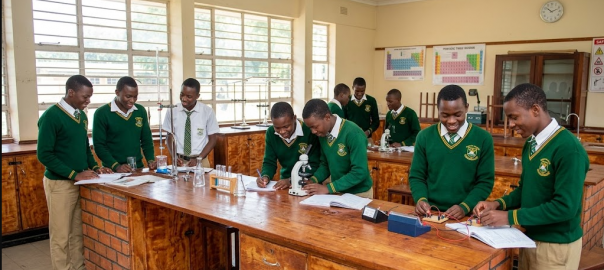
Building Zambia’s Engineers: The STEM Legacy and Academic Rigor of Kitwe Boys
Thur, July 03 2026 /Mpelembe Media/ — Kitwe Boys Secondary School, founded in 1957 during the peak of British colonial administration in Northern Rhodesia, reflects the broader social, political, and architectural transformations of the Copperbelt region. Spanning eras of strict racial segregation, rapid post-independence integration, and modern educational adaptation, the school’s history provides a powerful lens into the heritage of Zambia’s mining heartland.
Institutional Transformation Analysis: The Socio-Spatial Evolution of Kitwe Boys Secondary School (1957–Present)
1. Introduction: Educational Infrastructure as a Mirror of State Identity
Kitwe Boys Secondary School (KBSS) serves as a profound institutional prism for Zambian national development, illustrating the shifting ideological priorities of a state in transition. As a physical construct, the school’s architecture has acted as a primary site for the manifestation of political identity: first as a reinforced bastion of colonial hierarchy designed to preserve European settler privilege, and later as a vehicle for post-colonial aspirations of meritocracy and national industrialization. The evolution of the campus from an exclusive enclave to a mass-enrollment public institution reflects the broader historical trajectory of the Copperbelt—Zambia’s industrial heartland—where the built environment was strategically utilized to both delineate racial boundaries and, subsequently, to forge a unified national identity.The following profile details the school’s current administrative and geographic framework:
| Parameter | Detail |
| Official Motto | Success Through Labour |
| Establishment Date | 1957 |
| Founding Headmaster | Mr. J. Hall |
| Location | Kumboka Drive, Parklands, Kitwe, Zambia |
| Current Leadership | Steven Musto (Headmaster) |
| Institutional Nicknames | Kibo / Kiboz / KBSS |
| Campus Type | Suburban Boarding and Day School |
While KBSS today is a cornerstone of the Zambian public education system, its origins are rooted deeply in the exclusionary socio-economic structures of the colonial mining economy.
2. Colonial Foundations: The Architecture of Racial Hegemony (1957–1963)
The founding of Kitwe Boys Secondary School in 1957 was a strategic intervention by the British colonial administration and mining conglomerates such as the Rhodesian Anglo-American Corporation. During this era, the Copperbelt experienced a massive boom in copper prices, necessitating the recruitment of highly skilled European engineers to the Nkana mine complex. To retain these expatriates, the state invested in high-status social infrastructure. Under the leadership of the founding headmaster, Mr. J. Hall, the school was designed to mirror British academic standards, providing a premium environment exclusively for the children of white mine employees and civil servants.The “Spatial Apartheid” of the era was encoded directly into the region’s educational physical plants. There was a stark divergence between the feeder schools serving the white population and the utilitarian structures provided for indigenous communities.
| Comparative Infrastructure: Colonial-Era Primary Education in Kitwe | ||
| Feature | European Feeder Schools (e.g., Frederick Knapp) | Township Schools (e.g., Wusakile / Kitwe Main) |
| Classroom Design | Spacious layouts, robust construction, and beautiful architecture. | Utilitarian, crowded, small, and unplastered structures. |
| Recreational Amenities | Clean swimming pools, tennis courts, and athletic fields. | Complete absence of specialized sports or recreational facilities. |
| Assembly Facilities | Dedicated indoor halls with comfortable, formal seating. | No assembly halls; gatherings occurred outdoors in the elements. |
| Modern Status | Frederick Knapp (now Rokana Primary); Prince Charles (now Matete Secondary). | Persistent sites of high-density enrollment. |
The “Prohibitive Geography” of the Parklands location further reinforced these racial barriers. By situating the school in an affluent suburban zone, the colonial administration utilized physical distance and zoning as a social filter. This placement acted as a physical barrier to the indigenous Lamba and Bemba communities residing in mining compounds, effectively isolating the European elite. This rigid geographic separation created a physical operational identity that would define student life until the eve of independence.
3. Operational Identity: Pedagogy, Discipline, and the 1964 Transitional Pivot
The year 1964 represented a critical strategic pivot. As Zambia moved toward independence, the school had to balance British academic traditions with the immediate needs of a changing region. This was most evident in the “M” Level curriculum. Framed as a geopolitical academic shortcut , the “M” Level allowed students to bypass the standard two-year “A” Level pathway, offering a one-year matriculation into South African universities. This maintained critical regional ties with the white-minority ruled south during the height of decolonization.Internal order was maintained through a rigorous disciplinary code that emphasized institutional pride. The following requirements defined the daily life of a “Kibo” scholar:
- Uniform Integrity: Long-sleeved white shirts were mandatory and had to be worn at full length; folding or rolling sleeves was strictly forbidden, regardless of heat.
- Public Identification: Students were required to wear a straw boater (known as a “basher”) and the school tie at all times while in public view to and from school.
- Grooming Standards: Haircuts were strictly regulated; dyed hair or lengths that covered the ears were prohibited.
- The Butcher Paper Mandate: To preserve scarce resources, all textbooks had to be covered in brown “butcher” paper. Non-adherence was met with two to three strokes of the cane, ensuring students treated materials with extreme care.The school’s focus on Physics, Chemistry, and Mathematics established it as a vital human capital pipeline for the Nkana mine complex.
| Evolution of Academic Frameworks at KBSS | ||
| Era | Primary Target | Curriculum Focus |
| Colonial (1957–1963) | European Expatriate Integration | British GCE ‘O’ and ‘A’ Levels; preparation for UK universities. |
| Transitional (1964) | Regional Technical Matriculation | GCE ‘O’ Level and ‘M’ Level for South African engineering pathways. |
| Post-Independence | National Talent Development | Zambian curriculum with heavy STEM emphasis for industrial independence. |
This rigid internal order was vital as the school transitioned from a segregated enclave to a primary site for the national effort of desegregation following independence.
4. The Shared Spatial Ecosystem: KBSS and Helen Kaunda Girls
The spatial history of KBSS is inextricably linked with Helen Kaunda Girls Secondary School (formerly Kitwe Girls). Established as a co-educational facility in 1957, the school underwent gender separation in 1962. This separation was never absolute, creating a unique “shared spatial ecosystem.”An architectural anomaly remains the most visible evidence of this: the “Divided Infrastructure” model. The campus swimming pool is located on the grounds of the girls’ school, while the associated washrooms and changing facilities are located on the boys’ campus. Notably, this swimming pool is currently not functional , a testament to post-colonial resource constraints.Between 1962 and 1964, academic necessity overrode gender segregation. Severe staff shortages forced students to cross boundary lines for tuition in advanced mathematics and sciences. This early mobility and resource-sharing between sister institutions acted as a precursor to the institutional cooperation required during the later era of massification. These shared physical roots transitioned the school toward the challenges of a rapidly expanding student body.
5. Post-Colonial Transformation: Integration, Massification, and Decay
The Education Act of 1966 transformed the school’s mission from an exclusive day academy to a regional boarding hub intended to generate domestic talent for the state-owned Zambia Consolidated Copper Mines (ZCCM). This era saw KBSS become a cornerstone of Zambian public education, though “Massification” brought significant pressures:
- Enrollment Surges: From colonial levels, enrollment spiked to over 1,100 students, straining the capital-intensive colonial-era infrastructure.
- Infrastructure Deterioration: The decay of facilities like tennis courts and the swimming pool represented a strategic reallocation of limited state funds from luxury leisure to primary academic access .
- Persistent Identity: The “British House System”—comprising the Eagle, Falcon, and Hawk houses—persisted as a tool to foster internal competition and institutional loyalty amid these shifts.Student agency also evolved significantly. The school transitioned from hosting colonial-era “School Cadets” to modern organizations like the Anti-AIDS and Interact clubs. These reflect a shift toward addressing regional socio-economic challenges, providing public health advocacy and supporting vulnerable communities in Kitwe’s informal settlements. Through this, KBSS moved from being a segregated enclave to a primary engine of national talent.
6. Evaluative Summary: The Legacy of “Success Through Labour”
The history of Kitwe Boys Secondary School is defined by a paradox: it has maintained a high-value STEM reputation and strict discipline even as its colonial-era infrastructure faced the resource constraints of a post-colonial state. While the functional swimming pools and manicured courts of the 1957 campus have faded, the school’s core identity—”Success Through Labour”—remains a guiding principle for the “Kiboz” community.Ultimately, KBSS served as a critical human capital pipeline specifically engineered for the Nkana mine complex and the broader Zambian economy. By repurposing the exclusive architecture of the colonial past, the school played an essential role in producing the technical and administrative leaders required for Zambia’s industrial independence. Its legacy lies in its ability to adapt rigid academic traditions to the service of a modern, integrated, and industrializing nation.
Bashers, Butcher’s Paper, and the Shared Pool: 5 Surprising Realities of Kitwe’s Most Iconic School
The city’s name is an echo of a discovery—the Ichitwe skull that marked the start of the copper fever. Derived from the Lamba word for a large elephant skull found near early mining sites, Kitwe was forged in 1936 to tap the rich veins of ore beneath Chief Nkana’s domain. But for every ton of copper extracted by the steel giants of the Nkana mine, there was a human cost; the city’s founding was a story of rapid industrialization built upon the displacement of local Lamba communities. By the 1950s, Kitwe had matured into the undisputed hub of the Copperbelt, a landscape where the skyline was defined by towering headgears and the social fabric was etched with the rigid lines of colonial order.At the heart of this world sat Kitwe Boys Secondary School, known colloquially as “Kibo.” Established in 1957 within the suburban quiet of Parklands—a neighborhood of manicured lawns and affluent expatriates—the school served as a premier colonial time capsule. Behind the gates on Kumboka Drive, a specific brand of masculine discipline was cultivated. Yet, as Zambia neared its 1964 independence, this bastion of the European settler class underwent a profound identity shift. What remained were the stories of a life lived between strict tradition and the pragmatic compromises of a changing world.
The “Basher” and the “Butcher’s Paper”: Discipline as a Religion
In the early days of Kibo, discipline was not merely a set of rules; it was the school’s fundamental liturgy. The institutional identity was projected through a highly regimented uniform that tolerated no deviation. Meticulous inspections of necklines and ear-lengths were the norm; hair was never to touch the ears, and dyed locks were a cause for immediate sanction. Students were required to wear long-sleeved white shirts full length, a rule that made the Copperbelt heat feel all the more oppressive, as folding sleeves part-way up the forearm was strictly forbidden.The most iconic element, however, was the “basher”—a rigid straw boater that was part of the legally mandated uniform. To be seen in public without it while traveling to or from school was a grave transgression. This obsession with preservation extended even to the students’ tools of learning. Every state-issued textbook had to be immaculately shrouded in heavy brown “butchers paper.” This was not merely a suggestion of care, but a ritual of respect for the institution’s property, with physical consequences for the negligent.”One was punished for non-adherence to this ruling to the extent of two to three strokes of the cane being dispensed to serious defaulters so, needless to say, books were always immaculately covered.”This level of rigidity was intended to project a sense of elite institutional prestige. In a colonial context, the “immaculate” book and the perfectly tied navy-and-brown knot were tools used to cultivate a specific brand of personal discipline, intended to mark the students as the future administrators of the empire’s industrial heart.
The Secret Co-ed Years: Academics Over Gender Boundaries
While history often categorizes Kitwe Boys as an uncompromising bastion of male education, the reality was far more fluid. Though a Girls’ High School had been “completed” next door in 1959, it was only in 1962 that Kitwe Boys became “entirely” a boys’ school. Yet, for all this religious adherence to the rules of the past, the school was forced into pragmatic compromises that blurred the very lines it sought to draw.Right up until 1964, a “handful of girls” continued to cross over to the boys’ campus for tuition, and vice-versa. This was a necessity born of the era’s chronic shortage of specialized teaching staff. Academic survival meant that tuition in advanced mathematics and sciences—the very subjects George M. Lazarevic recalled as the “excellent schooling foundation” for future engineers—had to be shared across gender boundaries. It is a striking historical irony: in a society defined by strict social and gender segregation, the pursuit of scientific literacy was the one force capable of opening the gates between the two campuses.
A Geographic Puzzle: The Pool and the Washroom Divide
The physical proximity of Kitwe Boys and its sister school, Helen Kaunda (formerly Kitwe Girls), created a unique, shared spatial ecosystem. For years, no boundary wall existed between the two, leading to a bizarre infrastructure split that tethered the schools together through the architecture of leisure.The primary swimming pool—a centerpiece of the schools’ enviable sports facilities—was physically located on the grounds of the girls’ school. However, in a layout that seemed designed to force interaction, the core washrooms and changing facilities were located on the boys’ school grounds. This geography created a constant, rhythmic movement of students crossing invisible lines for a dip in the water, a subtle thaw in the rigid architecture of the era that ensured the two institutions remained symbolically connected even as they moved toward separate identities.
Education as “Spatial Apartheid”
Kibo’s location in Parklands was no accident of urban planning; it was a deliberate act of “spatial apartheid.” During the colonial struggle, the city was divided into prohibitive zones. The school sat in a neighborhood that was legally out of bounds for the black community, creating a physical and psychological barrier that reinforced the era’s racial hierarchies. The architecture itself told a story of two different worlds:
- White-only Feeder Schools (Frederick Knapp, Riverrain): These institutions were the jewels of the colonial system, featuring beautiful, spacious layouts and dedicated assembly halls where students sat comfortably in insulated environments.
- Black-only Township Schools (Wusakile, Mutende): These were utilitarian, crowded structures. They lacked plastered walls or insulated ceilings, and most notably, possessed no assembly halls at all. Students were required to gather outdoors, standing in the red dust or the driving rains of the “suicide months.””The location of the white-dominated schools was prohibitive because the schools were located in areas that were out of bounds for the black community.”This architecture of exclusion ensured that while one group of children learned in the shade of prestige, the other was left to the elements, a disparity that President Kenneth Kaunda would later seek to dismantle.
The “M” Level Shortcut: A Regional Academic Bridge
In 1964, as the ties to the British mainland began to loosen under the pressure of decolonization, Kitwe Boys introduced a specific curricular innovation: the “M” level. While the school maintained the British GCE “O” and “A” level tracks, the “M” level provided a one-year accelerated pathway specifically designed for entry into South African universities.This curriculum served as a bridge for the European settler class, allowing their children to bypass the traditional two-year British “A” levels to enter professional engineering and technical programs in South Africa. It was a reflection of the deep regional economic ties that defined the era—a shortcut for a community looking toward a different southern horizon as the colonial sun began to set over Northern Rhodesia.
Conclusion: From Colonial Exclusivity to National Pride
The story of Kitwe Boys Secondary School is one of profound transformation. Following the 1964 independence and the subsequent reforms of the Kaunda era, the school was repurposed from an exclusive academy into a hub for domestic talent. The focus on Physics, Chemistry, and Mathematics remained, but the mission changed; Kibo became the engine room for a new nation, training the engineers needed to manage Zambia’s nationalized industries.Today, the school’s motto, Success Through Labour , remains a lasting legacy of its founding principles. However, modern visitors often note the “deterioration” of the once-pristine swimming pools and tennis courts. As a cultural historian, one must ask: is the physical decline of these inherited colonial luxuries the inevitable price of democratizing access for the thousands of Zambian students who followed? In the shift from exclusive luxury to mass national education, perhaps the true success is found no longer in the immaculately covered books or the straw boaters, but in the expanded horizons of the students themselves.