
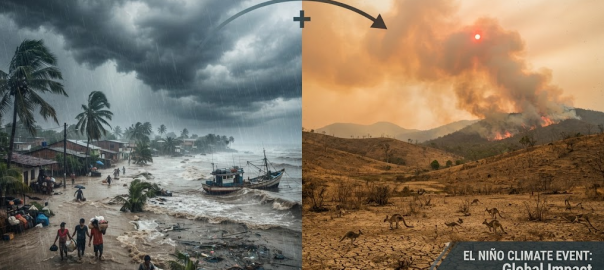
Global Economic Impacts of the 2026–2027 Super El Niño
The Severity of the Climate Shock in a Fragile Macro Context
Fri Oct. 23, 2026 /Mpelembe Media/ — The 2026–2027 El Niño climate event is developing into one of the most severe episodes on record, with equatorial Pacific sea-surface temperature anomalies projected to exceed +2°C to +3°C. Meteorological authorities assign a greater than 90% probability to a very strong event, with a 75% likelihood of exceeding the intensity of historical benchmarks recorded since 1950. Unlike previous cycles, this climate phenomenon collides with an exceptionally fragile macroeconomic environment characterized by historically elevated public debt, high interest rates, ongoing geopolitical tensions, and pre-existing supply chain frictions.
Triple Transmission Channels: Agriculture, Energy, and Logistics
The macroeconomic fallout operates across three primary transmission channels spanning agriculture, energy generation, and international trade logistics. Severe droughts in Southeast Asia, India, and parts of Africa, alongside excessive rainfall in southern South America, threaten major crops including rice, coffee, cocoa, sugar, and palm oil, driving global food commodity prices up by 5% to 8%. In the energy sector, reduced rainfall severely curtails hydroelectric power generation in nations such as Colombia, Ecuador, and Vietnam, forcing a heavier reliance on thermal fossil fuels and driving up demand for oil and gas. When combined with geopolitical risks in the Middle East and threats to the Strait of Hormuz, crude oil prices face significant upside potential and could surge toward $140 per barrel by 2027 under prolonged supply shortfalls. Meanwhile, maritime transport suffers severe operational delays as drought in the Panama Canal watershed forces transit slot restrictions, elevating freight costs and disrupting global trade corridors.
Sovereign Credit Vulnerabilities and Emerging Market Exposure
The economic impact varies widely across countries, with developing nations bearing the highest burden due to the heavy weighting of food in their consumer price index and a reliance on hydroelectric power. Quantitative sovereign risk modeling identifies Indonesia, Brazil, Ecuador, Colombia, and Kenya as the most exposed nations globally. Crucially, four of these top-tier exposed sovereigns—Brazil, Indonesia, Colombia, and Kenya—combine extreme climate sensitivity with large public debt burdens, leaving them with severely restricted fiscal room to absorb compounding shocks relative to previous El Niño cycles. Consequently, while advanced economies experience minimal direct GDP contraction, emerging markets face heightened credit spread volatility, currency devaluation risks, and widening fiscal deficits.
Policy Challenges and Economic Adaptation
Central banks face a difficult dilemma because weather-driven price surges represent supply-side shocks rather than demand-led inflation. Advanced economy central banks are largely expected to look past temporary food and energy price spikes to avoid dampening economic growth. Conversely, central banks in emerging markets—particularly across Latin America and Southeast Asia—face acute pressure to raise interest rates to contain food inflation expectations and prevent currency depreciation. To manage cascading disruptions, governments and shipping operators are increasingly adopting anticipatory measures, such as pre-positioning contingency credit lines, expanding strategic food buffers, and diversifying transport corridors to build long-term economic resilience.
The Climate-Macro Collision: 5 Shocking Macro-Economic Reality Checks Driven by 2026’s Climate and Energy Crisis
Introduction
Have you ever wondered how warming surface ocean temperatures in the Pacific ocean could directly influence the cost of your morning coffee, your home mortgage interest rate, and global natural gas prices?
As we navigate through 2026, the global financial landscape is confronting an extraordinary double shock: a 2026–2027 “Super El Niño” featuring sea-surface temperature anomalies exceeding +3°C in the equatorial Pacific, running concurrently with escalating Middle Eastern energy supply risks and regional war.
What lies ahead is far more than a routine weather update. It marks a fundamental structural realignment of global commodity markets, international trade logistics, and central bank monetary policy that will define asset prices well into 2027.
1. Oil Could Hit $140—and Gold Is Eyeing $5,400
Extreme climate anomalies and geopolitical supply deficits in the Middle East are converging to generate massive upward price shocks across energy and metal markets. While Goldman Sachs outlines a baseline scenario where Brent crude moderates to $90/bbl and European natural gas settles at EUR 70/MWh by end-2026 as supplies stabilize, their high-risk upside scenario reveals extreme market vulnerability.
If Persian Gulf oil output remains 5 million barrels per day below February 2026 levels due to prolonged war and shipping disruptions in the Strait of Hormuz , Brent crude is projected to surge to $140/bbl in early 2027 and average ****$ 125/bbl throughout 2027 . Concurrently, European natural gas could spike to EUR 150/MWh if Gulf liquefied natural gas (LNG) exports remain constrained during a colder-than-average European winter. Beyond energy, structural demand from global electrification, data centers, and artificial intelligence is expected to propel copper to USD 15,400 per tonne , while persistent central bank buying is targeted to drive gold to USD 5,400 per ounce by end-2027.
Reflecting these compounding physical shocks, the Bloomberg Commodity Index has already generated a 36% total return year-to-date , dramatically outperforming global stock and bond indexes.
“Brent might rally to $140 in early 2027 and average around $125/bbl in 2027 if average Gulf output remains 5 million barrels per day below February 2026 levels.” — Goldman Sachs Report
This financial decoupling underscores a broader structural shift. Commodities are no longer passive cyclical assets; they have transformed into crucial institutional portfolio hedges and potent cost-push inflationary threats.
2. Droughts Are Paradoxically Driving Up Fossil Fuel Demand
Extreme weather events are triggering a dangerous feedback loop across emerging economies: severe rainfall deficits are crippling clean hydroelectric infrastructure, forcing utility grids to revert to thermal fossil fuel generation.
El Niño-induced droughts have severely reduced river basins across Latin America and South-East Asia. In Colombia , where hydropower supplies 55% of national electricity, a 30% drop in hydroelectric generation increases power costs by 15–20% as utilities burn thermal fuels. Parallel grid vulnerabilities are disrupting industrial activity in Ecuador ( 70% hydro dependency ) and Vietnam ( 30% hydro dependency ).
To prevent systemic blackouts, affected nations are forced to buy spot thermal fuels during a period of already inflated global hydrocarbon prices. According to analysis from BNP Paribas , this emergency fuel switching creates a demand overhang that sustains upward pressure on global oil and natural gas spot markets for up to four quarters after the initial climate shock.
This climate-hydro crisis exposes an ironic macro reality: drought-stricken clean energy grids are actively bidding up thermal fossil fuels, compounding baseline energy inflation worldwide.
3. The Panama Canal and European Rivers Are Shrinking Global Trade
Critical maritime and inland logistics chokepoints are translating localized hydrological shocks directly into persistent global consumer supply shortages. Essential transport corridors are struggling to maintain normal trade volumes under extreme weather conditions.
The Panama Canal , which handles approximately 5% of global trade , relies on freshwater from its surrounding watershed. Severe drought forced transit authorities to cut daily vessel crossings from 36 down to 29 daily transits by October 2026, causing shipping backlogs and soaring freight tariffs. S&P Global warns that these canal capacity cuts pose acute risks to refrigerated cargo and agricultural supply chains right as the Southern Hemisphere harvest season gets underway.
Across Europe, similar hydrological choke points are widening. Unusually low water levels on the Rhine and Danube rivers are obstructing inland industrial barge transport and constraining cooling water for inland power generation.
These recurring river and canal chokepoints have exposed logistics infrastructure as a major macro vulnerability. In response, international corporations are systematically abandoning fragile “just-in-time” supply chain models in favor of strategic inventory buffers (“just-in-case” stocking) and alternative regional transit corridors.
4. Food Inflation Is No Longer Just About Agriculture—It’s Systemic
The convergence of record-breaking climate anomalies, geopolitical export restrictions, and critical input bottlenecks is creating severe, multi-year agricultural shocks.
Attribution data delineates the sheer scale of the threat:
- The US National Oceanic and Atmospheric Administration (NOAA) and the World Meteorological Organization (WMO) estimate a >90% chance of a very strong El Niño event persisting through winter.
- Research by Goldman Sachs highlights that this climate pattern carries an 81%+ probability of reaching “Super El Niño” intensity, featuring ocean surface temperature anomalies exceeding +3°C .
Analysis from the IMF and BNP Paribas indicates that while a standard El Niño raises global food prices by 5% , a high-intensity event causes prices to surge by 8% , with peak inflationary impacts hitting 6 to 12 months later. The Bloomberg Commodity Index agriculture component is already up 19% year-on-year , driven higher by fertilizer shipping bottlenecks in the Strait of Hormuz and grain transport friction in the Black Sea .
The domestic economic impact of an 8% food shock is highly regressive, dictated entirely by consumer price index (CPI) weightings:
- Developing Economies (Food CPI weight ~49%): Adds nearly 4 percentage points directly to headline inflation.
- Advanced Economies (Food CPI weight ~13%): Adds approximately 1 percentage point to headline CPI.
Protectionist policies amplify these climate shocks. As demonstrated when India’s 2023 rice export restrictions combined with South-East Asian drought to trigger a 30% average price surge in global rice, government intervention can prolong price spikes long after weather normalizes. Consequently, agricultural climate shocks act as a severe regressive tax, punishing developing nations like Ghana, Thailand, and the Philippines far more than advanced economies.
5. Oil and Wall Street Have Flipped Their Correlation
Since the outbreak of the Iran war and expanded Middle Eastern conflict, historic financial market correlations have undergone a stark structural reversal, destabilizing standard multi-asset portfolio models.
Over a six-month trading period, daily price changes between Brent crude and the S&P 500 flipped to a negative correlation averaging nearly -0.5 (oil prices rose while equities fell). Over the same period, the correlation between daily Brent crude changes and 10-year US Treasury yields rose to nearly 0.6 (oil prices and bond yields moved upward together).
This correlation shift presents a formidable policy trap for institutions like the European Central Bank . Because current price pressures stem from supply-side climate and geopolitical disruptions rather than demand-driven expansion, central bankers face an agonizing dilemma: raise interest rates into a slowing real economy or stand aside as cost-push stagflation anchors itself across the financial system.
Conclusion
The compounding crises of 2026 and 2027 demonstrate that planetary climate cycles, geopolitical conflicts, and global financial markets are now bound together within a single, hyper-sensitive economic system. A thermal shock in the Pacific Ocean or a supply disruption in the Middle East rapidly cascades into grid failures, trade choke points, and monetary policy impasses.
As global supply chains pivot from low-cost efficiency to climate resilience, are markets finally pricing in the true cost of unpredictable weather—or are financial systems still sleepwalking into the next global shock?