
From STORMFURY to HAARP: Unpacking the Physical Limits of Geoengineering and the Spread of Weather Disinformation
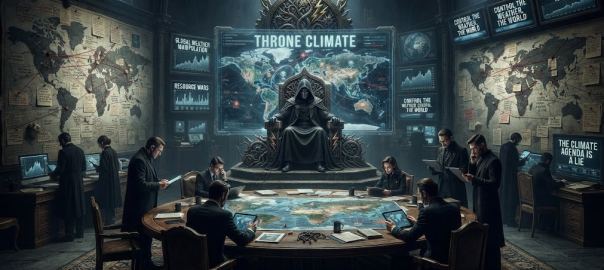
Fri Oct. 23, 2026 /Mpelembe Media/ — The viral “THRONE CLIMATE” narrative functions as a grand super-conspiracy, falsely alleging that a secretive elite connected to the Rothschild family operated a worldwide network of 22 weather modification stations for 47 years to manufacture catastrophes like Hurricane Katrina and the 2010 Haiti earthquake. This online legend adapts 19th-century antisemitic tropes regarding Jewish financial control to modern anxieties about emerging geoengineering technologies, echoing recurring claims made by political figures regarding atmospheric manipulation and space-based weapons. To create false plausibility, the narrative relies on capability substitution—taking bounded, real-world technologies like localized cloud seeding and misrepresenting them as total atmospheric command—alongside pseudo-technical jargon and institutional scapegoating to offer simplistic explanations for complex global market and weather events.
In scientific reality, human technologies are strictly bounded by thermodynamic laws and cannot generate, direct, or steer major atmospheric systems. Operational cloud seeding introduces ice-nucleating agents like silver iodide into preexisting clouds containing supercooled liquid water, enhancing localized seasonal precipitation by only 5% to 15% under specific meteorological conditions; it cannot create clouds in dry air or alter synoptic-scale pressure belts. The definitive empirical test of large-scale weather modification occurred during Project STORMFURY (1962–1983), a federal initiative that attempted to weaken hurricanes by seeding their outer rainbands. The project was officially cancelled after advanced atmospheric observations proved that mature hurricanes naturally lack sufficient supercooled liquid water and undergo concentric eyewall replacement cycles independently of human intervention.
Similarly, assertions linking high-frequency active auroral research facilities like HAARP to surface weather modification, severe storms, or earthquakes fail due to fundamental atmospheric physics. HAARP operates in the ionosphere above 80 kilometers altitude, transmitting high-frequency radio waves that pass directly through the neutral troposphere and stratosphere without physical or thermal absorption. Because the lower atmosphere contains no free plasma to absorb HF energy, the facility cannot generate wind currents, pressure gradients, or weather patterns. Furthermore, high-frequency electromagnetic waves cannot penetrate tens of kilometers of solid, conductive rock crust to influence tectonic fault mechanics or trigger earthquakes.
Long-term empirical hazard data directly contradicts the claim of a manufactured 50-year surge in global natural disasters. Systematic audits reveal that between 2019 and 2025, reported natural disasters averaged 393.4 annually—representing a minor 7.5% increase over historical baselines—while disaster-related mortality dropped by 58% to an annual average of 26,838. Major M7+ earthquakes averaged 13.4 per year during this period, remaining below the long-term geophysical expectation of approximately 16 annually. The observed increase in global financial disaster losses is driven by expanding population and high-value asset density in coastal and flood-prone zones, alongside the non-linear physical scaling of wind and seismic energy, rather than covert atmospheric warfare.
Public vulnerability to atmospheric conspiracy theories is heavily exacerbated by regulatory fragmentation and oversight deficits in legitimate weather modification and geoengineering programs. Government Accountability Office (GAO) audits revealed that over half of sampled municipal and commercial weather modification records submitted to federal oversight registries contained missing data or reporting errors. Addressing the spread of weather disinformation requires establishing mandatory, digitally audited federal registries, developing clear international governance frameworks for geoengineering research, and communicating plain-language technical explanations during severe weather events.
Controlling the Clouds: 5 Surprising Truths About the History, Hype, and Reality of Weather Modification
In the wake of devastating extreme weather events like Hurricanes Helene and Milton, a familiar phenomenon flooded social media: viral claims that severe weather is being secretly engineered, steered, or weaponized by human hands. High-profile figures and internet commentators asserted that these storms were targeted geo-engineered weapons, sparking widespread public curiosity and anxiety over who might be controlling the skies.
While these viral claims sound like modern science fiction, they obscure a fascinating historical reality. Humans have spent nearly a century attempting to alter the weather—spending hundreds of millions of tax dollars in the process. However, the true history of government weather modification reveals that these projects consistently stumbled not because of covert success, but because of extreme atmospheric scale, unexpected backfires, and endless bureaucratic infighting.
What You’ll Learn in This Deep Dive
- The Flawed History: How real cold-war military experiments and hurricane-seeding projects repeatedly backfired, prompting international bans.
- The Capability Fallacy: Why localized cloud seeding cannot be scaled into weather warfare or used to steer mega-storms.
- The Policy Collapse: How agency infighting and premature hype killed America’s $300 million federal weather research program.
- The Scale Problem: The exact physics explaining why technologies like HAARP and high-energy lasers cannot trigger or control hurricanes.
- Exploitation vs. Production: The crucial difference between political actors capitalizing on a natural crisis and actually manufacturing one.
1. Real Weather Control Has a Dark, Backfiring History
The urge to manipulate the atmosphere is not a conspiracy theory; it is a matter of documented history. Following World War II, the U.S. government invested heavily in atmospheric research, believing weather control was vital for national security, water supply, and agriculture. However, early efforts to alter severe storms and military environments frequently yielded unpredictable and embarrassing public failures.
Project Cirrus demonstrated the extreme risks of storm modification as early as 1947. Sponsored by the military and conducted by General Electric scientists, Project Cirrus involved dropping dry ice into a tracking hurricane. The storm, which was initially tracking west to east and heading out to sea, abruptly reversed its path after being seeded and made landfall in Savannah, Georgia, causing severe local destruction. The resulting legal threats and public outrage set atmospheric modification research back by more than a decade.
Military operations during the Vietnam War sparked international condemnation. Between 1967 and 1972, the U.S. Department of Defense and Department of State conducted Project Popeye—over 50 secret cloud-seeding experiments aimed at increasing rainfall over enemy supply routes along the Ho Chi Minh Trail in North Vietnam and Laos. When details of the covert operation were made public in 1974, congressional backlash led directly to the United Nations ENMOD treaty, which prohibited hostile environmental warfare.
“The memorandum described more than 50 cloud-seeding experiments and reported rainfall following a large proportion of seeded clouds, while also acknowledging uncertainty in spatial extent and collateral effects.”
Project STORMFURY spent over two decades attempting to weaken tropical cyclones. Running from 1962 to 1983, this joint government effort sought to reduce hurricane maximum winds by up to 30% by seeding supercooled water with silver iodide to disrupt the storm’s eyewall. Early seeding trials during Hurricane Beulah (1963) and Hurricane Debbie (1969) coincided with temporary wind speed drops of 18% to 20%, briefly convincing scientists that hurricane modification was attainable. However, the project was ultimately abandoned after extensive observational data revealed that hurricanes naturally lack sufficient supercooled liquid water, making seeding ineffective and its results indistinguishable from natural changes in intensity.
2. The “Capability Fallacy” – Why Cloud Seeding Isn’t Weather Warfare
Modern discussions often confuse localized cloud seeding with large-scale weather control. Operational cloud seeding is a narrow, proven technology that involves dispersing substances like silver iodide or dry ice into existing cloud structures. Its goal is modest: encouraging local rain or snowpack in drought-prone areas or dispersing cold fog around airport runways.
Hazards researcher Dr. Sixbert Sangwa introduced the CAAG Framework to evaluate environmental modification claims. The framework traces a clear evidentiary sequence: Capability $\rightarrow$ Anomaly $\rightarrow$ Attribution $\rightarrow$ Governance . Crucially, each step requires independent physical evidence, meaning a confirmed technological capability does not automatically explain an observed weather anomaly.
Conspiracy claims rely on three fundamental cognitive errors identified in hazards research:
- Capability Substitution: Assuming that because a technology exists (e.g., localized cloud seeding), it must be the cause of a specific, massive disaster.
- Anomaly Substitution: Assuming that a statistical deviation or rare weather pattern is definitive proof of deliberate human causation.
- Motive Substitution: Assuming that because a political institution benefits from or frames a crisis, it must have engineered the initiating disaster.
Understanding the physical boundaries of cloud seeding clarifies why it cannot be weaponized into mega-storms.
What Cloud Seeding Can Do,What Cloud Seeding Cannot Do
“Enhance localized snowfall or rainfall from existing, suitable precipitating clouds.”,”Create large weather systems or clouds out of clear, dry skies.”
Disperse cold fog at airport runways and military facilities.,”Steer or redirect tropical cyclones, hurricanes, or large atmospheric fronts.”
Suppress local hail intensity by breaking larger hailstones into smaller ones within thunderstorms.,”Manufacture widespread, multi-state disaster events or trigger continental-scale droughts.”
3. How Bureaucratic In-Fighting and “Hype” Killed Weather Research
America’s federal weather modification program did not vanish into a secret black project; it collapsed due to poor policy and bureaucracy. Between 1960 and the mid-1980s, the U.S. government expended over $300 million across fragmented agencies, including the National Science Foundation (NSF), Bureau of Reclamation, NOAA, Department of Defense, and USDA. Instead of building a cohesive strategy, agencies competed for funding while basic atmospheric science remained unresolved.
Congressional policy errors stripped the research effort of scientific leadership. In 1968, Congress passed PL90-407, ending the NSF’s designated lead-agency role before scientists fully understood atmospheric physics. Management of NSF’s weather projects was later shifted into the applied technology RANN (Research Applied to National Needs) Directorate. This premature push into development contributed to the scientific collapse of costly flagship field programs, including the $20-million-plus National Hail Research Experiment (NHRE) and the Metropolitan Meteorological Experiment (METROMEX) in St. Louis.
“The federal efforts have been badly fragmented and dispersed throughout the years with poor coordination and lack of leadership.”
Agencies pushed “Research to Development too soon,” prioritizing political optics over sound science. Driven by western political constituencies, the Bureau of Reclamation aggressively marketed “atmospheric management” through Project Skywater, applying cloud-seeding techniques before basic cloud physics were established. Ironically, the USDA—representing agriculture, the single greatest potential beneficiary of weather control—adopted a “let the other guy do it” policy and virtually ignored R&D. By the 1980s, inconclusive field trials, budget cuts, and widespread scientific skepticism caused federal funding to plummet from a peak of $18.7 million in FY77 down to $8.1 million by FY84.
4. The Scale Problem – Why Lasers and HAARP Cannot Trigger Hurricanes
Claims that viral technologies like HAARP or directed-energy lasers steer hurricanes violate the fundamental laws of physics. Evaluating these technologies across atmospheric layers and energy boundaries reveals why remote mega-storm control remains scientifically impossible.
- Atmospheric Layer Separation (HAARP): The High-frequency Active Auroral Research Program transmits radio waves strictly into the ionosphere , located hundreds of kilometers above Earth’s surface. Earth’s weather occurs entirely within the much lower troposphere and stratosphere . Radio waves in HAARP’s frequency ranges pass directly through the lower atmosphere without interaction, making weather manipulation physically impossible.
- Energy Threshold Boundaries (Lasers & Directed Energy): While researchers have conducted small-scale experiments using high-power lasers to nudge local precipitation or guide lightning paths, scaling lasers to create or direct a hurricane is unfeasible. As physicist Jérôme Kasparian notes, attempting to initiate or steer a tropical cyclone with lasers would require manipulating energy quantities “completely beyond what you could do.”
- Thermodynamic Scale and Nonlinear Energy: Tropical cyclones are massive thermodynamic engines driven by ocean heat. A hurricane’s power and Accumulated Cyclone Energy (ACE) scale nonlinearly, proportional to the square of its maximum wind speeds. Human technologies cannot match, generate, or direct the immense thermodynamic energy required to steer or produce these atmospheric systems.
5. Crisis Exploitation vs. Crisis Production
A critical distinction must be made between capitalizing on a crisis and manufacturing one. Political scientists use the term “crisis exploitation” (Boin et al.) to describe how institutions use disruptive events to advance pre-existing policy agendas or structural reforms. International frameworks—such as the UN Pact for the Future or the World Economic Forum’s Great Reset—frequently frame real-world environmental risks as catalysts for global coordination.
Exploiting a crisis for political or institutional reform does not mean the institution produced the physical hazard. Conflating institutional response with physical production represents a severe logic error. Real-world drivers—such as rising sea surface temperatures, rapid storm intensification, increased precipitation capacity, and expanding asset exposure in vulnerable coastal areas—fully explain modern disaster costs without relying on unfounded theories of engineered weather.
Official forensic investigations consistently disprove claims of exotic environmental warfare. For example, following viral social media claims that catastrophic wildfires (such as the 2025 Los Angeles fires) were initiated by directed-energy weapons, official fire investigations by CAL FIRE confirmed mundane human ignitions. The Palisades Fire was determined to be arson, while the Eaton Fire was caused by electrical failure, with both expanding rapidly under extreme, natural fire weather.
Conclusion: Science, Faith, and Finding Clarity in the Chaos
When natural disasters strike, humans naturally search for clear answers amid complex suffering. Across different worldviews, people turn to structured frameworks to find meaning in extreme events. Scientific evidence audits evaluate physical atmospheric data, while some theological traditions interpret compounding global hazards through bounded frameworks like the biblical “birth pains” motif (found in Matthew 24 and Luke 21).
Both scientific rigor and careful theological analysis agree on a key boundary: current hazard trends cannot be blindly attributed to hidden human puppet masters. While human activities certainly influence background climate trends, exposure, and disaster vulnerability, believing that humans secretly control mega-storms with remote-control precision ignores both recorded history and basic atmospheric physics.
As extreme weather continues to challenge communities worldwide, society faces a vital choice in how it directs its attention and resources. How can we shift the public conversation away from sensationalized weather-warfare distractions and toward genuine, science-based climate resilience and disaster risk reduction?