
Tag Archives: JavaScript

22Nov/26

Cleaning Code Bloat With Anti Gravity

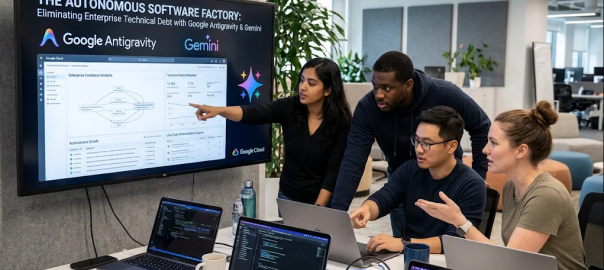
The Autonomous Software Factory: Eliminating Enterprise Technical Debt with Google Antigravity and Gemini

Sun, Nov 22 2026 /Mpelembe Media/ — Software engineering is undergoing a fundamental paradigm shift away from editor-centric autocompletion toward autonomous multi-agent software factories. Rather than relying on human developers to manually prompt tools line by line, this operational model deploys fleets of specialized artificial intelligence agents that independently plan, build, refactor, and test code across isolated branches before submitting verified pull requests for final human sign-off. This automation specifically targets the enterprise “maintainability gap” and systemic codebase degradation—exemplified by an 81% surge in duplicate code blocks across industry repositories—by systematically purging obsolete dependencies, removing dead code, and stripping unnecessary polyfills. Continue reading →

26Oct/26

Vibe Coding and the Slopsquatting Threat

Eulogy for the Syntax Coder: Architecting Code Quality, Supply Chain Security, and Human Taste in an Agentic World

Mon Oct. 26, 2026 /Mpelembe Media/ — The software engineering profession is undergoing a profound structural shift where manual code drafting, boilerplate execution, and routine syntax assembly are reaching technical obsolescence. Rather than destroying the discipline, generative AI and autonomous agentic workflows are elevating the role of the developer from a tactical syntax writer to a strategic director and systems curator. While informal “vibe coding”—building applications purely through conversational natural language prompts—accelerates initial prototyping, it relies on unverified outputs that frequently introduce subtle defects and structural brittleness. In contrast, professional “Agentic Engineering” treats multi-agent AI ensembles as execution engines that require continuous boundary definitions, formal specifications, and multi-layered verification pipelines to ensure production viability. Continue reading →