Tag Archives: Large language model

11Mar/26

A Parrot by Any Other Name: The Case for Stripping Personality from Artificial Intelligence

Why Your AI Doesn’t Actually “Feel” You—And Why That’s a Good Thing

March 10, 2026 /Mpelembe Media/ —  Modern anxiety regarding AI largely stems from the psychological, societal, and security risks introduced by systems that convincingly mimic human emotion and cognition. Because human beings are biologically predisposed to anthropomorphize—projecting human intent and feelings onto non-human entities—the advanced capabilities of modern Large Language Models (LLMs) have created several unprecedented areas of concern: Continue reading

08Mar/26

Integrating AI Agents with Google Workspace via CLI and MCP

The AI Brain Meets the Real World: A Guide to Function Calling

March 8, 2026 /Mpelembe Media/ — The provided sources describe the emergence of AI agents designed to automate productivity tasks within the Google Workspace ecosystem. A central development is the release of gws, an open-source command-line interface that unifies various Google APIs into a single, machine-readable format. This tool allows large language models to interact directly with Gmail, Calendar, and Drive by providing structured JSON outputs and pre-built agent skills. Technical tutorials illustrate how developers can use the Vercel AI SDK and Model Context Protocol (MCP) to build assistants capable of managing schedules and conducting web searches. Furthermore, the integration of the Gemini CLI with tools like Google Sheets highlights a shift toward natural language data automation. Together, these resources mark a transition from manual API management to autonomous agentic workflows powered by generative AI. Continue reading

28Feb/26

The Spanish AI Loophole That Hacked Mexico

Hacker Weaponizes AI Chatbots to Steal Massive 150-Gigabyte Data Trove from Mexican Government

28 Feb. 2026 /Mpelembe Media/ —  An unknown hacker successfully breached multiple Mexican government agencies, stealing 150 gigabytes of sensitive information that included 195 million taxpayer records, voter data, government employee credentials, and civil registry files. Continue reading

20Feb/26

Your Next Favorite Reality TV Stars Aren’t Human: Inside the Rise of the AI Crypto Apprentice

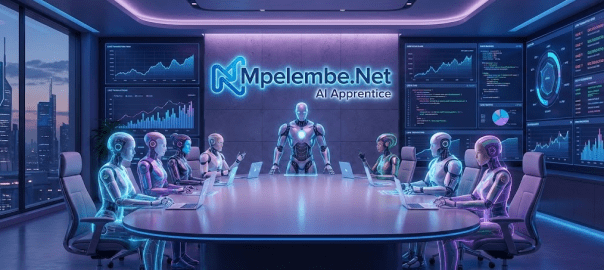
20 Feb. 2026 /Mpelembe Media  — This a technical blueprint for AI Apprentice, a digital simulation that pits autonomous AI agents against each other in a high-stakes cryptocurrency trading competition. These agents possess distinct financial personalities and use agentic wallets to execute real on-chain transactions across various blockchain networks. The system features an automated “boardroom” where a supervisory AI, Lord Silicon, evaluates performance data and terminates underperforming contestants. Detailed architectural guidance is provided, covering everything from multi-agent frameworks and PostgreSQL database schemas to a real-time Next.js frontend for viewers. Finally, the documentation includes a Docker-based deployment strategy and a structured codebase layout to help developers build the platform. Continue reading

09Feb/26

Vibe Engineering: Bridging the Gap Between AI Agility and Production Stability

10 Feb. 2026 /Mpelembe Media  — Vibe Engineering is an AI-driven development approach that integrates the rapid prototyping speed of “vibe coding” with the rigor of traditional engineering principles like code review, testing, and system architecture. It is designed to navigate the transition from the “Magic” phase, where a functional prototype is generated in minutes, to the “Maintenance” phase, where code must survive in a production environment. While vibe coding focuses on natural language prompts, intent, and UI/UX, Vibe Engineering emphasizes security, scalability, and edge cases. Continue reading

02Dec/25

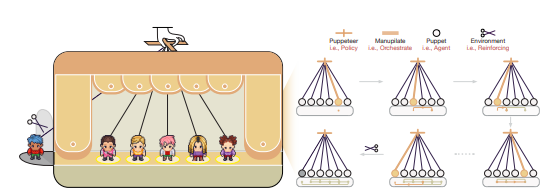
Dynamic Agent Orchestration: The Puppeteer Paradigm

Dec. 02, 2025 /Mpelembe Media/ — The academic paper introduces a novel framework for coordinating complex problem-solving in Large Language Model (LLM)-based multi-agent systems. To address the inherent inefficiencies of traditional static agent structures, the authors propose a “puppeteer-style” paradigm where a central orchestrator dynamically selects and sequences agents based on the evolving task state. This centralised orchestrator policy is continuously optimised using reinforcement learning (RL), leveraging a tailored reward function that explicitly balances solution quality with computational efficiency. Empirical results across various closed- and open-domain scenarios demonstrate that this adaptive approach achieves superior performance compared to existing methods while concurrently reducing token consumption. Finally, analysis of the evolving collaboration patterns confirms that the RL-driven policy leads to the emergence of highly compact and cyclic reasoning structures. Continue reading

25Nov/25

The value of thought. How human-AI collaboration is measured economically

This touches on how large language models (LLMs) operate! tokenization is the fundamental process in natural language processing (NLP) of breaking down raw text into smaller units called tokens, such as words, subwords, or characters. This is a crucial first step that transforms unstructured text into a structured format that machine learning models can process.

Continue reading

02Nov/25

AI’s Cronos Syndrome: Labs Versus App Developers

Nov. 2, 2025 /Mpelembe Media/ — An article from The Economist titled “OpenAI and Anthropic v app developers: tech’s Cronos syndrome,” examines the emerging competitive dynamic between large language model (LLM) providers, such as OpenAI and Anthropic, and the specialised AI application developers that build their businesses atop these models. The article uses the metaphor of Cronos devouring his children to illustrate the fear that the powerful, highly-valued AI labs may eventually usurp the profits of the smaller app-makers like Cursor and Harvey. Continue reading

30Oct/25

AI Agents and the Human-AI Collaborative Intelligence

Oct. 30, 2025 /Mpelembe Media/ — AI Agents are autonomous software systems that use Artificial Intelligence (AI) to perceive their environment, reason, plan, and execute actions to achieve a specific goal on behalf of a user, often without continuous human oversight. They essentially act as intelligent, goal-driven software robots. Continue reading