
The Cannabis Delusion: Why Weed Makes You Feel More Creative Than You Actually Are
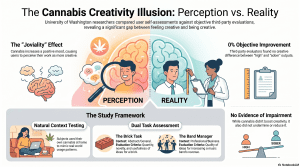
April 20, 2026 /Mpelembe Media/ — Christopher Barnes and his team investigated whether cannabis actually boosts creativity or if it merely alters perception. To navigate ethical restrictions, researchers had participants complete the study in their own homes using their own cannabis, testing them either within 15 minutes of consumption or after 12 hours of abstinence.
The researchers evaluated the participants’ ability to generate novel and useful ideas using two distinct methods: the abstract “brick task” and a practical “band manager” business scenario. The study revealed that cannabis induces a state of joviality, which leads users to overestimate the creativity of both their own ideas and those of others. However, when independent third-party evaluators assessed the results, they found no objective evidence that cannabis actually enhances creative output. Ultimately, while cannabis does not necessarily undermine a person’s effectiveness, the belief that it acts as a creative stimulant is largely a mood-driven illusion.
The “High” of Innovation: Why Your Best Ideas on Cannabis Might Be a Happy Illusion
For decades, the archetype of the “stoned artist” has dominated our cultural understanding of innovation. From the improvisational riffs of jazz legends to the counter-cultural ethos of Silicon Valley’s elite, cannabis is often romanticized as a chemical skeleton key capable of unlocking the doors of perception. This narrative suggests that a quick hit can dissolve cognitive rigidities, allowing the mind to wander into the fertile territory of genius. However, when we transition from the hazy lore of the studio to the clinical scrutiny of behavioral science, this shortcut to creativity begins to look more like a mirage.Christopher Barnes, a professor of organizational behavior at the University of Washington, has introduced a sobering perspective to this age-old debate. By applying rigorous psychological frameworks to the creative process, Barnes and his team discovered that the “spark” attributed to cannabis may actually be a case of chemically induced optimism. Their research indicates that while the substance undeniably alters the experience of creating, it leaves the actual quality of the output—the measurable metrics of innovation—entirely untouched.
The “Joviality” Effect: Why Everything Looks Better When You’re High
The crux of Barnes’ findings lies in a phenomenon he identifies as “joviality.” Through his research, it became clear that cannabis consistently functions as a potent mood-enhancer. This heightened affective state creates a significant perceptual bias: when users are in a better mood, their internal threshold for “excellence” drops. This “joviality” doesn’t just make the user feel better; it fundamentally skews their self-assessment, leading them to rate their own ideas as significantly more creative than they actually are.This bias isn’t confined to a narcissistic bubble; it extends to the user’s evaluation of the world at large. In a state of cannabis-induced joviality, subjects also perceived the work of others as more creative. Essentially, the drug creates a “rose-colored glasses” effect for the entire creative process. While this may make the act of creation more enjoyable, it suggests that the “brilliance” felt in the moment is a psychological byproduct of a pleasant mood rather than an objective increase in intellectual or artistic merit.
The Third-Party Reality Check: What the Judges Saw
The most significant takeaway for the modern professional is the “evaluation gap”—the stark disconnect between a creator’s internal confidence and the external reality of their work. While the cannabis-influenced participants were convinced they were experiencing a creative surge, objective, sober evaluators saw a completely different picture. This creates a potential “feedback vacuum” where a professional may operate with false confidence, producing work they believe is groundbreaking while their clients or managers see no improvement.When third-party judges—who were blind to the participants’ cannabis use—rated the results of the creative tasks, the perceived boost vanished entirely.”we did not find a relationship between cannabis use and that creativity, as rated by third-party evaluators.”For anyone using cannabis to gain a professional edge, this is a cautionary tale. The perceived genius of a high-concept idea often fails to survive the transition from the “jovial” mind to the objective marketplace.
The “Brick” vs. The “Band”: Testing Creativity in Context
To ensure these findings weren’t limited to a single type of thinking, the researchers utilized two distinct methodologies. They started with the “brick task,” an industry-standard test of divergent thinking where subjects list as many uses as possible for a brick. To provide a more robust “business relevant” analysis, they then implemented a “Band Manager” scenario. This task required both divergent and convergent thinking: participants had to generate ideas that were not only novel but also practically useful for increasing a band’s revenue.The study’s protocol was uniquely naturalistic. Because university ethics boards prohibited the researchers from distributing cannabis, they asked participants to use their own supply at home. This accounted for the “set and setting” often lost in sterile labs. Crucially, the team implemented a specific temporal window: subjects completed the tasks either within 15 minutes of their last use or after a minimum 12-hour period of abstinence. By coding responses for both “novelty” (originality) and “utility” (practical value), the researchers confirmed that cannabis failed to move the needle on either pillar of creativity, regardless of the task’s complexity.
Dispelling the “Brain Drain” Myth
While the research deconstructs the myth of the “stoned genius,” it simultaneously provides a defense against the trope of the “unproductive slacker.” A common refrain among critics is that cannabis is a cognitive poison that inevitably undermines effectiveness. Barnes’ data, however, found no evidence that the substance acts as a talent-killer or significantly impairs the ability to generate useful ideas.”on the other side, for people that would say that cannabis is just bad for your brain and undermines your effectiveness at everything, we would say we also did not find any evidence that cannabis undermines creativity.”The findings suggest that cannabis is essentially a neutral factor regarding objective output. It doesn’t elevate you to a higher plane of innovation, but it also doesn’t render you incapable of professional-grade thought. It is neither the secret ingredient nor the fundamental obstacle; it is simply a mood-altering variable.
The “Contingency” Caveat: Why Science Isn’t Finished Yet
Despite the clarity of these initial results, Barnes acknowledges that creativity is not a monolith. In the world of behavioral insights, we must account for “moderating variables”—factors that could potentially shift these outcomes in different directions. This study was an initial step, but it did not account for every possible nuance of the cannabis experience.Future longitudinal research will need to address several key contingencies:
- Strain and Dosage: The chemical ratio of THC to CBD and the specific “dose-response” curve could impact cognitive flexibility.
- Experience Levels: The neurochemical response of a seasoned consumer may differ vastly from that of a novice.
Task Specificity: Different “types” of creativity—such as visual arts versus mathematical problem-solving—might interact with the substance differently.As Barnes notes, we will only understand these nuances as “science marches on.”
Conclusion: A Final Thought for the Modern Creator
The data-driven reality of cannabis use in the workplace is that it serves as a potent mood-booster, not a talent-booster. For the modern creator, this research shifts the focus from the substance to the self. While the feeling of being “in the zone” is a desirable state, we must be careful not to mistake a chemically induced sense of satisfaction for a superior final product. In an era where workplace success depends on data-driven self-awareness, the most important question remains: Do you value the feeling of being creative, or the actual output you produce for the world to judge?