
Decoding the Film Production Lifecycle: A Comprehensive Guide to the Industry.
Sun, Aug 02 2026 /Mpelembe Media/ — The modern cinematic production pipeline is a complex lifecycle that transforms an initial concept into a finalized film ready for global audiences, fundamentally anchored by a rigorous development and legal phase. At the very inception of a project, securing intellectual property rights through option or purchase agreements is essential to establish a clean chain of title, which proves ownership and is mandatory for securing financing, insurance, and distribution. Filmmakers must navigate various funding models, from studio backing to independent equity or bank loans, often requiring detailed business plans or producer’s packages to attract capital. To mitigate risk for investors, productions frequently utilize completion bonds to guarantee a film will be finished on time and on budget, while Collection Account Management Agreements (CAMAs) are established to centralize the receipt, allocation, and disbursement of worldwide revenues according to a pre-negotiated recoupment waterfall.
Once financing is secured, the project enters pre-production, a highly logistical phase where the script is broken down to identify every required element, such as cast, locations, and props, for each scene. This breakdown directly informs the creation of a stripboard, a scheduling tool where scenes are reordered based on practical constraints like location availability, rather than chronological story order, to maximize efficiency and avoid paying for the same resources multiple times. From the stripboard, producers generate a Day Out of Days (DOOD) report, which serves as a vital grid tracking the exact working, traveling, or holding status of every cast member across the shoot. Accurately managing the DOOD is critical for adhering to union regulations and minimizing expensive “hold days,” ultimately dictating the daily call sheets and safeguarding the production’s budget.
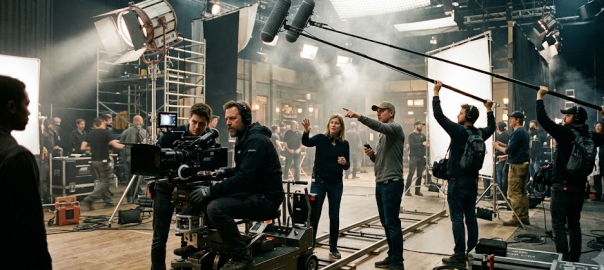
The production phase is where the planned vision is captured on camera, guided by the director and cinematographer’s choices in composition, lighting, and camera movement. In recent years, the traditional linear workflow has been profoundly disrupted by virtual production technologies, which blend physical sets with real-time rendered digital environments displayed on massive LED volumes. This innovation requires a Virtual Art Department (VAD) to design and pre-visualize assets early in the process, allowing filmmakers to capture complex visual effects in-camera, maintain perfect lighting continuity, and drastically reduce location shoots and post-production reshoots. Whether utilizing traditional methods or advanced LED volumes, disciplined daily tracking through production reports and diligent cost accounting are mandatory to ensure the film does not burn through its contingency funds before the final wrap.
Following principal photography, the post-production stage meticulously assembles the captured footage, intertwining editing, sound design, visual effects, and color grading. Sound design plays a crucial role in building the film’s auditory world through dialogue cleanup, foley, composed scores, and licensed music, all while maintaining strict loudness compliance standards. Simultaneously, colorists perform vital color correction and grading, increasingly mastering films in High Dynamic Range (HDR) formats like Dolby Vision before deriving Standard Dynamic Range (SDR) trims. A seamless handover from the editorial team via consolidated timelines and XML files is imperative for these finishing processes, culminating in a rigorous quality control (QC) review to catch any visual or audio anomalies before distribution.
The final pillar of the pipeline is distribution, where the finished film is packaged and delivered to theaters and streaming platforms. For theatrical exhibition, the industry standard is the Digital Cinema Package (DCP), a highly specific, often encrypted collection of MXF video and audio files alongside XML metadata that securely delivers the film to cinema servers. The strategic timing of these releases relies on theatrical windows, which maximize a film’s box office potential by keeping it exclusive to cinemas for several weeks before transitioning to premium video-on-demand (PVOD) or streaming platforms. Ultimately, successfully navigating this entire pipeline ensures that a creative vision not only reaches a global audience but also generates the financial returns required to sustain future cinematic endeavors.
The Architecture of the Blockbuster: Decoding the Secret Currency of Cinema
Introduction: The Invisible Machinery of Cinema
The world sees the glamour: the flashbulbs of a world premiere, the polished acceptance speeches, and the seamless magic of a final cut. To the casual observer, a movie is a creative miracle. To a senior industry analyst, however, a film is a “globally distributed commercial asset” built upon a ruthless foundation of logistics, legalese, and risk management. Behind every frame lies a complicated web of negotiations—an invisible machinery—that determines whether a story is ever allowed to reach a screen.Most people watch movies, but very few understand the secret currency that powers the trade. It is not just about the budget or the star power; it is about the rigorous technical reports like the “Day out of Days,” the legal armor of a “Chain of Title,” and the shifting windows of theatrical exclusivity. These are the mechanics that make and break careers long before the first ticket is sold.If you want to understand how a film actually gets made, you have to look past the actors and into the contracts. This is an initiation into the unfiltered world of the film business—where creative dreams collide with cold, hard paperwork.
Takeaway 1: You’re Not Selling Your Story, You’re Renting It (For Now)
In the high-stakes world of development, the most common transaction isn’t a sale; it’s a rental. Producers rarely buy a script or novel outright due to the high risk of a project failing to find financing. Instead, they use specific legal instruments to control the intellectual property:
- Option Agreements: A producer “rents” the exclusive rights for a set period, typically 12 to 24 months. For Writers Guild of America (WGA) signatory deals, the option fee is traditionally benchmarked at approximately 10% of the WGA minimum purchase price , whereas non-union independent deals typically command a flat fee of 1% to 3% of the purchase price.
- Purchase Agreements: If the producer secures financing, they “exercise” the option by paying the full, pre-negotiated price. Only then is ownership permanently transferred.
- Shopping Agreements: These grant a producer permission to pitch a work for a short window without an upfront fee. The writer retains complete ownership and veto power, but the producer risks losing the project if they can’t strike a deal quickly.Analysis: This system creates what is known as “Development Hell”—a state where projects linger in limbo for years. However, “reversion clauses” act as a vital safety net for writers. If a producer fails to secure financing before the option expires, the rights automatically revert to the original author, allowing them to take the story elsewhere.”If you don’t control the rights, you don’t control the story.” — Maya, industry agent
Takeaway 2: The Secret Codes of Performer Pay (The DOOD Report)
To bridge a shooting schedule with a talent budget, production offices use a “Day out of Days” (DOOD) report. This is a graph-like interface that maps every cast member’s contract status against the shooting calendar. It is the primary tool for calculating payroll and ensuring union compliance. The report uses specific codes that determine when an actor must be paid:
- SW (Start Work): The performer’s first paid day on set (includes rehearsals or fittings).
- W (Work): An active filming day.
- WF (Work Finish): The performer’s final scheduled day of photography.
- H (Hold): A paid idle day. The actor is not needed on set but is “on call.”Analysis: The “Hold” rule is often counter-intuitive. Under SAG-AFTRA rules, if an actor is scheduled for Day 5 and Day 9, the production must usually pay them for the days in between as “Holds.” While SAG rules allow holds for 10 or sometimes 14 days, savvy line producers use the “Drop-and-Pickup” rule: if there is a hiatus of seven or more days, the actor can be “dropped” (WD) and “picked up” later (PW). Crucially, a performer can only be dropped once per schedule , making the DOOD a ruthless exercise in mathematical optimization.
Takeaway 3: The Paperwork That Can Kill a Masterpiece (Chain of Title)
A film can be artistically perfect and yet remain unreleased if its “Chain of Title” is broken. This is the “invisible string” of documentation proving a production company has sole ownership of every element in the film. Without a “clean” title, distributors will refuse to touch a project, as it becomes impossible to secure Errors and Omissions (E&O) insurance.Essential documents for a clean title include:
- Option and Purchase Agreements for the script.
- Talent and Crew Agreements containing “Work-for-Hire” language.
- Quitclaims: Documents where previous contributors formally give up any claims to the work.
- Clearance Agreements: Releases for artwork, logos, and music.Analysis: A “gap” in the chain—such as a missing signature from a co-writer—can be catastrophic. For any transfer or assignment of copyright to be binding, it must be in writing and signed by the parties. Successful filmmakers treat this “writing requirement” as an existential priority, conducting copyright searches long before the cameras roll to ensure no third party can block the film’s release.
Takeaway 4: Why 30 Seconds of Silence is a Filmmaker’s Best Friend
One of the most overlooked aspects of production is the capture of “Room Tone”—30 to 60 seconds of silence recorded at every location. Because every space has a unique “sound signature,” this silence is the glue that allows sound editors to patch gaps in dialogue.Post-production sound follows a strict six-step workflow:
- Picture Lock: The edit is finalized; no further visual changes are made.
- Mastering Dialogue: Cleaning location audio using filters and equalization to remove humming, pops, and hisses, and utilizing ADR to re-record ruined lines.
- Sound Design: Creating and sourcing sound effects.
- Composition: Creating an original score tailored to the film’s “emotional cues.”
- Mixing: Balancing the volume levels of dialogue, music, and effects.
- Mastering (Sweetening): Fine-tuning the final soundtrack for enriched quality.Analysis: Sound is the most predictable way to add value to a project for very little money. While many directors focus on the “Foley” process—the “art of fiction” where artists perform footsteps or rustle clothing—the ultimate truth remains: you cannot fix lousy production audio in post.
Takeaway 5: The “Brain Bar” and the Death of the Linear Pipeline
Technology is fundamentally changing the filmmaking workflow. Traditionally, movies followed a linear “assembly line.” With the advent of Virtual Production (LED volumes), labor is shifting “upstream.” In this new paradigm, the Virtual Art Department (VAD) builds photorealistic 3D environments in game engines before a single actor steps on set. To ensure visual consistency, modern pipelines establish a color management strategy using ACES 1.3+ during pre-production.
Analysis: Central to this is Frustum Control . The “Inner Frustum” is the area the camera sees, rendered at maximum resolution. The “Outer Frustum” covers the rest of the LED wall; it is rendered at lower resolution and acts as a dynamic light source , projecting realistic ambient reflections onto the actors. This process is managed by the “Brain Bar”—a specialized workstation on set where engineers modify environments instantly, effectively performing “post-production” in real-time.
Takeaway 6: The 2026 Rebound of the Theatrical Window
The pandemic disrupted the “theatrical window”—the period a film plays exclusively in cinemas. During the “Pandemic Peak,” this window collapsed to 15–17 days. However, data from 2025 and projections for 2026 indicate a significant rebound.
- 2025 Market Realities: The window for wide releases rose to an average of 39 days . Remarkably, the “Top 10” hits of 2025 averaged 51 days for TVOD and often waited over 100 days before their SVOD debut.
- 2026/2027 Baseline: Major studios are moving back toward a 45-to-49-day exclusive run.Universal Pictures has formally committed to a five-weekend (35-day) minimum for 2026, expanding to a 49-day (seven-weekend) floor in 2027. Even tech giants like Amazon MGM are extending windows, inspired by the “120-Day Dream” of theatrical purists who argue that a film’s long-term downstream value is directly linked to its status as a theatrical “event.”
Conclusion: The Future of the Hustle
The film industry is evolving into a hybrid of high-stakes legal rigor and cutting-edge automation. As we look toward 2027, the use of Collection Account Management Agreements (CAMA) to automate Revenue Waterfalls will become standard, ensuring that financial contributors are repaid with algorithmic precision.While technology like ACES color management and Virtual Production shifts the creative burden to pre-production, the foundational need for a “clean” title remains absolute. In an age where stories are traded like stocks and environments are rendered in real-time, does the “auteur” still hold the power, or has the system finally become the lead actor?