
The Artemis II mission will conclude with a highly coordinated splashdown in the Pacific Ocean off the coast of San Diego, California, scheduled for Friday, April 10, 2026, at approximately 8:07 p.m. EDT.
April 9, 2026 /Mpelembe Media/ — The Descent and Parachute Sequence Returning from the Moon, the Orion spacecraft will slam into Earth’s atmosphere at a blistering 25,000 mph. After surviving intense reentry heat using its ablative heat shield, the capsule relies on a carefully choreographed sequence of 11 parachutes to reach a safe landing speed. After the forward bay cover is jettisoned, two 23-foot drogue parachutes deploy at 25,000 feet to slow and stabilize the spinning capsule. At 9,500 feet, three pilot parachutes are released, which pull out the three massive 116-foot main parachutes. These main chutes gracefully decelerate Orion from around 130 mph to a splashdown speed of just 17 mph.
Splashdown and Uprighting Upon impacting the water, the capsule is prone to flipping upside down into a “Stable 2” position, which would leave the astronauts hanging upside down and submerge the communication antennas. To counter this, the Crew Module Up-righting System (CMUS) activates within seconds. This system inflates five bright orange, high-pressure helium airbags on the top of the capsule, providing the buoyancy needed to force Orion into an upright orientation.
The Maritime Recovery Operation A joint NASA and U.S. Navy team will retrieve the crew using the USS John P. Murtha, a San Antonio-class amphibious transport dock ship equipped with a flooded well deck. Navy divers will approach the capsule in small boats, verify the surrounding air and water are safe, and help the four astronauts exit onto an inflatable raft called the “front porch”. From there, the crew will be hoisted into Sea Hawk helicopters and flown to the USS Murtha’s medical bay for evaluations. Finally, divers will attach tethers to Orion and tow the empty capsule directly into the ship’s well deck.
This entire splashdown procedure requires strict weather criteria to proceed safely: winds must be below 29 mph, waves under 6 feet, and there must be no rain or thunderstorms within 35 miles of the landing zone.
Moonbound: 5 Surprising Realities of the Historic Artemis II Mission
The 50-year wait is officially nearing its end. Not since Gene Cernan stepped off the lunar surface in 1972 has a human-rated spacecraft ventured beyond low Earth orbit, but on April 1, 2026, the silence of the deep-space frontier will be broken.Artemis II is not a mere nostalgic “repeat” of the Apollo era; it is a high-stakes engineering stress test. This 10-day mission will carry four astronauts around the Moon and back inside the Orion capsule—newly christened Integrity —to prove that NASA’s modern architecture can handle the rigors of deep space before we attempt a landing on Artemis III and an eventual multi-year transit to Mars. From record-shattering distances to counter-intuitive flight maneuvers, here are the five most surprising realities of our return to the Moon.
1. It Will Break a Record Held for Over Half a Century
While the Apollo missions were designed to enter specific lunar orbits for landing, Artemis II utilizes a “free-return trajectory.” This is a safety-first engineering choice: once the spacecraft is on this path, Earth’s and the Moon’s gravity act like a cosmic slingshot, naturally pulling Orion back home even if its main engines fail. Because this wide arc swings far behind the Moon’s mysterious far side, the crew—Commander Reid Wiseman, Pilot Victor Glover, and Mission Specialists Christina Koch and Jeremy Hansen—will travel farther from Earth than any humans in history.The mission will reach a maximum distance of 252,756 miles (406,771 km), eclipsing the legendary record set by the Apollo 13 crew in 1970. This flight also represents a massive cultural shift in exploration. Victor Glover will be the first person of color to go to the Moon, Christina Koch the first woman, and Jeremy Hansen the first non-U.S. citizen. Additionally, at age 50, Reid Wiseman will become the oldest person to travel into deep space.”During their lunar flyby, the crew set the record for human distance from Earth… breaking Apollo 13’s record of 248,655 miles. The Moon’s gravity essentially grabbed the spacecraft, bent its path, and redirected it back toward Earth.” — Harford County Astronomical Society
2. The Heat Shield “Gas Trap” Changed Everything
The road to Artemis II was paved with technical drama that nearly grounded the mission. After the uncrewed Artemis I flight in 2022, inspections of the Orion heat shield revealed “unexpected char loss”—chunks of the protective AVCOAT material had eroded in a way pre-flight models never predicted. NASA engineers discovered a terrifying root cause: gases were becoming trapped within the material during the manufacturing process. During the searing 5,000-degree heat of reentry, these gases expanded, causing the shield to crack and “spall” away.In a move that drew heavy criticism from some former astronauts and outside experts—and resulted in a heavily redacted NASA Inspector General report—engineers opted against a complete shield redesign for this flight. Instead, they made a critical operational pivot: they eliminated the “skip reentry” maneuver. Originally, Orion was meant to bounce off the atmosphere like a stone on a pond to dissipate energy. For Artemis II, Orion will perform a steeper, shorter descent to minimize the time spent in the peak thermal environment. It’s a calculated risk designed to keep the capsule’s underlying structure intact at the cost of higher G-loads on the crew.
3. The “Bang-Bang” Secret to Optimal Aerocapture
To enter the target orbit with surgical precision while saving fuel, Artemis II employs a “two-phase numerical predictor-corrector algorithm.” The centerpiece of this guidance system is a counter-intuitive “bang-bang control structure” for aerodynamic lift. Rather than maintaining a steady angle, the spacecraft’s flight computer will command Orion to fly with its maximum vertical lift pointed up, then abruptly switch to maximum vertical lift pointed down.This “bang-bang” method is a massive leap forward from the constant bank-angle models used in earlier designs. The technical benefits of this optimal guidance include:
- Propellant Savings: Reduces the fuel required for post-atmospheric orbital correction burns by up to two-thirds.
- Targeting Accuracy: Achieves a precise apoapsis (highest point of orbit) regardless of unpredictable atmospheric density.
- Robustness: Unlike older methods, this algorithm is adaptive, allowing the vehicle to maximize lift-up during the descent to keep the spacecraft from diving too deep, too fast.
4. High-Stakes Space “Tailgating” and Laser Comms
Early in the mission, Pilot Victor Glover will perform a proximity operations demonstration that looks a lot like space-faring tailgating. He will manually fly the 35,000-kg Orion spacecraft near the spent Interim Cryogenic Propulsion Stage (ICPS) to test handling qualities. This isn’t just for show; the crew will grade Orion’s performance using the Cooper-Harper rating scale. In this system, a “1” represents excellent handling, while a “10” indicates a major deficiency that could lead to a loss of control. Ensuring Orion can be hand-flown is vital for future missions that will require docking with the Lunar Gateway or the Starship HLS.While Glover is busy with manual flight, the spacecraft will be testing the O2O Optical Communications system. This laser-based link achieves downlink speeds of 260 megabits per second. To put that in perspective, traditional deep-space radio is like a dial-up connection that can barely handle a grainy photo; O2O is fast enough to stream 4K video from the vicinity of the Moon.
5. The “Scariest” Part: 8-9 Gs and a Pacific Splashdown
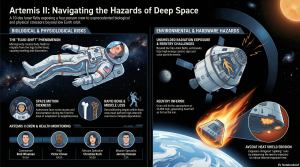
The final act of Artemis II is, in the words of mission planners, the “scariest” part. Reentry is essentially a 25,000 mph blunt-force trauma to the spacecraft. As Integrity slams into the atmosphere, the friction will generate a superheated plasma field reaching 3,000 degrees Fahrenheit, temporarily cutting off all communications. Because of the steeper descent profile chosen to protect the heat shield, the crew will be crushed into their seats by forces between 8 and 9 Gs.The recovery is a massive naval operation centered off the coast of San Diego. The USS John P. Murtha , an amphibious transport dock with a specialized “well deck,” will be waiting.“The public should not approach the landing area, partly because pieces of debris are expected to break off and fall into the sea during descent.” — NASA Official WarningOnce the five-airbag “uprighting system” ensures the capsule isn’t bobbing upside down, Navy divers from EODGRU-1 and MH-60S Sea Hawk helicopters from the HSC-23 squadron will move in. They will secure the capsule and track it with high-resolution imagery as the crew is extracted and flown to shore.
Conclusion: Beyond the Far Side
Artemis II is the bridge between the heritage of Apollo and the future of Mars. Every maneuver, from the proximity “tailgating” to the bang-bang aerocapture, validates the hardware needed for sustained human presence on the Moon. Perhaps the most vital data won’t come from the engines, but from the AVATAR payload. This “organ-on-a-chip” experiment will use human tissue analogs to study how deep-space radiation damages the body outside the protective shield of the Van Allen Belt.As we look toward the 2027 launch of Artemis III, we have to wonder: As we push the limits of human endurance and technical precision, will our biological systems be able to withstand the long-term radiation of the deep-space frontier?