The Inevitability of Regret: Socratic Wisdom in a World of Binary Choices
March 26, 2026 /Mpelembe Media/ — According to the teachings of the ancient Greek philosopher Socrates, the relationship between human choice and inevitable regret is rooted in the fact that no life path is perfect, and every decision involves compromises. Using the choice between marriage and celibacy as an example, Socrates noted that “let a man take whichever course, he will be sure to regret it” because human desires and circumstances inevitably change over time.
The Socratic Problem and Historical Accounts
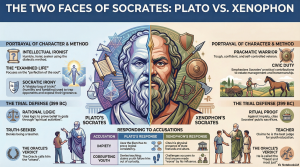
Socrates authored no texts, meaning his life and philosophies are entirely pieced together through the often contradictory accounts of his contemporaries, primarily Plato, Xenophon, and the playwright Aristophanes. This discrepancy has created what is known as the “Socratic problem”. Scholars continually debate whether Plato’s conceptually complex dialogues or Xenophon’s highly practical and historical depictions offer the most accurate portrait of the real Socrates.
Philosophy as a Way of Life
Socrates shifted the focus of ancient philosophy away from natural science and toward human ethics and moral conduct. He famously declared that “the unexamined life is not worth living,” emphasizing that true happiness (eudaimonia) derives from self-knowledge, inner virtue, and psychic harmony rather than external wealth, prestige, or power. He championed Socratic intellectualism by equating virtue with knowledge, arguing that no one commits wrong willingly and that all ethical failures essentially stem from ignorance.
Choice, Regret, and the Divine Sign
Socrates viewed human life as a series of trade-offs where every significant choice requires sacrificing competing values. This is encapsulated in his ironic advice regarding domestic life: whether you choose to marry or remain celibate, you will inevitably regret it. Socrates himself navigated life guided by a daimonion, a divine inner sign or voice. While Plato insists this voice was strictly apotreptic—meaning it only warned Socrates away from bad actions—Xenophon argues it was also protreptic, providing him with positive, proactive guidance.
The Socratic Method (Elenchus)
To help others realize the depths of their own ignorance, Socrates employed a rigorous dialectical method of questioning known as the elenchus. By asking probing questions, he exposed logical contradictions in his interlocutors’ beliefs, leading them into a state of aporia (profound puzzlement). While this method promoted intellectual humility and critical thinking, his use of Socratic irony—feigning ignorance while flattering and subsequently undermining supposedly wise authorities—frequently sparked anger and resentment among the Athenian elite.
Trial and Enduring Legacy
Socrates’ unapologetic pursuit of truth, his disruptive questioning, and his refusal to pander to political factions led to his trial in 399 BC on charges of impiety and corrupting the youth. During his trial, he remained defiant, refusing to beg for his life and even proposing that he be rewarded with free meals in the Prytaneum for his services to the city instead of being punished. Sentenced to death, he willingly drank poison hemlock rather than compromise his principles by fleeing into exile. His life and martyrdom laid the foundation of Western philosophy, heavily influencing subsequent traditions ranging from Stoicism to 19th-century existentialists like Søren Kierkegaard.
The Socratic Paradox of Choice: Why You’ll Regret Everything (and Why That’s a Good Thing)
1. Introduction: The Original Gadfly in the Age of Anxiety
In our modern era, we are haunted by the “dizziness of freedom”—a phrase Søren Kierkegaard used to describe the vertigo of absolute possibility. We stand in the metaphorical aisles of our lives, paralyzed by choice, terrified that selecting one path will irrevocably extinguish a thousand others. Yet this “contemporary” neurosis is actually a relic of the Athenian agora. It was Socrates, the barefoot “Father of Western Philosophy,” who first introduced this radical subjectivity into the human consciousness, stinging his fellow citizens like a gadfly until they were forced to confront the internal vacuum of their own certainties.Socrates left no writings, yet his life—and his state-sanctioned execution in 399 BC—remains the ultimate case study in the “examined life.” He didn’t promise a way to avoid the anxiety of decision-making; instead, he suggested that the vertigo is exactly where wisdom begins. By looking back at this original disruptor, we find that the key to navigating modern regret isn’t in making the “right” choice, but in understanding the structural necessity of the “wrong” one.
2. The Marriage Trap: Regret is Not a Bug, It’s a Feature
Socrates viewed regret not as a psychological failure, but as a structural reality of human existence. This perspective is best captured in his blunt advice to a young man torn between commitment and independence.”As to marriage or celibacy, let a man take which course he will, he will be sure to repent.”This isn’t mere cynicism; it is a profound observation on the “tyranny of binary choice.” Socrates recognized that human life is defined by trade-offs where the selection of one “good” (the companionship of marriage) necessitates the loss of another (the autonomy of the single state). To Socrates, “repentance” is the natural friction of a mind awake to its own limitations. He even famously added a witty consolation for those brave enough to wed: “By all means, marry. If you get a good wife, you’ll become happy; if you get a bad one, you’ll become a philosopher.”Socrates lived this radical realism. He was married to Xanthippe—traditionally portrayed as a “nagging shrew”—and possibly to a second wife, Myrto, during a period when Athens allegedly passed a bigamy law to increase its dwindling population. Rather than lamenting his domestic strife, Socrates claimed that if he could endure Xanthippe, he could “easily get on with the rest of the world.” For him, the “bad” marriage wasn’t a mistake to be regretted, but the very training ground for his virtue.
3. The Two Socrates: Truth is a Matter of Perspective
To understand the Socratic project, one must navigate the “Socratic Problem”: the jarring discrepancies between the accounts of his two primary biographers, Plato and Xenophon. Their records of his trial defense, or Apology , act as mirrors for their own priorities, creating an intellectual friction that forces us to choose which Socrates we believe.The contradictions are not minor; they are fundamental to his identity:
Plato’s Philosophical Ironist:
Strategy: Employs the dialectic; claims a “divine mission” from the Oracle of Delphi to seek definitions of virtue.
The Teacher Charge: Categorically denies being a teacher: “I have never been anyone’s teacher.”
Tone: Humble, ironic, and suspended between the world and the absolute.
Xenophon’s Practical Warrior:
Strategy: Aggressive and “smug”; focuses on his “tough character,” physical sacrifices at state festivals, and history of military duty.
The Teacher Charge: Boasts of his role in education, claiming to be the “best judge about… the greatest good for men.”
Tone: Prudent and patriotic; perhaps seeking death deliberately to avoid the decline of old age.
4. The Radical “Watchdog”: Disrupting Family Values
In Book 5 of The Republic , Socrates moves from questioning individuals to disrupting the entire social fabric. He proposes the “nationalization of the family,” arguing that private loyalties are the root of corruption. To maximize political unity, he suggests a world where children are raised by the state and parents do not know their own offspring—a proposal that includes a “state eugenics program” jarringly disguised as a religious festival.To justify including women in the upper echelons of this society, Socrates uses the metaphor of the female watchdog . He asks if we expect female dogs to stay inside and “make puppies” while the males hunt. Since female dogs hunt and guard alongside the males, he concludes that human women must be trained in gymnastics, poetry, and war. These ideas make Socrates appear simultaneously like a radical feminist—advocating for meritocracy over gender—and a terrifying fascist, prioritizing state efficiency over the most intimate human bonds.
5. The Intellectualist Twist: Why “Evil” is Just a Cognitive Error
Perhaps the most counter-intuitive Socratic claim is that “no one does wrong willingly.” This concept of Socratic Intellectualism posits that we always act in accordance with what we believe, at that moment, will benefit us. Therefore, what we call “evil” or a “bad choice” is actually a cognitive error—a failure of the Nous , the immortal part of the soul that is the site of true well-being.In this framework, moral failure is replaced by the “therapeutic model”:
Injustice as Self-Harm: The “unjust” person is most to be pitied because they have caused the “foulest evil” to their own soul. Injustice produces internal pain and discord that material wealth cannot soothe.
Denial of “Weak Will”: Socrates argued that if a person truly knew the “Good,” they would be unable to act against it.
Pity, Not Vengeance: Since wrongdoing is ignorance, the criminal should be instructed rather than merely punished. Their “wickedness” is a miscalculation of their own happiness.
6. The Midwifery of Puzzlement: The Goal is Not to Know
Socrates famously described his method as maieutikós , or midwifery . He claimed to have no wisdom of his own to “give,” but acted as a guide to help others “give birth” to their own understanding—often by first stripping away their false certainties ( doxa ).This process of Elenchus (cross-examination) is designed to lead the partner into Aporia —a state of profound puzzlement. While frustrating, Socrates viewed Aporia as an “improved state.” It is a cleansing of the soul, a clearing of the “arrogances of popular opinion.”Interestingly, this method survives in modern pop culture through the “fumbling and stumbling” technique of Lieutenant Columbo. Much like the detective who uses a “shopworn bag of tricks” and “homey anecdotes” to lure villains into a false sense of superiority, Socratic irony involves a “qualification of subjectivity.” Socrates plays the fool, flattering his hearer while meticulously hunting for the “jugular”—the internal contradiction that reveals their ignorance.
7. Conclusion: The Wisdom of the Hemlock
The “examined life” is not a destination where regret vanishes or choices become easy; it is a mode of travel where we use our inevitable regrets as data points for soul-building. Socrates’ calm acceptance of the hemlock demonstrated his ultimate conviction: that while external circumstances may fail us, the health of the “just soul” remains within our control.We must navigate the tension between action and reflection. As the playwright George Furth famously countered: “The unlived life is not worth examining.” This is the modern Socratic challenge. We cannot simply sit in a room and think; we must live, choose, and “repent” our choices, using that very regret to refine our understanding of the Good. The “dizziness of freedom” is not a sign of failure, but proof that we are awake.“Life without examination is not worth living.”