Why the “Money Printer Goes Brrr”: The Ancient Roots of Modern Inflation
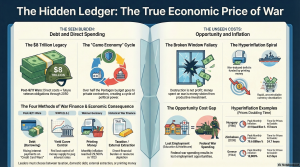
- The Broken Window Fallacy: Coined by Frédéric Bastiat, this parable illustrates that while spending money to repair destruction (like a broken window or war damage) generates visible economic activity for specific trades, it ignores the unseen opportunity costs. The resources used for repair or war could have been invested in productive, wealth-creating activities instead.
- Military Keynesianism: This is the debated theory that government spending on the military can effectively stimulate a domestic economy. However, economic analyses demonstrate that prioritizing defense spending over civilian infrastructure or education often weakens the civilian economy, diverts resources, and ultimately hinders long-term economic growth and employment.
These documents explore the mechanics and historical consequences of extreme monetary instability and government efforts to manipulate interest rates. The first source provides an extensive analysis of hyperinflation, defining it as a rapid erosion of currency value typically triggered by government budget deficits and excessive money creation. It details various global crises, such as those in Weimar Germany, Hungary, and Zimbabwe, where prices doubled in hours and local currencies eventually collapsed. The second source examines a specific era of yield curve control in the United States between 1942 and 1951, during which the Federal Reserve pegged interest rates to manage World War II debt. This policy gave the government stable financing but ultimately caused the central bank to lose control over its own balance sheet. Together, the texts illustrate how state-driven financial interventions can stabilize war-time economies or, if mismanaged, lead to total monetary failure.
In the world of economics, inflation is a common concept—it is the gradual rise in prices over time. However, there is a threshold where inflation stops being a manageable byproduct of growth and transforms into a destructive force known as hyperinflation . This guide explores how these economic spirals begin, the mechanics that drive them, and why they represent a total breakdown of the social contract between a state and its citizens.
1. The “50 Per Cent” Threshold: Defining the Extreme
While the public often uses “hyperinflation” to describe any period of high prices, economists rely on a specific mathematical benchmark to distinguish “high inflation” from a true currency collapse. Established by Columbia University professor Phillip Cagan in 1956, this standard provides a formal boundary for academic and policy study.The Cagan Standard A hyperinflationary episode officially begins in the month that the monthly inflation rate exceeds 50% . This compounds to a staggering 12,874.63% annual rate. The episode is only considered “over” when the monthly rate drops below 50% and remains there for at least one full year.A formal definition is vital because the remedies for “high inflation” (usually minor interest rate adjustments) are insufficient for “hyperinflation.” Crossing the 50% threshold signals that the currency has ceased to function as a reliable store of value; it is no longer money in the functional sense, but a hot potato that every citizen is desperate to discard.Transition: While the 50% rule describes the speed of the collapse, the underlying engine is a massive imbalance between the supply of money and the supply of goods.
2. The Engine of Devaluation: Money vs. Goods
According to Monetarist theories, hyperinflation occurs when the amount of money in circulation increases rapidly without a corresponding growth in the output of goods and services. Simply put: when too many units of currency chase too few items of real value, prices must rise to clear the market.This process is accelerated by the Velocity of Money . As citizens realize their cash is losing value by the hour, they rush to spend it immediately on “hard” assets (gold, foreign currency, or even basic commodities like grain). This frantic spending increases the “velocity” of circulation, which causes prices to rise even faster than the government can physically print new banknotes.| Feature | Normal Inflation | Hyperinflation || —— | —— | —— || Price Stability | Prices are predictable; changes are noticed over years. | Prices rise continuously, often doubling in days or hours. || Consumer Behavior | People save money in banks and plan for the future. | People spend cash immediately to avoid losing purchasing power. || Currency Value | The local currency is a trusted store of value. | The currency becomes “anathema to investment”; people flee to foreign cash. |
The “So What?”: The fundamental lesson for any learner is the Scarcity Principle . Money is only valuable if it is scarce relative to the things you can buy with it. When a government makes money as overabundant as wastepaper, the market treats it as wastepaper.Transition: If printing money leads to such obvious destruction, why would a government choose to do it?
3. The Government’s Dilemma: Why the Presses Start Rolling
Hyperinflation is rarely the result of a simple “mistake.” It is usually the result of a government facing an existential crisis—such as war or total social upheaval—with no good way to pay for it. Research into the “Political Economy of War Finance” identifies four primary ways a state can fund a crisis:
- Taxation: The most stable method, but it requires high bureaucratic capacity (the ability to collect) and public support.
- Domestic Debt: Selling bonds to citizens, which requires high public trust in future repayment.
- External Extraction: Borrowing from foreign nations, which risks dependency and outside influence.
- Printing (Seigniorage): Known as the “inflation tax,” this is a less overt way to fund a deficit by creating new currency.Governments with low bureaucratic capacity often default to printing money because it is the path of least resistance. To delay a total collapse, some governments attempt Yield Curve Control (YCC) . For example, the U.S. Federal Reserve pegged short-term T-bills at 3/8% between 1942 and 1951 to help the Treasury finance war debt cheaply. Hyperinflation often begins when these “caps” fail—when the government loses control over the bond market and can no longer find willing lenders, leaving the printing press as the only remaining tool for survival.Transition: Once the government relies on the press to fund its daily operations, it enters a feedback loop known as the “vicious circle.”
4. The Vicious Circle: A Step-by-Step Collapse
The transition into hyperinflation is a self-reinforcing process that eventually escapes the control of central bankers.The Anatomy of a Spiral
- The Deficit: The government spends more than it collects and cannot find lenders.
- Monetization: The government prints new money to pay for immediate needs like military or civil salaries.
- The Price Shock: The influx of cash causes prices to rise, reducing the public’s purchasing power.
- Revenue Erosion: Because of the “time gap” between when a tax is levied and when it is collected, the tax revenue loses most of its real value before it reaches the Treasury.
- Hyper-Printing: Forced to cover an even larger real deficit, the government prints exponentially more money, accelerating the cycle.A critical tipping point is reached when the “real stock of money” (the total cash in the economy divided by the price level) actually decreases. This happens because prices are rising faster than the government can physically print and distribute new bills.Transition: This theoretical loop has manifested in some of the most extreme physical realities in history.
5. History’s Heavy Hitters: Case Studies in Currency Collapse
The following cases illustrate how quickly a modern economy can disintegrate when the currency loses its function as a medium of exchange.| Country | Peak Monthly Rate | Daily Doubling Time | Iconic Symptom / Trigger || —— | —— | —— | —— || Hungary (1946) | 41.9 Quadrillion % | 15.3 Hours | 100 quintillion pengő note; triggered by post-WWII instability. || Zimbabwe (2008) | 79.6 Billion % | 24.7 Hours | 100 trillion dollar notes; triggered by failed land reform and corruption. || Germany (1923) | 29,525 % | 3.7 Days | Banknotes used as wallpaper or fuel; triggered by war reparations. |
In each of these cases, the local currency became so worthless that people reverted to bartering or used stable foreign currencies to survive. Once a currency reaches this state, only “Shock Therapy” can restore order.Transition: Ending the bleeding requires a return to the basic principles of economic trust and scarcity.
6. The “Shock Therapy”: How Hyperinflation Ends
To stop the spiral, a government must convince the public that the currency will be scarce again. This requires a combination of structural and cosmetic changes.
- Orthodox Solutions: These include Dollarization (formally adopting a foreign currency like the U.S. Dollar) or implementing strict Capital Controls to stop money from fleeing the country.
- Redenomination: Governments often “cut zeros” off their bills (e.g., a million “Old Pesos” becomes one “New Peso”).However, we must apply the logic of the French economist Frédéric Bastiat and his Parable of the Broken Window . Bastiat taught us to distinguish between the “Seen” and the “Unseen.”A currency redenomination is the Seen —a new, clean banknote with fewer zeros. But the Unseen is what actually matters: the restoration of the central bank’s independence, the slashing of government expenditures, and the rebuilding of public trust. As Bastiat argued, destruction is not profit. Every dollar printed to fund a crisis is a dollar of wealth “uselessly destroyed” because it represents a foregone opportunity for productive investment. Without structural reform, a new currency is merely a “face lift” on a dying system.
7. Final Summary: The Learner’s Cheat Sheet
To master the concept of hyperinflation, internalize these three mental models:
- The Scarcity Principle: Money is a tool for exchange that relies on limited supply. When it becomes as common as paper, the market will treat it as paper, destroying its value.
- The Trust Factor: Currency is a social contract. Hyperinflation is the physical manifestation of a population losing faith in the government’s ability to manage its budget and honor its debts.
- The Opportunity Cost of War: Every unit of currency created to fund destruction (war) has an unseen cost : the foregone opportunity of public spending on infrastructure, education, and the long-term stock of national wealth. Hyperinflation is the final bill for these choices.