Mon, Jun 01 2026 /Mpelembe Media/ — The climax at Sad Hill Cemetery represents the literalization of the American quest as a “field of death.” The quest for the American Dream—represented by the buried Confederate gold—ends in a “hallucinatory finale” where thousands of graves serve as the backdrop for a final shootout. The cemetery is not a place of rest, but a site of ritualistic greed.The “Mexican Standoff” between the trio uses the geometry of the triangle to illustrate the final game of capitalism. Semiotically, Leone contrasts the grotesque, extreme close-ups of the three individuals with sweeping long shots of the anonymous mass of graves. This shift illustrates the movement from individual myth to the crushing, crowded reality of history. It is a ritual where the outcome is determined not by morality, but by the precarious and cynical nature of success.
Blondie’s final act—leaving Tuco with his share of the gold but in a position of mortal peril—underscores the instability of the capitalist victory. Success is never absolute; it is a temporary reprieve that leaves the victor cynical and the loser in jeopardy. Leone’s “sensationalist oater” successfully fractured the romanticized Western fantasy. By exposing the systemic violence behind the American foundational myth, Leone did not repair the fractured psyche of a nation; instead, he exposed the “brutal reality” that the romanticized myth was designed to hide. The film leaves the audience at the grave of the American Dream, where the only prize is gold found among the dead.
Political Undertones and the Critique of Capitalism Far from a traditional, romanticized American Western, Leone’s film is widely analyzed as a bleak, politically charged deconstruction of the frontier myth. The film portrays a Hobbesian environment driven by “caveman capitalism,” where death is treated as a transactional commodity and human life has no inherent value. In this world, traditional authorities and the state are depicted not as purveyors of liberty, but as engines of corruption, torture, and absurd mass slaughter—most notably through the devastating backdrop of the American Civil War, which the film treats as an industrial holocaust driven by greed.
The Pathos of Tuco and the “Cave Philosophy” While Blondie (The Good) and Angel Eyes (The Bad) are presented as stoic, mythic ciphers driven purely by financial accumulation and professional violence, Tuco (The Ugly) emerges as the film’s true emotional core and a representation of the struggling proletariat. His criminality is born out of colonial subjugation and a desperate need to survive poverty, a fact heavily emphasized by his frantic, recurring pursuit of food and a tragic confrontation with his priest brother.
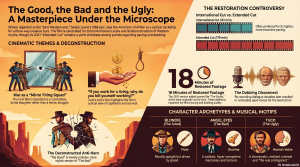
Tuco’s dialogue in the controversial “Il Grotto” scene—”If you work for a living, why do you kill yourself working?”—serves as the intellectual anchor of the film. Modern scholars, bloggers, and audiences celebrate this line as a devastating existential critique of capitalist exploitation and the modern “hustle culture”. Tuco recognizes the paradox of the working class: destroying one’s physical life in the exhausting pursuit of the wages required to merely sustain it. This philosophy has permeated modern pop culture, directly inspiring episode titles in shows like Weeds, characters in Breaking Bad, and even critiques of the modern cryptocurrency “get-rich-quick” mindset.
The “Extended Cut” Controversy The film’s editorial history remains highly debated among cinephiles. In 2003, MGM funded a restoration that added roughly 18 minutes of footage originally excised from the international theatrical release. While scenes like “Il Grotto” and Angel Eyes’ visit to a ruined Confederate fort repair massive narrative plot holes and amplify the film’s anti-war themes, many purists argue the additions damage the film. Critics note that these scenes halt the escalating, mythic pacing of the narrative and suffer from highly distracting audio, as they required the elderly Clint Eastwood and Eli Wallach to record new dubs nearly 40 years after filming. Recent definitive home video releases, such as the Arrow Video 4K UHD, resolve this by utilizing seamless branching, allowing viewers to choose between the taut 162-minute International Cut and various permutations of the Extended Cut.
Morricone’s Score and Cinematic Legacy Ennio Morricone’s legendary score is frequently highlighted for its brilliant, unconventional orchestration—utilizing coyote howls, electric guitars, and Edda Dell’Orso’s sweeping vocals in “The Ecstasy of Gold” to elevate the film’s tension to operatic heights. Combined with Leone’s visual mastery, the film has cemented a monumental legacy, inspiring decades of Neo-Westerns and remaining a touchstone for how cinema can seamlessly blend high-stakes entertainment with deep socioeconomic cynicism.
The Ugly Protagonist: How Sergio Leone Subverted the American Myth through a Mirror Firing Squad
1. Introduction: The Spaghetti Western That Refused to Stay in its Grave
For over half a century, Sergio Leone’s The Good, the Bad and the Ugly has occupied a permanent seat in the pantheon of cinema, consistently ranking among the top five films of all time on IMDb. To the casual viewer, it is the quintessential Spaghetti Western: a sprawling tale of three men chasing $200,000 in Confederate gold across a war-torn landscape. However, beneath the iconic ponchos and the smoke of Remington revolvers lies a “hidden” movie—a deeply cynical, Homeric epic that deconstructs the very myths it appears to celebrate. Through various restorations and “extended cuts,” the film has revealed itself to be less about a treasure hunt and more about a brutal critique of humanity and history, rendered with a visual language of Techniscope and operatic scale.
2. The “Ugly” Truth: Why Tuco is the Film’s Secret Protagonist
While Clint Eastwood’s “Blondie” provided the face for the franchise, Eli Wallach’s Tuco Ramírez is the undeniable heart of the narrative. Tuco is the only character granted a fully realized personal history, most notably in the poignant sequence where he confronts his brother, Father Pablo, at a monastery.In a landscape populated by mythic abstractions, Tuco represents “gross, concupiscent humanity.” The “Good” and “Bad” characters are stylized archetypes, but Tuco’s motivations—hunger, greed, and survival—are grounded in the visceral reality of a man living on the margins. Despite a rap sheet that includes everything from arson to “intended slave trading,” Tuco remains the audience’s only real bridge to humanity. The film’s ultimate tension does not rest on the gold, but on a moral question: Is Tuco “barely good enough” to live, or is he “evil enough” to deserve the gallows?As the source context reflects on Tuco’s role as the central axis:”It’s too bad he did all that raping and murdering, otherwise he’s kinda enduring… Tuco is the star of the movie. The movie happens around him mostly.”
3. The Morality of a Cigar: Why “The Good” Isn’t Actually Good
The film’s title is famously ironic. Blondie, labeled “The Good,” is an anti-hero whose morality is a matter of style rather than substance. His primary income is derived from a systematic reward-collecting scam: he captures Tuco, collects the bounty, and then shoots the rope to rescue him so they can repeat the process in the next town.In Leone’s world, “Good” is a relative term used to describe the most efficient scavenger. Blondie’s humanity only surfaces in fleeting, unsentimental moments, such as when he offers Tuco a cigar after the latter’s painful encounter with his brother. This gesture acts as a symbol of “brotherhood” between two men who are essentially the same—greedy scavengers navigating a world of slaughter.”Good embodies a systematic defiance and humiliation of the law, inhuman greed, betrayal and attempted sadistic murder… He was the most morally upright only by comparison.”
4. War as a Mirror: The Civil War is the Film’s Most Brutal Character
Leone decontextualizes the American Civil War, stripping it of its traditional Hollywood heroics. It is not presented as a noble struggle for abolition or union, but as a “great crime” that dwarfs the “petty crimes” of the three protagonists. To Leone, “Progress” is nothing more than a “mass slaughter”—a “mirror firing squad” that sears the land.The film makes shocking visual parallels between the Betterville POW camp and 20th-century history. The presence of a prisoners’ orchestra—forced to play music to drown out the screams of those being tortured by Angel Eyes—deliberately evokes the horrors of Nazi concentration camps. The trio largely ignores the war’s carnage, viewing it as a mere obstacle to be navigated, most notably during the bridge sequence where they destroy a strategic military target simply because it stands between them and the gold.
5. The Restoration Trap: Why More Footage Isn’t Always Better
The 2003 “Extended Cut” added 18 minutes of footage, attempting to recreate the original Rome premiere version. However, this restoration remains a point of contention. Purists often prefer the “International Cut” approved by Leone, which is celebrated for its economical storytelling.A major point of criticism is the “Grotto” (or chicken) scene. While it explains where Tuco’s henchmen originated, critics find it “visually flat” and “wretched,” lacking the dynamism and visual geometry typical of Leone’s montage. Furthermore, the 2003 dubbing is highly jarring; Eastwood and Wallach, then in their 70s and 80s respectively, had to re-voice scenes filmed decades earlier. The lip-sync quality is noticeably inferior, and the use of Simon Prescott to imitate the late Lee Van Cleef creates a “vocal imitator” effect that breaks the immersion.Beyond what was added, cinephile historians still chase the “Holy Grail” of lost footage: the “Socorro” sequence. This legendary scene featured Eastwood in bed with actress Silvana Bacci. Its loss—reportedly stolen or destroyed—preserves the “Man with No Name’s” mystery, as it remains one of the few instances where the character was intended to be seen in a vulnerable, domestic context.The Extended Cut: A Technical Balance Sheet
- Pros:
-
- Deepens the character of Angel Eyes, showing a more “thoughtful” side at the ruined fort.
- Accentuates the melancholy of the Civil War’s waste.
- Resolves minor continuity gaps regarding Tuco’s associates.
- Cons:
- Sonic Discontinuity: Jarring vocal contrast between 1966 and 2003 recordings.
- Aesthetic Flatness: The “Grotto” scene lacks Leone’s signature “deep depth of field” and kinetic editing.
- Pacing Issues: The “International Cut” is considered more “thrilling” and “fleet” without the added chaff.
6. The Music of the Ocarina: Morricone’s Auditory DNA
Ennio Morricone’s score is inseparable from the film’s identity. The composer used character-specific instrumentation to create a musical “DNA” for the trio:
- The Flute: Blondie (The Good).
- The Ocarina: Angel Eyes (The Bad), imitating a howling coyote.
- Human Voices: Tuco (The Ugly).The score reaches its zenith with “The Ecstasy of Gold,” featuring the sublime soprano of Edda Dell’Orso . Morricone himself noted the difficulty of synchronizing the music to the “spiraling” camera work as Tuco sprints through Sad Hill. While the music is transcendent, the Extended Cut has been criticized for “clumsy” musical edits, particularly regarding the “Carriage of the Spirits” theme, which lacks the meticulous synchronization Leone demanded in his approved cuts.
7. Conclusion: A Grave with No Gold
Ultimately, The Good, the Bad and the Ugly transcends the “Spaghetti Western” label to become a Homeric “ancient epic.” It is a journey through a field of death where the quest for capital is inextricably equated with the grave. As modern cinema moves further away from the era of Leone’s mythic drive, we are left to wonder if we still possess the capacity to create archetypes that outlast history itself. Leone’s masterpiece suggests that while the gold may be found, the “Good,” the “Bad,” and the “Ugly” within the human spirit are the only things that truly never stay in the grave.