The 2026 US-Iran Interim Peace Agreement and Its Fallout
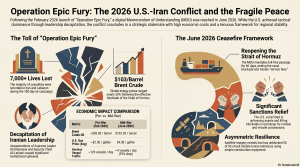
Wed, Jun 17 2026 /Mpelembe Media/ — In June 2026, the United States, under the Trump administration, and Iran agreed to an interim peace deal to halt a devastating four-month conflict that began in February. While the White House has attempted to frame the ceasefire as a victory that will reopen the Strait of Hormuz, geopolitical analysts and international media overwhelmingly characterize the war as one of the greatest strategic blunders in modern US history. The conflict cost the US an estimated $30 billion, resulted in the loss of advanced military hardware, and caused over 7,000 deaths, primarily in Iran and Lebanon.
A Strategic Defeat and the “Five Nos” The US and Israel launched “Operation Epic Fury” with sweeping goals, but the military campaign failed to achieve its primary objectives, leaving analysts to summarize the failure through “five big nos”:
- No to destroying the nuclear program: Iran’s highly enriched uranium stockpiles and enrichment facilities remain intact, with discussions deferred to future negotiations.
- No to regime change: High-profile decapitation strikes failed to collapse the clerical establishment; instead, deceased commanders were replaced by even more hardline figures.
- No to destroying the missile arsenal: Despite intense US and Israeli bombing of tunnel entrances, Iran used simple construction equipment like bulldozers to unblock 50 of 69 entrances. US intelligence estimates that 70% of Iran’s ballistic missile stockpile remains fully serviceable.
- No to domestic uprising: The intense bombing did not trigger a revolution but instead fueled defensive nationalism, uniting the Iranian public against external aggression.
- No to reining in proxies: The bilateral US-Iran deal entirely excluded Iran’s regional proxy networks, leaving groups like Hezbollah fully operational.
Furthermore, the reopening of the Strait of Hormuz—a central pillar of the peace deal—merely restores the pre-war status quo, as the waterway was open before the US and Israel initiated the conflict. Iran successfully proved it could unilaterally choke off 20% of the world’s energy supply, gaining unprecedented long-term leverage over global commerce.
Domestic Crisis and the “Suez Moment” The rushed peace agreement was largely driven by an unsustainable domestic crisis in the United States. The disruption of energy markets caused retail gas prices to spike to an average of $4.56 per gallon, while core inflation surged to 2.9%. The federal debt surpassed 100% of GDP, and the economic strain triggered massive labor strikes across the auto, rail, and meatpacking industries. Fearing a devastating loss in the upcoming midterm elections, Donald Trump was forced to seek a diplomatic off-ramp, a failure that has triggered erratic, vindictive behavior and a personal political crisis for the president. Globally, the war is being viewed as America’s “Suez moment”—a devastating exposure of the limits of US military power that has accelerated imperial decline and benefited peer competitors like China.
Israel’s Defiance and Backlash The US-Iran agreement has caused a profound strategic rift with Israel. Israeli officials are furious that the deal leaves Iran’s nuclear and ballistic capabilities intact and does not apply to Iranian proxies. In response, Defense Minister Israel Katz stated that Israeli forces will remain in occupied parts of Lebanon, Syria, and Gaza indefinitely, vowing to destroy terror infrastructure above and below ground. Prime Minister Benjamin Netanyahu is facing intense domestic criticism from both his right-wing coalition partners, who say the deal does not bind Israel, and opposition leaders who accuse him of presiding over the greatest strategic failure in Israel’s history.
The Bulldozer Peace: How Washington’s “Total Victory” Became a $25 Billion Retreat
When “Operation Epic Fury” was unleashed on February 28, 2026, the air over the Potomac was thick with a particular brand of Washington braggadocio. Secretary of War Pete Hegseth heralded the most “lethal air power campaign in history,” a conflict with “no stupid rules of engagement” designed to force Tehran into an “unconditional surrender.” Yet, four months later, the “Islamabad memorandum” has revealed the staggering chasm between that initial rhetoric and the grinding reality of tactical exhaustion. Far from a “Golden Age,” the ceasefire looks like a strategic stalemate—a $25 billion retreat disguised as a breakthrough. In the gap between the pyrotechnics of decapitation strikes and the cold calculus of the status quo, the true costs of this strategic mirage are finally coming to light.
The “Bulldozer” Defense: Why High-Tech Bombing Failed
The central irony of the conflict lies in the mismatch of tools: the United States and Israel expended millions in precision-guided munitions to “entomb” Iran’s missile arsenal, only to be defeated by the strategic equivalent of a garden shovel. Using million-dollar bunker-busters, the coalition struck 69 tunnel entrances at 18 facilities, including key sites at Dezful, Isfahan, and Kermanshah. The intent was to bury the Iranian threat under mountains of rubble.However, Tehran’s response was primitive and effective. Utilizing simple earthmoving equipment—bulldozers and dump trucks—Iranian crews excavated the damage at great peril while under fire. Satellite imagery confirms that 50 of those 69 entrances have already been reopened. At sites like Dezful, craters were filled and roads repaved within weeks, leaving the missile crews mission-ready despite the high-tech onslaught.”The US military is good at delivering tactical successes, and entombing and suppressing the Iranian missile force is a great example of that,” says Sam Lair, a research associate at the James Martin Center for Nonproliferation Studies. “However, if that isn’t accompanied by a set of reasonable strategic war aims and an achievable theory of victory, it can end up being a strategic failure.”
The Selective Blockade: A Wedge Between Partners
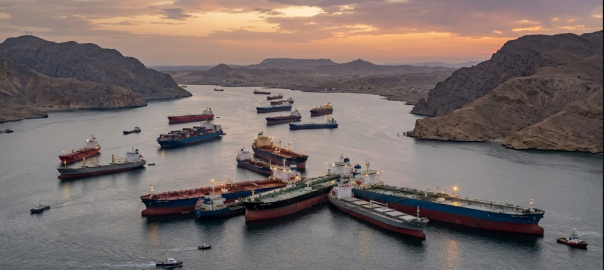
While Washington controlled the skies, Tehran managed the water. By effectively “calling the shots” in the Strait of Hormuz, Iran turned an asymmetrical military disadvantage into a surgical economic weapon. Shipping traffic plummeted 97%, driving Brent crude to $103.20 a barrel and US gas prices to a politically toxic $4.50 average.The true strategic brilliance, however, was not the closure of the Strait, but its selective opening. Iran successfully drove a wedge between the US and its “strategic partners” by allowing specific vessels to transit its territorial waters under Iranian military management. This was underscored by the Settebello tanker incident, where US aircraft were forced to fire on a vessel to enforce a blockade that America’s own allies were increasingly desperate to bypass. This desperation was evident when Secretary of State Marco Rubio was reduced to warning his Indian counterpart, Subrahmanyam Jaishankar, that commercial vessels must comply with US orders—a clear sign that Washington’s traditional partners were beginning to prioritize their own energy security over the American war effort.Nations Granted Selective Transit by Tehran:
- India: (e.g., the Pine Gas tanker carrying critical LPG)
- China: Maintaining steady energy flows throughout the crisis
- Pakistan: Leveraging its role as a key diplomatic mediator
The PURSUE Files: Transparency as a Tactical Sleight of Hand
As the domestic pressure of $4.50 gas and an unpopular war mounted, the Trump administration engaged in a bizarre piece of political theater: the “Presidential Unsealing and Reporting System for UAP Encounters” (PURSUE). Starting in May 2026, the Department of War began releasing tranches of declassified UFO and extraterrestrial files, claiming a commitment to “unprecedented transparency.”To the cynical insider, this was a classic “Epstein’s Law” deflection—a term coined by legal scholar Jabeur Fathally to describe a world defined by the power of perfidy and impunity. The timing suggested the UAP release was less about “the truth” and more about shifting the national conversation away from a grinding military failure and the looming threat of the unsealed Epstein files.Secretary of War Pete Hegseth framed the move as a noble endeavor, stating:”These files, hidden behind classifications, have long fueled justified speculation—and it’s time the American people see it for themselves.”
The “Blink”: Rhetoric vs. the Reality of the 10-Point Plan
The Islamabad memorandum, though heralded by the White House as a “total and complete victory,” is described by analysts as maddeningly vague. In truth, it is a reversion to the pre-war status quo, bought with a $25 billion unfreezing of Iranian assets. While Washington secured the reopening of the Strait, Iran’s nuclear infrastructure remains intact, and its regime—though “wounded and wary”—is still firmly in power.The strategic failure is best understood through the lens of 1968. Much like Lyndon B. Johnson in Vietnam, the Trump administration won nearly every tactical engagement—including the assassination of Ali Larijani, an institutional loss for Tehran arguably greater than that of the Supreme Leader—yet remained trapped in a war it could not end on its own terms. Under the weight of economic strangulation and the “Vietnam-style” reality of a resilient enemy, Washington was forced to the table.Peter Beaumont, writing for The Guardian , characterizes the deal as a “huge strategic failure,” noting: “Despite having killed Iran’s Supreme Leader Ali Khamenei and other senior leaders, the regime change initially promised by Trump and Benjamin Netanyahu failed to materialise.”
The Lebanon Loophole: A Peace of “Brutal Silence”
The most haunting aspect of this ceasefire is its regional incompleteness. While the US and Iran have signed their papers, the “brutal silence” of the White House regarding the ongoing regional slaughter in the Levant remains deafening.The Persistence of the Regional Front
- The “Security Zone” Policy: Israeli Defence Minister Israel Katz has made it clear that Israel is not bound by the US-Iran deal. Israeli forces will remain in southern Lebanon, Syria, and Gaza indefinitely, clearing contact-line villages to establish permanent “security zones.”
- The Humanitarian Collapse: Despite the “Golden Age” rhetoric in DC, 1.2 million Lebanese remain displaced. Netanyahu’s insistence on a continued ground campaign against Hezbollah suggests the US-Iran deal is not a regional peace, but a superpower’s exit ramp from a fire it can no longer contain.
Conclusion: The Price of the “Golden Age”
The war’s legacy will not be found in its tactical triumphs, but in the structural decay it accelerated. Gold has overtaken the euro as the world’s second-largest reserve asset, a clear signal of the dollar’s fading hegemony. NATO lies in a state of fractured exhaustion, poisoned by the “Remember Greenland” rhetoric used to lambast allies like Australia, Japan, and South Korea for refusing to join a war they viewed as a rogue intervention.Washington has learned a hard lesson about the limits of raw might. As the administration prepares for a second stage of talks, it would do well to remember the warning issued by Saeed Khatibzadeh, Iran’s deputy foreign minister. When asked what would happen if the US followed through on threats to put boots on the ground at Kharg Island, his response was chillingly succinct: “Just read what happened in Vietnam.” In the end, the “Bulldozer Peace” proves that while power can entomb an enemy, it rarely has the patience to keep them buried.