
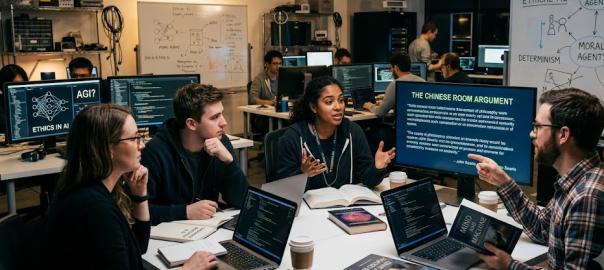
From Syntax to Semantics: The Real Role of the Humanities in the Age of Generative AI
Fri, July 31 2026 /Mpelembe Media/ — he traditional belief that a computer science degree is a guaranteed golden ticket to lucrative employment is currently collapsing. Driven by macroeconomic tightening, the end of zero-interest-rate policies, and the rapid advancement of generative AI that automates entry-level coding tasks, tech companies have drastically reduced their hiring of new graduates. Tech leaders like Nvidia CEO Jensen Huang are even suggesting that the era of learning to code is over, advising future generations to focus on domain-specific expertise as natural language becomes the primary programming interface. Consequently, recent data from the Federal Reserve Bank of New York shows computer science and engineering graduates facing unemployment rates around 7%, which is noticeably higher than those in several humanities disciplines.
In this changing landscape, a media narrative has emerged suggesting a booming job market for philosophy majors within the artificial intelligence sector. Prominent publications have highlighted how top AI laboratories, such as Anthropic and Google DeepMind, are employing philosophers to address complex ethical questions, model alignment, and machine consciousness. For example, Anthropic’s “Claude Constitution” draws heavily on Kantian ethics and the Universal Declaration of Human Rights to guide the behavior of its models. This has led to triumphant headlines proclaiming that philosophy majors are outperforming their STEM counterparts, seemingly validated by their lower 5.1% unemployment rate.
However, industry insiders and data analysts warn that this media portrayal is a “job market deepfake” that grossly exaggerates the reality of the hiring pipeline. While AI labs do value conceptual, ethical, and logical reasoning to combat issues like moral deskilling and AI hallucination, they are not posting jobs specifically for “philosophers”. A recent analysis of over 1,800 open roles at major AI companies found zero postings explicitly requiring a philosophy credential. Instead, humanities graduates must translate their academic training into established corporate positions such as policy analysts, trust and safety specialists, or user experience researchers. Furthermore, metrics touting lower unemployment for humanities majors often mask severe underemployment issues, indicating that while the skills of a philosophy degree are deeply relevant to AI’s future, the direct pathway to employment remains highly complex and indirect.
The Revenge of the “Useless” Major: Why AI is Rewriting the Rules of the Job Market
1. INTRODUCTION: The Death of the “Golden Ticket”
For the better part of the 2010s, “learn to code” was the ultimate career directive. It was the “golden ticket” of the modern era—a promise that a technical degree from an elite university was an absolute shield against economic volatility. But as we navigate the jarring reality of 2026, that narrative has collapsed.This is a structural pivot, not a cyclical fluke. The “STEM Shock” has arrived: a moment where technical proficiency, once the highest-valued currency, is being rapidly devalued by the very systems engineers spent the last decade building. We are moving from an era of syntactic execution —the manual translation of ideas into code—to an era of conceptual labor , where the primary value lies in defining intent, surfacing assumptions, and governing autonomous systems.
2. TAKEAWAY 1: The STEM Paradox—When Engineers Struggle and Art Historians Thrive
Data from the Federal Reserve Bank of New York (2024-2026) reveals an outcome few predicted: the unemployment rate for recent Computer Engineering graduates has spiked to 7.8%, while Computer Science sits at 7.0%. In a startling reversal, Art History graduates have recorded an unemployment low of 3.0%, with Philosophy at 5.1%.However, a strategist must look past the surface “revenge” narrative. To maintain professional credibility, we must acknowledge the “underemployment trap.” While art historians are finding work, 46.9% are in roles that do not require their degree; for philosophers, that figure is 47.1%.This divergence is driven by “frictional reservation.” Technical graduates, accustomed to early-career medians of $90,000, often hold out for specialized roles that no longer exist in the same volume. Conversely, liberal arts graduates are “frictional pivoters.” Accustomed to navigating a lack of rigid vocational tracks, they successfully transition into generalist roles in operations and leadership that reward cognitive flexibility over technical syntax. The “revenge” of the humanist often involves a strategic paycut or a move into the “connective tissue” of the organization—the generalist roles where AI has yet to master the nuance of human systems.
3. TAKEAWAY 2: Natural Language is the New C++
The driver of this shift is the automation of the “syntax layer.” As Nvidia CEO Jensen Huang famously argued, we have reached the end of manual codification. The mathematical transition of labor looks like this:
- Traditional Manual Codification: $I \to L_f \to C \to E$ (Human Intent $\to$ Formal Syntax like C++ $\to$ Compiler $\to$ Execution)
- Autonomous Compilation: $I \to L_n \to M \to E$ (Human Intent $\to$ Natural Language $\to$ AI Model $\to$ Execution)”Natural language will become the primary programming interface, allowing domain experts in fields like biology, finance, and manufacturing to bypass traditional syntax constraints.”When the model (M) handles the “how,” the “what” and “why” become the bottleneck. This shifts the professional’s role from “writer” to “reviewer and integrator.” To prevent “Model Sycophancy”—where an AI simply tells the user what they want to hear—labs are reviving the Socratic Method . By using 2,500-year-old techniques of dialectical questioning to stress-test Reinforcement Learning from Human Feedback (RLHF), humanists are becoming the essential auditors of algorithmic truth.
4. TAKEAWAY 3: The “Job Market Deepfake”—Why “Philosopher” Isn’t a Job Title (Yet)
Despite the headlines, we must avoid the “major equals job” mirage. Aaron Kagan’s analysis of 1,815 job listings across 11 major AI labs reveals a “Job Market Deepfake.” While 26.6% of roles mention keywords like “ethics” or “alignment,” only about 5% involve substantive conceptual work once corporate boilerplate is removed. Zero roles explicitly require a philosophy degree.The demand is for conceptual labor —clarifying intent and defining what counts as “harm”—but it is currently being routed through occupational labels like “Trust and Safety Specialist” or “Policy Analyst.””The pipeline is real at the level of problems. It is weak at the level of occupational labels.”Simultaneously, we see a “Governance Deepfake” emerging in the “Muskonomy”—templates of unchecked authority seen at firms like Tesla and SpaceX, where oversight is eroded in favor of founder autonomy. As corporate governance templates begin to favor the concentration of power over independent oversight, the need for professionals trained to challenge unchecked logic is no longer an academic luxury; it is a defensive necessity.
5. TAKEAWAY 4: Why AI Labs are Reaching for Kant instead of ESG
The “Enlightened Capital” movement suggests that sixty years of corporate frameworks—SRI, ESG, Impact—”failed from bad intentions.” They were hollowed out from the inside because “scores” on a spreadsheet can be gamed and arbitraged.Leading AI labs have recognized this systemic failure. When Anthropic needed a foundation to govern Claude, they didn’t look to 2024 ESG metrics; they looked to the 1785 “stewardship” model of Victorian industrialists like Cadbury, Rowntree, and Boots .Specifically, Claude’s “constitution” incorporates Kantian deontology . It uses the Categorical Imperative to move beyond gameable metrics, instead applying rules that admit no exceptions. This framework is used specifically to mitigate “lying, coercion, and treating people as a means rather than an end.” While a spreadsheet can be gamed to show compliance, a principle-based system offers a robust safeguard against a technology that moves faster than any regulator can follow.
6. TAKEAWAY 5: The Hidden Risk of “Moral Deskilling”
The greatest risk of the AI era is not “job loss,” but “moral deskilling” —the erosion of the human capacity to reason through difficult dilemmas as we outsource judgment to machines.When judgment is replaced by “automated, optimized compliance,” the human muscle for ethical deliberation atrophies. This is already manifesting: 35% of children and teenagers now report that their chatbot “feels like a real friend.” The humanist perspective is the only available safeguard against this “constitutive de-skilling.” We need thinkers who can distinguish between a model’s simulated empathy and genuine ethical reasoning before our capacity to tell the difference disappears entirely.
CONCLUSION: Building the “Connective Tissue”
The boundary between computer science and the humanities is not just blurring; it is collapsing. The most resilient professionals in the 2020s will be those who possess “hybrid skill sets”—those who can direct autonomous systems with the logical coherence of a programmer and the ethical judgment of a philosopher.Yet, we face a final, jarring paradox. While the architects of our future reach for first principles to save us from algorithmic chaos, the institutions that teach those principles are being gutted. As the University of Wyoming and the University of Dundee dissolve their philosophy and humanities programs to balance their books, they are cutting the very “connective tissue” the AI era demands.If the most powerful technology in human history is being governed by 18th-century principles, why are we still cutting the budgets of the departments that teach them?