
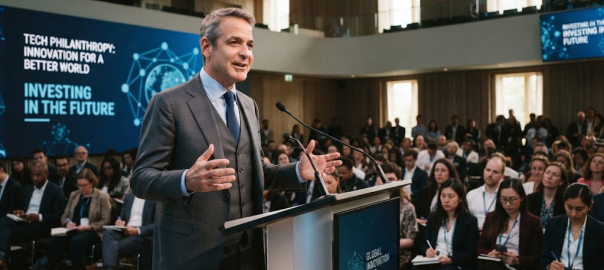
Technocratic Capital vs. Traditional Charity: The Billionaire Battle Over Philanthropy
Mon Oct. 19, 2026 /Mpelembe Media/ — Prominent Silicon Valley leaders, most notably Elon Musk and Coinbase CEO Brian Armstrong, have spearheaded a systematic ideological shift away from traditional billionaire philanthropy. Armstrong and Musk argue that conventional non-profit grantmaking and large private foundations are inefficient, prone to administrative bloat, and routinely “captured by ideology,” rendering many charitable endeavors a net negative for society. Rooted in capitalist techno-determinism and Effective Accelerationism (e/acc), this perspective holds that civilizational advancement is best achieved not through non-profit redistribution, but by aggressively deploying private capital into high-risk, engineering-driven for-profit enterprises—such as electric vehicles, space exploration, and digital infrastructure. Consequently, leaders subscribing to this philosophy prioritize market innovation and founder-controlled capital allocation over legacy grantmaking models exemplified by Bill Gates or Warren Buffett.
This ideological rift is further highlighted by public clashes between technocratic leaders and proponents of traditional or trust-based philanthropy, such as MacKenzie Scott. Scott has deployed over $26 billion in unrestricted, trust-based grants to thousands of non-profits focused on social justice, racial equity, education, and community infrastructure. Musk and conservative critics have publicly condemned Scott’s giving model as “concerning,” asserting that funding progressive social agendas and Diversity, Equity, and Inclusion (DEI) initiatives destabilizes social cohesion and actively worsens global issues. A similar skepticism is voiced by Armstrong, who rejected setting up a traditional foundation after financial advisers suggested it for tax purposes, preferring instead to retain control through donor-advised funds (DAFs) and direct investments. Furthermore, figures like Musk and Armstrong have distanced themselves from commitments like the Giving Pledge, influenced by warnings that uncontrolled legacy assets eventually drift toward political agendas aligned with left-leaning foundations.
Despite public critiques of traditional philanthropy, an examination of the Musk Foundation reveals significant reliance on tax breaks alongside self-directed capital allocation. IRS Form 990-PF filings indicate that while the Musk Foundation holds over $14 billion in assets—boosted by tax-deductible stock transfers saving billions in personal tax obligations—it has repeatedly failed to distribute the federal 5% minimum payout required to avoid penalties. Moreover, the vast majority of disbursements made by the foundation flow into entities tied directly to Musk’s commercial interests, family, or localized operations. Major recipients include Ad Astra (a private school created for Musk’s children and SpaceX executives’ families), The X Foundation, police departments in regions where his companies operate, and large transfers into anonymous donor-advised funds at Fidelity and Vanguard. Critics point out that this structure allows private wealth to function as a tax-shielded extension of corporate strategy rather than an independent public benefit.
The anti-philanthropic ethos extended beyond private wealth management into federal policy through the Department of Government Efficiency (DOGE), led by Musk and Vivek Ramaswamy. Targeting foreign aid as inherently wasteful and biased, DOGE systematically froze payments and attempted to dismantle the U.S. Agency for International Development (USAID), abruptly halting global humanitarian and public health initiatives. Scholars and political theorists, such as Rob Reich, argue that the broader shift toward technocratic capital allocation exacerbates a critical democratic deficit. Because charitable tax deductions act as state-subsidized tax expenditures costing tens of billions annually, the concentration of untaxed wealth in private foundations and DAFs allows mega-donors to exercise unaccountable influence over civil society and public policy. Bypassing democratic budgeting and public oversight in favor of private market dominance risks consolidating authority over civilizational priorities within an exclusive circle of corporate founders.
💡 If you’d like to explore this topic further, we could generate a structured report comparing the tax mechanics and governance rules of donor-advised funds versus private foundations.
The New Tech Aristocracy: 4 Mind-Bending Takeaways on Billionaires, Power, and Philanthropy
How did Silicon Valley’s celebrated wunderkinds shift so rapidly from visionary software builders into unchecked modern power brokers? Today, a small cluster of tech moguls commands foreign policy in active war zones, openly disdains civic obligations like traditional charity, and accumulates unprecedented fortunes under the guise of “changing the world.” What we are witnessing is not merely a shift in corporate rhetoric, but the consolidation of a tech-feudal aristocracy—one where private whim routinely supersedes democratic governance and public oversight.
Takeaway 1: When Charity Becomes the Enemy: The Anti-Philanthropy Backlash
A growing cadre of top tech executives is openly abandoning the long-standing pretense of corporate altruism. Leading this retreat is Coinbase CEO Brian Armstrong, who publicly declared on The Katie Miller Podcast that traditional philanthropy and private foundations are a “net negative on the world.” Armstrong explained that despite financial advisers pushing him to establish a foundation for tax advantages following Coinbase’s public debut, he explicitly refused, claiming that charitable institutions inevitably get “captured by ideology.”To ground his grievance, Armstrong pointed to historical and contemporary examples, asserting, “If you look at the Ford Foundation, I think Henry Ford would be turning over in his grave if he knew what they were up to.” He added that well-intentioned philanthropic ventures frequently backfire, arguing that “a lot of people, by trying to do something good, like criminal justice reform, it turns out they just increased crime.” Elon Musk quickly amplified this mindset, replying “He’s right” to online endorsements of Armstrong’s comments. Musk went a step further by publicly criticizing MacKenzie Scott’s $16 billion in trust-based, unrestricted grants as “concerning.” Scott—who has pledged over $19 billion since 2019 through her Yield Giving initiative—has distributed direct, no-strings-attached funding to over 2,500 non-profits targeting racial equity, immigrant rights, and LGBTQ justice.”I guess I have sort of a contrarian view where a lot of charities and philanthropies are actually net negative on the world. And they get captured. It’s actually remarkably hard to find a foundation that has not gotten captured by ideology.” — Brian ArmstrongThis explicit hostility toward established giving marks a dramatic departure from historical American industrialists like Andrew Carnegie, who built thousands of public libraries, or John D. Rockefeller, who funded scientific research to eradicate hookworm. It also creates a stark rift with modern figures like Bill Gates and Warren Buffett. Where previous generations utilized philanthropy as a tool for public image rehabilitation or civic legacy, today’s tech elite increasingly view traditional charity not as a civic duty, but as an ideological opponent—paving the way for a transition from gilded-age image laundering to tech-feudal self-sovereignty.
Takeaway 2: Billionaires as Geopolitical Warlords: The Ukraine Starlink Standoff
When tech moguls discard public accountability, their economic sovereignty quickly transforms into state-like authority over international conflicts. This alarming dynamic was laid bare during the war in Ukraine, when Elon Musk single-handedly dictated battlefield connectivity during a covert Ukrainian operation near the Crimean coast. As Ukrainian explosive submarine drones approached the Russian naval fleet, they suddenly lost connectivity and washed ashore harmlessly.Initial reports suggested Musk had active satellite coverage shut off, but subsequent accountings revealed a more unsettling truth: Starlink coverage had never been enabled over Crimea in the first place, and Musk personally refused Ukrainian military requests to activate it. Driven by an acute fear of a “mini-Pearl Harbor” and nuclear escalation following direct conversations with senior Russian officials, Musk chose to unilaterally enforce his own foreign policy. Ukrainian Deputy Prime Minister Mykhailo Fedorov sent desperate text messages pleading for connectivity, writing: “I just want you—the person who is changing the world through technology—to know this.” Musk held firm, replying that Ukraine was “inviting strategic defeat.”Musk’s unilateral intervention created intense internal friction within SpaceX. President Gwynne Shotwell was left “livid” when Musk abruptly announced on Twitter that SpaceX would continue funding Ukraine’s Starlink terminals for free—right at the moment when the U.S. Pentagon had a $145 million check ready to hand her to cover the operational costs.”Starlink was not meant to be involved in wars. It was so people can watch Netflix and chill and get online for school and do good peaceful things, not drone strikes.” — Elon MuskWhether actively disabling military infrastructure or refusing to switch it on during an active offensive, the underlying reality remains identical: sovereign nations, international alliances, and frontline soldiers are now dependent on the personal anxieties and philosophical whims of an unelected corporate titan.
Takeaway 3: The Giving Pledge Paradox: Pledging Millions, Gaining Billions
To understand how individual tech executives amassed the sovereign leverage to control war zones and defy public norms, one must examine the mechanisms of modern wealth accumulation. In 2010, Bill Gates and Warren Buffett launched the “Giving Pledge,” an initiative inviting the world’s richest individuals to sign a moral commitment to give away at least half their wealth to charity. Joined by 242 signatories across 29 countries, the pledge was marketed as an unprecedented act of redistribution. Yet financial data reveals a striking paradox: for most signers, committing to give away their fortunes has coincided with unprecedented wealth expansion.Rather than diminishing their capital, signers have seen their assets skyrocket, turning philanthropic pledges into powerful strategic branding and tax-mitigation vehicles:
- Elon Musk: Possessed $2.7 billion when he signed the pledge in 2012. Today, his net worth stands at $223 billion. Although he transferred $5.7 billion in stock to the Musk Foundation in 2021, IRS filings revealed that only 2.7% of those funds were actually distributed to working charities that year.
- Warren Buffett: Held $66 billion when co-founding the pledge in 2010. His fortune has nearly doubled to $122 billion today.
- Robert F. Smith: The first African American to sign the pledge joined in 2017 with $3.1 billion and has grown his wealth to $9.2 billion. Smith famously paid off the student debt of Morehouse College’s 2019 graduating class, but just a year later entered a federal plea deal for a 15-year international tax evasion scheme, agreeing to pay over $139 million in back taxes.While there are rare instances where pledged fortunes evaporated entirely—such as disgraced FTX founder Sam Bankman-Fried, whose $21.7 billion net worth at his 2022 signing collapsed to zero following his arrest—the broader pattern is unmistakable. Pledging wealth has largely functioned as a high-yield public relations exercise, allowing tech magnates to compound their economic capital while insulating themselves from meaningful taxation.
Takeaway 4: The “Troubled Genius” Myth Machine and Access Journalism
How has society come to accept a system where tech oligarchs exercise feudal authority over geopolitical infrastructure while dodging civic contribution? The answer lies in a sophisticated cultural myth-making machine that recasts authoritarian impulse as the necessary price of human progress. Central to constructing this narrative is biographer Walter Isaacson, whose biographical canon spans Benjamin Franklin, Albert Einstein, Leonardo da Vinci, Steve Jobs, and Elon Musk.Isaacson’s project operates much like that of Giorgio Vasari, the 16th-century Florentine chronicler whose Lives of the Most Eminent Italian Architects, Painters, and Sculptors crafted the heroic myth of the Renaissance Man to glorify his patrons, the ruling Medici family. Where Vasari established Florence as the artistic center of Western civilization, Isaacson—the former CEO of the influential Aspen Institute and founder of the Aspen Ideas Festival—helped frame Palo Alto as the 21st-century Renaissance capital. Through his biographic lens, erratic, abusive, or autocratic behavior is normalized as the “flawed genius” tax.When Musk’s brutal South African veldskool upbringing, his arm-wrestling match with PayPal CTO Max Levchin over operating systems, or his erratic late-night tweets are chronicled, they are structurally positioned not as character deficiencies, but as vital creative engine fuel. Isaacson bookends this framing by invoking Apple’s famous “Think Different” slogan—a marketing copy line that Jobs himself initially dismissed as “shit”—as a serious analytical framework:”The people who are crazy enough to think they can change the world are the ones who do.” — Apple “Think Different” Campaign / Steve JobsWhen biographers and access journalists convert destructive, unchecked power into a romanticized tale of “misfit visionaries,” they grant tech leaders cultural immunity. By convincing the public that world-changing innovation requires accepting volatile private sovereignty, the myth machine provides the intellectual cover required for a new aristocracy to reign supreme.
Conclusion
The cultural narrative surrounding Silicon Valley has completed a profound transformation. The wide-eyed techno-optimism of the early internet era has dissolved into an age of tech-feudal authority, where media mythmaking shields billionaires while they dictate military actions, dismiss civic obligations, and compound unthinkable private wealth.As private corporate power continues to eclipse democratic institutions, global society confronts an existential choice: Should critical infrastructure, global security, and public welfare remain subject to the personal whims of an unchecked tech aristocracy?