
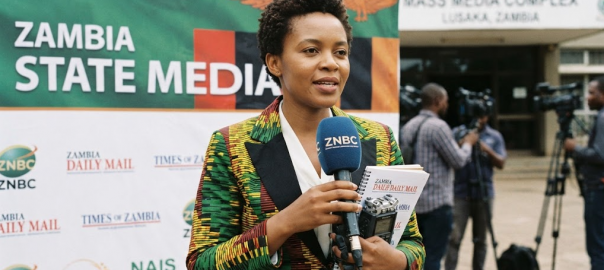
The Glass Cliff at Zambia Daily Mail: Historic Female Appointment Overshadowed by Newsroom Subversion
Mon, July 26 2026 /Mpelembe Media/ — The Zambia Daily Mail Independence Day publication scandal erupted on October 23, 2026, when a special commemorative feature chronicling Zambia’s political history and presidential lineage systematically excised the country’s sixth Republican President, Dr. Edgar Chagwa Lungu. While portraits and historical narratives for all other post-independence heads of state were published, Dr. Lungu’s complete omission sparked immediate national outcry, political backlash from opposition quarters, and severe displeasure from both State House and the Ministry of Information. Subsequent internal forensic investigations revealed that Chief Sub-Editor Jackson Sitengu unilaterally deleted Dr. Lungu’s portrait and textual references prior to transmitting press-ready files. Sitengu acted independently without approval from senior management, later explaining that he felt Dr. Lungu should be omitted due to ongoing political controversies surrounding his legacy and an unforced desire to align the publication with perceived state preferences.
The administrative crisis unfolded just days after Emeldah Libanga Musonda was confirmed as the first female Managing Director in the newspaper’s seven-decade history. Although Musonda had no prior knowledge of or involvement in the layout alteration, she accepted ultimate institutional accountability, authorized an unreserved public apology to the nation, and initiated formal disciplinary proceedings managed by Managing Editor Beavan Saluseki alongside human resources and legal teams. The scandal highlights major structural vulnerabilities in state-owned media, demonstrating how entrenched self-censorship, production pipeline loopholes, and potential bureaucratic resistance can undermine executive authority. It also illustrates the “glass cliff” phenomenon facing female leaders in public institutions, where new executives face asymmetric accountability for subordinate insubordination and legacy patronage friction.
Rather than avoiding friction, the preemptive erasure produced a dramatic rebound effect, elevating the former president’s legacy to the center of national discourse and sparking intense debate over state media integrity. Media analysts and civil society bodies argue that resolving such crises requires structural reforms, including mandatory multi-signature digital workflow auditing, statutory editorial firewalls to insulate public newsrooms from political pressure, and codified objective standards to protect state historical archives from selective editing.
Strategic Framework for State-Owned Media Reform and Democratic Governance in Zambia
1. Executive Context & Policy Mandate: Grounding Media Reform in Democratic Governance
Zambia’s 2021 general election marked a critical juncture in the nation’s post-2021 democratic transition, culminating in a peaceful transfer of executive power following the election of President Hakainde Hichilema of the United Party for National Development (UPND) over incumbent President Edgar C. Lungu of the Patriotic Front (PF). However, this transition occurred against a backdrop of severe economic contraction in 2020—driven by declining global copper prices, high inflation, currency depreciation, a mounting sovereign debt crisis, and the COVID-19 pandemic—compounded by a multi-year trajectory of institutional democratic backsliding observed since 2016. Between 2016 and 2021, the Zambian political landscape experienced structural political polarization, a systematic narrowing of civic space, selective police enforcement of the Public Order Act, severe infringements on freedom of expression, and the arbitrary state-sponsored shutdown of major independent news platforms, notably The Post newspaper in 2016 and Prime TV in 2020. Central to this democratic erosion was the systematic capture of the state communications apparatus by incumbent political cadres, granting structural electoral advantages to the ruling regime while severely suppressing opposition outreach. Rebuilding institutional integrity, democratic legitimacy, and public trust in Zambia’s governance architecture necessitates an immediate overhaul of state-owned media.
To quantify the structural tilt of the public communications ecosystem during the 2021 election campaign, empirical content monitoring reveals a stark, systematic pro-government bias across state-owned print, radio, and television channels when compared to the broader media landscape. Rather than operating as neutral public assets bound by constitutional mandates of fair representation, state media outlets functioned as partisan campaign channels for the ruling party, violating statutory reporting obligations.
Media Outlet / Entity,Sector / Type,Coverage Alignment & Tone (2021 Campaign),Compliance with Legal Mandates & Fair Reporting Standards,Primary Empirical Indicators & Operational Observations
Zambia National Broadcasting Corporation (ZNBC),State-Owned Public Broadcaster (TV/Radio),Overwhelming Pro-Government / PF Bias,Non-compliant with statutory duty under Electoral Process Act (Sec. 29) to provide fair and balanced coverage.,”Out of 408 political publications on Facebook (July 26–Aug 8, 2021), 306 were positive toward ruling PF vs. 2 positive toward opposition UPND . Maintained pro-government bias to a degree that stripped its journalistic credibility; gained 82,000+ Facebook followers (+35%) but faced public ridicule in user comments.”
Zambia Daily Mail,State-Owned Print / Digital Outlet,Direct Pro-Government / PF Bias,Non-compliant with public service standards; functioned as a political mouthpiece for the incumbent administration.,”Out of 91 political publications on Facebook (July 26–Aug 8, 2021), 53 were positive toward ruling PF vs. 5 positive toward UPND . Continuously amplified pro-PF alliance narratives and political messaging.”
Times of Zambia,State-Owned Print / Digital Outlet,Direct Pro-Government / PF Bias,Non-compliant with objective journalism standards; exhibited systemic bias toward the ruling party.,”Mirror-imaged the pro-government coverage patterns of the Zambia Daily Mail , suppressing opposition perspectives and prioritizing executive campaign activities.”
Prime TV (Contextual Benchmark),Private Television Broadcaster,Critical of Government / Independent,Statutory license arbitrarily revoked by the Independent Broadcasting Authority (IBA) in April 2020.,”Forced off the air prior to the election following continuous executive pressure, government ad bans, signal removal, and dispute over free COVID-19 ad broadcasts. License restored post-election.”
The Post (Contextual Benchmark),Private Newspaper,Independent / Opposition-Aligned,Formally shut down in June 2016 under executive pressure preceding the 2016 election.,”Closed under tax debt liquidations, removing the primary print platform for opposition voices prior to the 2016 and 2021 electoral cycles.”
This capture of state media assets by ruling political cadres produced severe systemic risks for democratic governance. By converting public broadcasters and news publishers into partisan promotional mechanisms, the state created a “verificatory vacuum.” Verified, factual information regarding policy choices and electoral platforms was replaced by unverified executive claims, low-integrity political polling, and state-driven disinformation. Opposition political parties were systematically denied equitable access to state communication networks, directly undermining their constitutional rights to association and assembly while restricting the electorate’s access to unbiased political information. When public institutions tasked with delivering neutral information become conduits for partisan campaigns, public trust in democratic institutions degrades, leaving the public sphere vulnerable to polarization, cadre-led intimidation, and political instability.
This operational bias within state media is directly sustained by legislative loopholes and statutory ambiguities that invite executive interference, underscoring the urgent necessity for a comprehensive legislative reform agenda.
2. Legislative Overhaul: Statutory Editorial Autonomy and Legal Harmonization
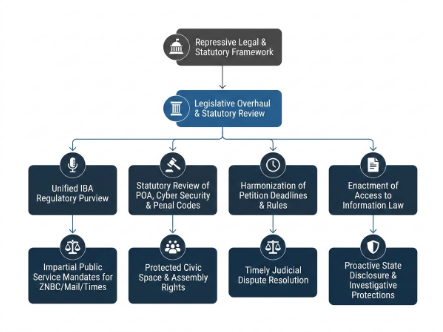
Dismantling executive capture and establishing enduring guarantees for press freedom, digital expression, and public access to information requires sweeping statutory reform. The primary legislative objective is to eliminate statutory contradictions that allow state media to operate under direct executive patronage while subjecting private outlets to punitive regulatory enforcement.
To achieve structural parity across the media ecosystem, state-owned communications entities must be brought under a unified, independent regulatory framework. A comprehensive regulatory harmonization strategy requires placing the Zambia National Broadcasting Corporation (ZNBC) , the Zambia Daily Mail , and the Times of Zambia under the direct, exclusive oversight of the Independent Broadcasting Authority (IBA) . Conflicting statutory provisions within the ZNBC Act must be repealed to eliminate dual regulatory standards that historically shielded state media from impartial scrutiny. Crucially, bringing state media under IBA purview is designed to enforce public service mandates and political neutrality on state entities, while simultaneously stripping the IBA of its arbitrary administrative powers used historically to shut down private broadcasters such as Prime TV and The Post . Under a harmonized regulatory architecture, state media entities must be legally bound to strict standards of political impartiality and balanced reporting, while private broadcasters are protected from arbitrary license revocations.
In parallel, legislative harmonization must resolve statutory contradictions within the judicial and dispute resolution frameworks governing elections. Currently, a sharp conflict exists between Article 73(2) of the Zambian Constitution—which mandates that the High Court hear and determine parliamentary election petitions within 90 days—and Section 106(1)(b) of the Electoral Process Act, which creates procedural ambiguity regarding filing and determination timelines. Legislative harmonization must explicitly align all statutory petition rules with constitutional deadlines. Furthermore, structural reforms must institutionalize the procedural advances introduced under Statutory Instrument No. 29 of 2021 (Constitutional Court Amendment Rules), which adopted reliance on affidavit-based evidence to streamline case management and eliminate technical delays that previously prevented petitions from being heard on their merits.
To clean the broader statutory ecosystem of repressive laws that foster self-censorship, restrict public assembly, and criminalize legitimate journalistic inquiry, Parliament must execute four prioritized statutory reviews:
- Public Order Act (1955, Sec. 5 & Sec. 5(6)): Codify precise statutory guidelines removing police discretion to arbitrarily deny or cancel public assemblies. Section 5(6) must be explicitly amended to compel law enforcement officers to provide written justifications when an assembly notification is rejected and mandate the immediate provision of a reasonable alternative date in the near future, fulfilling the constitutional thresholds established by the Supreme Court in Law Association of Zambia v. The Attorney General .
- Cyber Security and Cyber Crimes Act (2021): Thoroughly revise the act through open consultation with civil society, media, and legal stakeholders. Statutory definitions of “false information,” “harassment,” “emotional distress,” and “hate speech” must be narrowly defined to eliminate overbroad interpretations used to suppress online speech, aligning the text strictly with Article 20 and Article 11(b) of the Zambian Constitution and Article 19 of the International Covenant on Civil and Political Rights (ICCPR).
- Data Protection Act (2021): Revise the broad exemptions granted under the rubric of “national security.” Statutory definitions must be narrowed to safeguard individual privacy, secure digital rights, and align with regional standards established under Article 13 of the African Convention on Cyber Security and Personal Data Protection, preventing unauthorized state surveillance and phone-hacking practices.
- Penal Code Act & Archaic Statutes: Expunge criminal defamation provisions, Section 155 penal sanctions (anti-LGBT+ provisions used to orchestrate political smears and online disinformation campaigns against opposition leaders), Section 139 (“defilement of imbeciles”), and archaic, offensive language targeting persons with disabilities across the Mental Disorders Act (e.g., “idiots,” “imbeciles,” “lunatics”), the Criminal Procedure Code, and the Prisons Act.
In tandem with legal harmonization, statutory reforms must address systemic inequities in civic administration, specifically the unequal issuance of National Registration Cards (NRCs) by the Ministry of Home Affairs across provinces prior to voter registration drives. Unequal NRC distribution creates severe voter registration bottlenecks, disproportionately affecting specific regional demographics. Amendments to the National Registration Act must mandate full observer access and independent civil society oversight of all mobile NRC registration exercises ahead of voter registration.
Finally, the long-delayed Access to Information (ATI) bill must be enacted by Parliament. Operationalizing ATI legislation will legally mandate proactive disclosure obligations across all government ministries, public bodies, and state enterprises. By establishing an enforceable legal mechanism for journalists, civil society, and citizens to request state-held data, ATI eliminates government information monopolies, provides legal protections for investigative reporters exposing corruption, and equips public media with the factual baseline necessary to refute state-level disinformation.
Legislative protections, however, remain vulnerable to administrative erosion unless reinforced by independent, depoliticized institutional governance structures.
3. Institutional Governance: Independent Oversight, Board Appointments, and Leadership Safeguards
Statutory protections for media freedom are ineffective if governing boards and regulatory commissions remain subordinate to executive power. Insulating state media and regulatory bodies from political interference requires restructuring appointment processes, enshrining statutory self-regulation, strengthening judicial integrity, and establishing legal tenure protections for operational leadership.
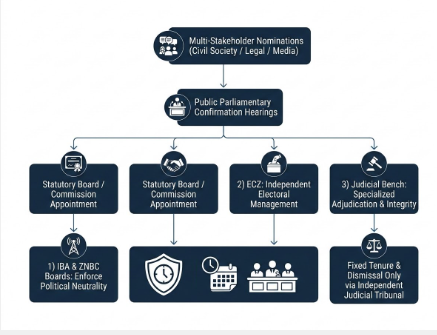
The foundational step in institutional reform is the establishment of a depoliticized, multi-stakeholder appointment mechanism for members of the Independent Broadcasting Authority (IBA) board, the ZNBC Board , and the Electoral Commission of Zambia (ECZ) . The executive branch’s unilateral power to appoint and dismiss board members and electoral commissioners at will must be completely removed from the presidency. Appointments must be conducted through an open, transparent, merit-based framework featuring:
- Civil society, media, legal, and professional association shortlisting of qualified candidates.
- Public parliamentary confirmation hearings conducted by the National Assembly.
- Statutory protection preventing executive dismissal, requiring any removal attempt to be referred to an independent judicial tribunal based strictly on proven misbehavior or physical/mental incapacity.
In parallel with administrative oversight, judicial capacity and dispute resolution structures must be systematically strengthened. The effectiveness of electoral dispute resolution relies heavily on public confidence in the Constitutional Court and High Court. To address historical concerns regarding political influence and unqualified appointments (such as appointments falling short of the Article 141 constitutional threshold requiring 15 years of specialized legal experience), the Judicial Service Commission must enforce rigorous, transparent appointment criteria for all superior court judges. Comprehensive judicial performance tracking, mandatory integrity training on constitutional petitions, and broad public outreach programs regarding petition procedures must be instituted to ensure election petitions are resolved transparently on their merits within statutory limits.
To complement state-level regulatory reform, the Zambian Media Council (ZAMEC) must be fully operationalized as a statutory self-regulatory body for the media sector. ZAMEC will serve as the primary professional authority enforcing journalistic ethics, upholding media accountability, and adjudicating public complaints regarding media performance. By establishing ZAMEC as an independent self-regulatory council, the state removes the justification for arbitrary regulatory interventions by government bodies, preventing a recurrence of state-directed media shutdowns such as those executed against Prime TV and The Post .
Furthermore, explicit legal safeguards must be instituted to shield newsroom leaders, editors-in-chief, and media executives from “glass cliff” vulnerabilities—where executive leadership is targeted for termination or political pressure when refusing to comply with partisan directives. Governing frameworks must establish fixed, legally protected tenures for editors-in-chief and public media executives. Performance evaluation must be decoupled from political alignment and tied to objective, professional staff audits assessing competency, journalistic adherence to statutory fairness, and organizational performance. Arbitrary terminations during political transitions must be rendered unlawful, with removal conditioned strictly on documented cause verified through independent board review.
Reinforcing institutional governance structures creates the structural foundation required to integrate technical, operational, and digital safeguards across modern newsrooms and information systems.
4. Digital Information Integrity: Cryptographic Audits, Counter-Disinformation, and Archival Standards
In an increasingly digital public sphere, insulating state media and governance institutions from partisan capture requires modernizing digital newsroom workflows, building active counter-disinformation capabilities, and enforcing strict digital record preservation standards.
During the 2021 election cycle, third-party social network fact-checking partnerships (e.g., the Facebook/AFP partnership, which yielded only two fact-checks in Zambia throughout 2021) and algorithmic content moderation failed to halt the spread of state-linked disinformation, doctored images, and low-integrity political polling. State media outlets and the ECZ must establish real-time, non-partisan counter-disinformation units. These units must proactively deploy platform-verified digital channels—specifically securing official “Blue Badge” verification across all major social networks—to swiftly dispel viral political smears, fake polling data, and unauthorized results announcements. (In the 2021 election, only 3 of 16 presidential candidates possessed verified Facebook pages and only 2 had verified Twitter accounts, while 86% of campaign advertisements were run by unverified accounts, creating severe verificatory gaps).
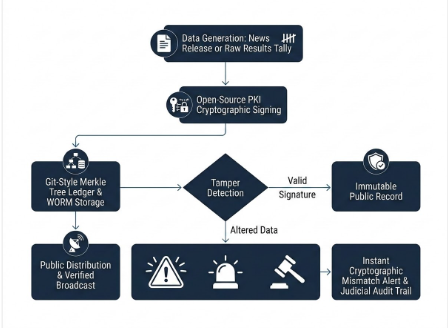
To guarantee the absolute integrity of public news publishing and election-related data processing, state media newsrooms and the Electoral Commission of Zambia must deploy open-source cryptographic audit frameworks tailored to Sub-Saharan digital infrastructure:
- Cryptographic Signing via Open-Source PKI: All published digital news items, official press statements, and polling-station-level election results must be cryptographically signed at the point of origin using light, open-source Public Key Infrastructure (PKI) standards.
- Immutable Audit Logs: Newsroom Content Management Systems (CMS) and ECZ results tabulation databases must integrate version-controlled, Git-style Merkle tree ledgers and write-once-read-many (WORM) storage architecture to record all creation, edit, publication, and deletion events.
- Tamper-Evident Election Tallying: Any unauthorized post-publication modification, raw news feed alteration, or parallel vote tabulation data tampering will instantly invalidate the cryptographic hash signature, triggering automated public alerts and generating an unalterable audit trail for judicial review.
Concurrently, public archive regulations must be statutorily updated to prevent the arbitrary deletion of public digital records during political transitions—specifically addressing instances such as the unannounced deletion of former President Edgar Lungu’s official Facebook page in late August 2021 post-election. Statutory archival standards must explicitly define all official social media accounts, digital broadcasts, and electronic communications produced by public officials and state media enterprises as permanent public records subject to National Archives preservation laws for scholarly and academic research.
Finally, state-mandated telecommunications interference—such as the 48-hour blanket shutdown of social media platforms (WhatsApp, Facebook, Twitter, Instagram, Messenger) executed between August 12 and August 14, 2021—must be strictly outlawed. Telecommunications service providers (Zamtel, Airtel Zambia, MTN Zambia) must be legally prohibited from implementing network throttling or blackouts that violate Article 20 of the Zambian Constitution. Providers must maintain mandatory compliance with the UN Guiding Principles on Business and Human Rights, upholding digital connectivity as a prerequisite for democratic expression.
Technological and operational integrity safeguards must be grounded in structural financial independence to fully insulate state media from political patronage.
5. Financial Sustainability: Commercial Revenue Decoupling and Inclusive Public Funding
Editorial independence cannot exist without financial autonomy. State-owned media’s historical reliance on executive discretionary funding, ministry subsidies, and partisan government advertising allocations creates structural financial leverage that executive authorities exploit to dictate editorial policies.
A sustainable public media model requires decoupling state media budgets from executive patronage. The state must establish a statutory, ring-fenced Public Broadcasting Fund . To guarantee total insulation from executive leverage, the fund’s revenue collection mechanism will be anchored in statutory levies collected directly through independent utility billing (e.g., electricity grid user surcharges or telecommunications spectrum licensing fees) alongside parliamentary block grants. Administered at arm’s length from the executive branch by an independent multi-stakeholder board, this formula-based funding structure ensures that ZNBC, the Zambia Daily Mail , and the Times of Zambia can fulfill public service obligations without relying on discretionary state advertising contracts or ministry subventions.
To prevent financial resources from distorting political competition, Parliament must enact a comprehensive Political Parties Act under Article 60(4) of the Zambian Constitution. This legislation must regulate political party financing and campaign advertising through three statutory requirements:
- Expenditure Caps: Enforce strict statutory limits on campaign advertising expenditures across traditional media and digital platforms (Facebook, Google, YouTube).
- Financial Disclosure: Mandate full public disclosure of all political campaign revenue sources, donor identities, and audited annual financial accounts submitted to an independent oversight authority.
- Advertising Parity: Enforce absolute prohibitions against state media granting free, subsidized, or hidden advertising access, state resources, or logistics advantages to incumbent political parties.
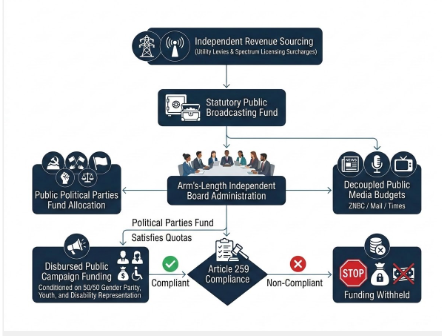
Finally, public political party funding must be utilized to drive social inclusion. Allocation of state funding from a public political parties fund should be explicitly conditioned on a political party’s compliance with constitutional inclusion quotas under Article 259. Parties that satisfy statutory targets—specifically 50/50 gender parity, meaningful youth integration, and representation for persons with disabilities among nominated candidates in winnable seats—will receive prioritized financial support. (In the 2021 general election, only 20 women were elected to the 156-seat National Assembly, dropping female representation from 17% in 2016 to 13%, despite women constituting 53.4% of the registered electorate). Conditional funding mechanisms create structural financial incentives for political parties to dismantle patriarchal barriers and eliminate prohibitive candidacy fees for underrepresented groups.
These financial mechanisms provide the structural backing for a consolidated, actionable implementation roadmap for state media reform and governance oversight.
6. Strategic Implementation Roadmap: Policy Recommendations and Institutional Responsibilities
To convert policy analysis into prioritized, accountable legislative and administrative action items, the following comprehensive matrix maps strategic directives to primary responsible institutions, establishing clear priority tiers and target systemic impacts.
Target Institution,Actionable Reform Directive,Priority Level & Timeline,Target Outcome / Systemic Impact
National Assembly / Government,Amend Section 5(6) of the Public Order Act to compel police to justify assembly denials in writing and mandate immediate alternative dates.,Short-Term (0–12 months),Eliminates executive and police discretion in regulating peaceful public assemblies; aligns assembly regulation with Supreme Court rulings.
National Assembly / Government,”Amend ZNBC Act to place ZNBC, Zambia Daily Mail , and Times of Zambia under the unified regulatory authority of the Independent Broadcasting Authority (IBA).”,Short-Term (0–12 months),”Ends dual regulatory standards, enforcing political impartiality and public service mandates across state media while protecting private media from arbitrary shutdowns.”
National Assembly / Government,Present and enact the Access to Information (ATI) bill with robust proactive disclosure mandates across all government entities.,Short-Term (0–12 months),”Eliminates state information monopolies, protects investigative journalists, and equips media to refute state-driven disinformation.”
National Assembly / Government,Amend Cyber Security and Cyber Crimes Act (2021) and Data Protection Act (2021) to narrow vague speech definitions and security exemptions.,Medium-Term (12–36 months),Protects constitutional freedom of expression (Art. 20) and privacy (Art. 17); eliminates self-censorship and legal overreach.
National Assembly / Government,”Enact a Political Parties Act under Article 60(4) establishing campaign finance disclosure, advertising caps, and a Public Political Parties Fund.”,Medium-Term (12–36 months),”Regulates campaign expenditures, eliminates improper use of state resources, and incentivizes candidate inclusion quotas (Art. 259).”
National Assembly / Government,Amend National Registration Act and electoral laws to remove presidential powers to appoint/dismiss ECZ commissioners at will.,Long-Term (36+ months),Depoliticizes electoral governance; establishes multi-stakeholder appointments and independent tenure protections.
National Assembly / Government,”Expunge derogatory disability terms across the Mental Disorders Act, Penal Code, Criminal Procedure Code, and Prisons Act.”,Short-Term (0–12 months),Upholds human dignity and constitutional rights for persons with disabilities in accordance with international conventions.
Judiciary / Judicial Service Commission,”Implement judicial performance tracking, integrity training on constitutional petitions, and public outreach programs; harmonize Art. 73(2) with Electoral Process Act Sec. 106(1)(b).”,Medium-Term (12–36 months),”Enhances judicial independence, restores public confidence in electoral dispute resolution, and eliminates conflicting petition timelines.”
Electoral Commission of Zambia (ECZ),”Mandate the public release of polling-station-level election results on the ECZ website in open, downloadable data formats.”,Short-Term (0–12 months),Ensures total election result transparency and supports parallel vote tabulation verification efforts.
Electoral Commission of Zambia (ECZ),Operationalize continuous voter registration structures at provincial/district levels and permit external civil society audits of the voter register.,Medium-Term (12–36 months),Restores public confidence in the voter register; fulfills constitutional continuous registration mandates.
Electoral Commission of Zambia (ECZ),”Establish real-time counter-disinformation units, secure “”Blue Badge”” verification, and deploy open-source cryptographic audit trails for results tabulation.”,Short-Term (0–12 months),”Mitigates online disinformation, prevents tamper events, and eliminates verificatory vacuums during results collation.”
Electoral Commission of Zambia (ECZ),”Enforce full polling station accessibility, tactile braille ballot jackets, sign language instruction, and dedicated disability inclusion budgets.”,Medium-Term (12–36 months),Guarantees secret ballot rights and full physical/procedural access for voters with disabilities (fulfilling 2011 High Court ruling).
Independent Broadcasting Authority (IBA),Enforce uniform code of conduct standards and political impartiality mandates across both state-owned and private media outlets.,Short-Term (0–12 months),”Prevents arbitrary station shutdowns (e.g., Prime TV) and holds public broadcasters accountable for campaign bias.”
Security Forces / Zambia Police,”Enforce strict legal neutrality, protect campaign gatherings equally, and issue clear, reasonable travel/rally approvals without political bias.”,Short-Term (0–12 months),”Restores political playing field equity, stops cadre violence, and guarantees constitutionally protected freedom of movement.”
Media / ZAMEC,Fully operationalize the Zambian Media Council (ZAMEC) as a statutory self-regulatory body enforcing professional journalistic ethics.,Medium-Term (12–36 months),”Establishes independent peer review for journalistic standards, removing state pretexts for regulatory intervention.”
Social Media Platforms (Facebook/Google),”Enforce robust Ad Library verification pathways for local political entities, flag state media, and expand ad transparency reports to Sub-Saharan Africa.”,Short-Term (0–12 months),”Prevents blanket political ad takedowns, ensures complete transparency on campaign ad spend, and combats digital manipulation.”
Political Parties,Implement internal adoption quotas guaranteeing 50% women candidates and minimum thresholds for youth and persons with disabilities.,Medium-Term (12–36 months),Reverses the decline of female representation in Parliament and expands inclusive political participation.
Final Synthesis
The long-term democratic viability of Zambia’s political system depends on transitioning from sporadic election-day compliance to permanent, structurally enforced media and institutional integrity. Achieving equitable democratic governance requires dismantling repressive statutes, establishing depoliticized multi-stakeholder oversight bodies, guaranteeing digital information integrity through modern cryptographic tools, and decoupling public communications from political patronage. By executing this comprehensive policy framework, Zambia can secure editorial independence for state media, restore public trust in governance, and consolidate its standing as a resilient constitutional democracy in Sub-Saharan Africa.