

Scalable Media Discovery Meets Immersive Reality: The Technical Blueprint of Horizon
Thu, July 29 2026 /Mpelembe Media/ —The Horizon streaming ecosystem combines a zero-friction identity architecture with broad media delivery capabilities to streamline subscriber acquisition and long-term engagement. To eliminate the user drop-off typical of manual registration forms and credential entry, the platform integrates standard OAuth 2.0 and OpenID Connect protocols alongside in-context Google One-Tap authentication. Utilizing browser-level Federated Credential Management APIs, Google One-Tap detects active sessions and transmits cryptographically signed JSON Web Tokens directly to backend verification endpoints without triggering disruptive page redirects. This passwordless entry pattern produces conversion rate increases ranging between 50% and 107%, capturing verified demographic data immediately to personalize content catalogs upon arrival.
The platform’s interface topology is structured on a dark-mode obsidian black canvas accented with charcoal containers and crimson red action triggers designed to minimize glare and emphasize visual assets. Navigation relies on a persistent global header featuring predictive auto-complete search, followed by a dynamic promotional hero carousel and horizontally scrolling semantic discovery rails that segregate popular films, upcoming releases, and top-rated titles. Individual media cards utilize progressive disclosure upon hover, expanding to display key decision-making metadata such as IMDb scores, maturity ratings, and technical format badges including 4K Ultra HD and HDR10+. Continuous state-tracking algorithms monitor cross-device playback timestamps through a dedicated Continue Watching rail, ensuring synchronized watchlists, subtitles, and audio preferences across web, native mobile, and television endpoints.
Beyond on-demand film catalogs, the platform incorporates live IPTV channels, interactive Electronic Programme Guides, and custom M3U and HLS playlist loading. The technical architecture extends playback from conventional 2D monitors into spatial computing environments across visionOS and Meta Horizon OS headsets, as well as IMAX Enhanced 4K home theater projectors. In spatial environments, the interface renders floating 3D windows with ambient physical lighting reflections, stereoscopic 3D decoding, and integrated spatial audio engines that use real-time dynamic head tracking to anchor sound sources to the virtual display.The Future of Digital Experiences: 5 Game-Changing Lessons from Modern Streaming & Authentication Architecture
The Future of Digital Experiences: 5 Game-Changing Lessons from Modern Streaming & Authentication Architecture
1. Introduction: The Silent Friction Killing Digital Growth
Standard user registration flows present an invisible tax on digital growth. Legacy onboarding sequences that demand manual form entries, password creation, CAPTCHA challenges, and out-of-band email verification generate massive cognitive load. This unnecessary friction triggers top-of-funnel visitor drop-off before users ever experience a product’s core value proposition.
When combined with visual clutter and the rigid boundaries of physical display hardware, traditional software products struggle to maintain long-term subscriber engagement. Modern digital streaming ecosystems, such as the Horizon platform, alongside streamlined identity patterns like Google One-Tap , are fundamentally resetting user expectations. By synthesizing zero-redirect identity layers, disciplined visual design systems, and spatial computing, product leaders can capture, retain, and immerse audiences more effectively than ever before.
2. Takeaway 1: The “Zero-Redirect” Sign-In Boost (Why Forms Are Dead)
Say Goodbye to Registration Forms: How Zero-Redirect Authentication Triggers Massive Conversion Lifts
Forcing users to navigate away from their active context into multi-step registration forms causes immediate onboarding decay. Modern authentication architecture replaces manual data entry with non-intrusive identity overlays powered by OAuth 2.0, OpenID Connect (OIDC), and browser-level Federated Credential Management (FedCM) APIs.
Google One-Tap detects active Google sessions running within a user’s browser or operating system environment. When a visitor arrives at the gateway, the platform displays a single-gesture prompt without triggering disruptive page redirects. Upon interaction, a cryptographically signed JSON Web Token (JWT) is issued to the backend, enabling instant passwordless account creation and sign-in.
Authentication Paradigm,Friction Level,Conversion Impact / Lift,Technical Protocol Standard
Traditional Credential Form,High,Baseline (0% Lift),Local Hashed Database Credentials
“Social OAuth (e.g., Facebook, Apple)”,Medium-Low,+20% to +40% Lift,OAuth 2.0 / OpenID Connect
Google One-Tap Overlay,Minimal,+50% to +107% Lift,FedCM / Server-Verified JWT
Real-world A/B testing highlights the drastic impact of zero-redirect authentication across diverse industries:
- GenPPT: Achieved a +107% lift in trial conversions (jumping from 7.48% in the control group to 15.50% with Google Sign-In prompts).
- Reddit: Experienced a combined ~185% increase in sign-ups after launching Google Sign-In buttons (+50–60%) and layering One-Tap overlays on top (+90%).
- Iron Company: Realized 8x more sign-ups overall (and 70x more sign-ups via One-Tap compared to legacy social buttons), driving signed-in purchase rates from 24% to 40%.
- The News Minute: Generated 8x more new sign-ups within 90 days and boosted subscription revenue by +15% .
“Sign in with Google and One Tap solutions have significantly increased account creation and email coverage for Reddit by reducing friction during the account sign up flow for users. These are critical components as we continue to improve the user experience, establish long-term relationships with our users, and drive long-term retention.”
— Yee Chen , Director of Product, Reddit
As enterprise leaders like J.P. Brice (President of Iron Company) and Vignesh Vellore (CEO of The News Minute) have noted, removing top-of-funnel barrier points directly accelerates customer acquisition. From a growth strategy perspective, instant profile provisioning—delivering verified full names, primary emails, and avatars—compresses the user’s initial Time-to-Value (TTV) to under 60 seconds. Bypassing registration forms yields higher deliverable data quality, allowing growth engines to deliver hyper-personalized catalog recommendations on initial entry and maximizing customer lifetime value (LTV).
3. Takeaway 2: Designing for Focus: Dark Mode Canvases & Progressive Disclosure
Strict Visual Hierarchy and Semantic Topology: Structuring Dark-Mode Canvases for Immediate Focus
Delivering clear visual visual hierarchy requires absolute design system discipline. Streaming platforms like Horizon build their user interfaces on high-contrast dark-mode canvases anchored by obsidian black and deep grey tones. This foundation minimizes visual glare, heightens dynamic color contrast for High Dynamic Range (HDR) cover art, and trains viewer attention directly on primary content assets.
Token Color Hex,Design System Label,Visual Role & Hierarchy,UI Component Application
#030303,Obsidian Black Base,Canvas Backdrop & System Chrome,”Primary interface background, view canvas”
#FEFEFE,Pure White,Primary Text & High-Priority Icons,”Main title headers, active navigation text”
#CF0607,Crimson Red Accent,Brand Identity & Primary Action,”Primary Play CTAs, active selection indicators”
#3F4346,Charcoal Container,Secondary Surface Neutral,”Card containers, structural dividing borders”
#423537,Deep Burgundy Tint,Interactive Hover State,”Media card hover overlays, focused card backdrops”
#A09FA0,Neutral Grey,Secondary Information Subtext,”Metadata labels, release years, runtime text”
#7F7F81,Slate Grey,Inactive Control Surface,”Unselected menu items, disabled control icons”
To organize vast media catalogs without overwhelming the user, interface topologies are divided into structural semantic modules. A persistent global header anchors search utilities, while dedicated horizontal content rails structure visual scanning patterns.
UI Module / Rail,Structural Placement,Visual & Metadata Components,Functional Interaction Pattern
Global Navigation Bar,Persistent Header,”Brand Mark, Instant Search Input, Category Links”,”Real-time predictive search, category filtering”
Hero Spotlight Carousel,Top Body Viewport,”Cinematic Art, Synopsis, Primary Action CTAs”,”Auto-advancing promotional reel, instant play”
Popular Films Rail,Primary Body Row,”Poster Artwork, IMDb Rating Chips, Genre Badges”,”Horizontal swipe/scroll, hover preview expansion”
Upcoming Releases Rail,Secondary Body Row,”Pre-release Stills, Debut Dates, Teaser Trailers”,”Trailer modal trigger, watchlist reminder toggle”
Top-Rated Movies Rail,Tertiary Body Row,”Critical Score Badges, Accolade Icons”,Curated catalog sorting by critical acclaim
Content Detail View,Slide-over / Overlay,”Cast List, Director Info, Technical Format Badges”,”Playback resumption, audio track & subtitle setup”
Preventing visual clutter across catalog rows relies heavily on micro-interactions powered by “progressive disclosure.” Hovering over an interface media card triggers a controlled sequence:
- Depth Shift: The media card scales outward smoothly to establish visual focus over surrounding items.
- Chromatic Highlight: Backdrop surfaces transition to Deep Burgundy (#423537) tint to signify active selection.
- Metadata Reveal: Essential evaluation signals appear dynamically—including high-contrast IMDb rating badges, content maturity tags, audio format labels, and resolution chips like 4K Ultra HD and HDR10+.
This strict layout topology allows users to scan categories vertically while exploring thematic collections horizontally, drastically reducing cognitive load during content selection.
4. Takeaway 3: Spatial Computing is Decoupling Entertainment from Physical Displays
Beyond 2D Screens: Spatial Operating Systems, Passthrough Architecture, and 3D Viewports
Software visual design is no longer bound to rigid 2D screen real estate. Modern streaming platforms extend their ecosystems into spatial operating systems—such as Apple visionOS and Meta Horizon OS—and high-end ambient hardware like 4K smart projectors with IMAX Enhanced certification.
Platform Endpoint,Display & Rendering Spec,Audio Technology Framework,Interaction Input Modality,Spatial Ecosystem Capability
Desktop & Mobile Web,Standard 1080p / 4K WebGL Canvas,Stereo / Bitstream Surround Sound,”Mouse, Touchscreen, Keyboard”,Responsive 2D fluid navigation
4K Smart Projector,”4K Ultra HD, Dolby Vision, IMAX Enhanced”,Harman Kardon Multi-Driver Array,”Remote Control, Voice Commands”,Large-format ambient projection
Meta Horizon OS,HD / 4K Infinite Passthrough Display,Integrated Spatial Audio Engine,”Touch Plus Controllers, Hand Tracking”,Virtual theater environments
Apple visionOS,”Dual Micro-OLED (23M pixels, up to 120Hz)”,Spatial Audio Pods with dynamic head tracking,High-precision Eye Gaze + Pinch gesture,Stereoscopic 3D spatial video playback
Decoupling digital UIs from fixed glass monitors fundamentally transforms interaction design. Spatial hardware engines handle multi-tiered rendering capabilities seamlessly:
- Stereoscopic 3D Video Decoding: Systems decode complex Multiview Video Coding (MVC) and High-Efficiency Video Coding (HEVC) streams to generate natural binocular depth.
- Dynamic Head-Tracked Spatial Audio: Audio pods anchor sound sources to explicit coordinates on virtual viewports, adjusting directional sound in real time to match physical theater acoustics as the user moves.
- Physical Passthrough & Lighting Engine: Suspended 3D spatial windows project realistic ambient light reflections onto real-world living room walls and surrounding physical surfaces.
For product growth strategists, moving from fixed aspect ratios to floating spatial viewports removes traditional interface boundaries. Designing for spatial operating environments increases average session duration and deepens brand immersion by turning standard content consumption into an active, theater-grade experience.
5. Takeaway 4: The Hidden Mechanics of Frictionless UX: Cooldowns & Fallbacks
Navigating Edge Cases: Exponential Cooldown Rules, Browser Restrictions, and Server Defenses
While zero-redirect authentication creates a seamless onboarding experience, product managers must design strategically around browser-enforced constraints. Google One-Tap relies on existing active Google browser sessions and operates under strict dismissal rules. If a user manually closes the One-Tap prompt by clicking the upper-corner ‘X’, the browser enforces an exponential suppression schedule:
- 1st Manual Dismissal: Suppressed for 2 hours
- 2nd Manual Dismissal: Suppressed for 1 day
- 3rd Manual Dismissal: Suppressed for 1 week
- 4+ Manual Dismissals: Suppressed for 4 weeks
- Mobile Auto-Dismissal Window: Automatically closes after 90 seconds on mobile web browsers when FedCM is not enabled, unless directly interacted with.
Product teams must recognize that browser constraints—such as Intelligent Tracking Prevention (ITP) in Safari and Firefox, or restricted environments like Chrome on iOS—prevent overlay execution entirely. Respecting these cooldown periods and privacy constraints is essential for preserving long-term user trust and preventing prompt fatigue.
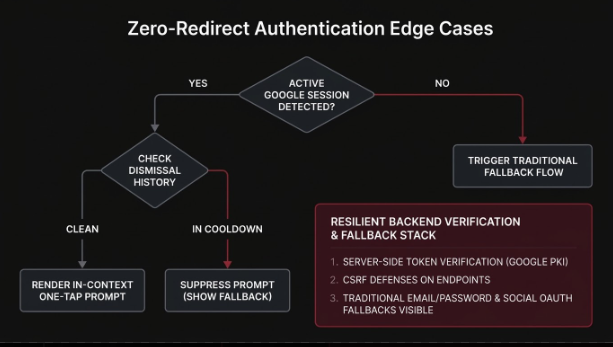
Architecting a resilient identity strategy requires treating zero-redirect overlays as progressive enhancements. System backends must rigorously verify incoming JWT credentials against Google’s public key infrastructure and enforce robust CSRF defenses, while keeping traditional email/password forms accessible for opted-out users.
6. Takeaway 5: Ecosystem Convergence: Seamless State Persistence Across Hardware
Cross-Device State Persistence: Unifying Live IPTV, HLS VOD, and Custom Playlists
Modern subscribers switch fluidly across hardware platforms throughout the day. Unified identity models execute background state-synchronization algorithms that continuously connect web browsers, native mobile apps, smart TVs, smart projectors, and spatial headsets under a single tokenized user context.
When a user signs in, authentication tokens are saved locally in the browser’s localStorage and managed securely until explicit sign-out. This session token powers cross-device continuity via a dedicated “Continue Watching” rail:
- Exact Timestamp Playback: Pausing a stream on a mobile device allows immediate resumption at the precise second mark on a spatial headset or projector.
- Preference Synchronization: Subtitle language selections, audio channel configurations, and personalized watchlists instantly sync across all authorized user endpoints.
- Aggregated Content Pipeline: A unified token layer powers diverse stream playback within the same UI context—including live IPTV channels with interactive Electronic Programme Guides (EPG), full-length HTTP Live Streaming (HLS) VOD assets, and custom M3U (.m3u8) playlists.
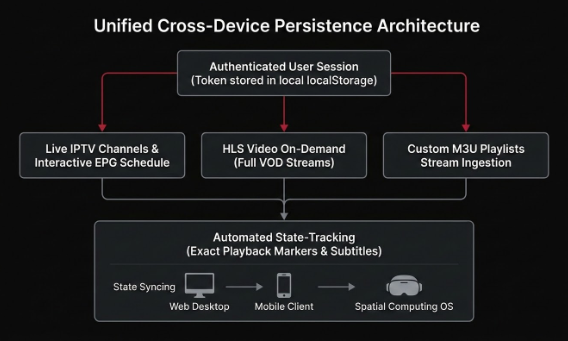
Unifying disparate streaming formats under a persistent identity layer converts fragmented device usage into a single, cohesive product experience, driving long-term retention.
7. Conclusion: The New Baseline for Digital Products
Digital growth relies on eliminating structural friction across the user journey. Synthesizing zero-redirect identity layers, disciplined visual topologies, and spatial computing architecture establishes a new operational benchmark for digital product design. Removing onboarding barriers, standardizing visual dark-mode canvases, and supporting cross-device state persistence unlocks immediate product value for end-users.
Take a critical look at your platform’s current design architecture: Are your authentication mechanisms, visual layout systems, and session states building frictionless bridges for your users, or are legacy patterns quietly driving them away?