March 26, 2026 /Mpelembe Media/ — Agentic payment protocols like x402, MPP, and L402 are fundamentally reshaping the internet economy by enabling machines to transact seamlessly without human intervention, user accounts, or traditional subscriptions. By allowing software to autonomously negotiate and settle micro-transactions, a wide variety of real-world use cases have emerged across several distinct categories:
1. On-Demand Data and API Access Instead of relying on expensive monthly subscriptions or static API keys, AI agents can pay for the exact data they need on a “pay-per-request” basis.
Financial & On-Chain Data: Agents can autonomously purchase real-time crypto quotes and market metrics from platforms like CoinGecko for as little as $0.01 per request. They can also access professional-grade blockchain analytics, whale tracking, and yield scoring through services like Nansen and Messari.
General Information: Agents can pay fractions of a cent to access utility APIs providing live weather updates, maps, domain analysis, or legal information mid-workflow.
2. AI Compute and Software Tooling Agents can now procure their own infrastructure and computational power to complete complex tasks.
Compute & Inference: An AI assistant that requires specialized processing power can outsource tasks to other models, paying for GPU inference time per millisecond through providers like Hyperbolic.
Web & Developer Tools: Agents can spin up and pay for headless cloud browser sessions via Browserbase to navigate the web, use Firecrawl to scrape and turn websites into LLM-ready data, or even pay Obol to generate production-ready code, run tests, and open GitHub pull requests.
MCP Integration: Through the Model Context Protocol (MCP), agents can dynamically discover and pay for specialized “skills” or tools on the fly—such as image generation, speech-to-text, or secure code execution—paying per tool call to complete user requests.
3. Real-World Commerce and Fulfillment AI agents are increasingly bridging the gap between the digital and physical worlds by executing real-world commercial transactions.
Physical Goods & Services: Agents can order sandwiches for delivery or pickup anywhere in New York City via Prospect Butcher Co., and Lowe’s Innovation Labs has demonstrated workflows where an AI agent handles the entire process from product discovery and research to placing a physical order.
Logistics & Admin: Agents can pay to print and send physical mail through PostalForm, pay to send and receive emails via AgentMail, or even book and pay for human consultation slots on gated calendars.
IoT & Smart Devices: Machine-to-machine commerce allows autonomous devices to pay each other for resources. For example, drones can pay for updated flight maps, electric vehicles can pay roadside sensors, or IoT fleets can autonomously purchase power and bandwidth.
4. Digital Content and Media Micropayments Agentic payments offer a powerful alternative to traditional advertising and subscription silos, creating an ecosystem where users and bots alike pay only for what they consume.
Bypassing Paywalls: Instead of signing up for full subscriptions, readers (or AI web crawlers) can pay a few cents to instantly unlock a single news article, research paper, or premium dataset.
Metered Consumption: Streaming services and software features can be billed dynamically, allowing a user to pay a fraction of a cent per second to stream a video strictly for the duration they watch.
Ultimately, agentic payments transform AI from passive chatbots into active economic participants capable of managing their own operational costs to get things done on your behalf.
The 27-Year-Old Ghost in the Machine: How x402 and MPP are Finally Giving AI a Wallet
The Checkout Bottleneck
Imagine an autonomous AI agent tasked with conducting a multi-variate market analysis or booking a complex travel itinerary. It navigates the open web with superhuman speed, synthesizing data and chaining tool calls—until it hits a wall. That wall isn’t a technical limitation; it is a “Buy Credits” button, a KYC-heavy signup form, or a legacy credit card entry field.This is the fundamental friction point of the modern internet. Our digital economy was built for humans with fingers to type and eyes to watch advertisements. For an autonomous agent, these human-centric hurdles are economic dead ends. The solution lies in “Agentic Payments”: a paradigm shift where the fundamental action of the web evolves from browsing to transacting. At the heart of this shift is the revival of a long-dormant piece of internet architecture: the 402 status code.
The Resurrection of HTTP 402
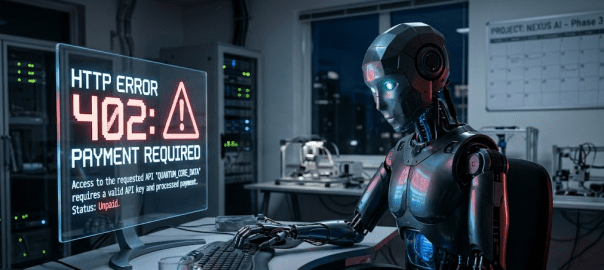
The HTTP status code 402, defined as “Payment Required,” has been a “ghost in the machine” since the late 1990s. While status codes like 404 (Not Found) or 200 (OK) became the universal vocabulary of the digital age, 402 was “Reserved for future use.”This omission represents the “Original Sin” of internet design. By shipping the web without a native layer for value transfer, developers were forced to build fragmented workarounds: third-party processors, invasive ad-driven models, and complex subscription silos.”the web shipped with a ‘pay here’ slot that nobody ever wired up.”It took nearly three decades and the rise of Agentic AI to finally wire that slot. The December 2025 update to the protocol, known as x402 V2 , finally moved all payment data into headers, freeing the response body and formalizing a unified payment interface. By transforming 402 from a placeholder into a functional “pay-per-request” mechanism, we are enabling machines to purchase resources—compute, data, or API calls—as effortlessly as they request web pages.
Moving from Attention to Micro-Value
The current web model is predicated on the “Attention Economy.” Content is ostensibly free because humans stay on pages long enough to view commercials or provide data for targeted ads. AI agents, however, do not watch commercials. They do not browse pricing pages or click banners. As machines become the primary consumers of web content, the ad-driven and subscription-heavy models simply break.This forces a shift from “Attention” to “Micro-Value,” where concepts like “Pay-Per-Crawl” and “Pay-Per-Inference” become the new standard. In this world, a $0.01 API call is viable because it doesn’t have to absorb the traditional $0.30 + 2.9% credit card processing fee. On high-throughput networks like Solana, fees drop to a negligible $0.00025, making sub-cent transactions a reality.
- The Old Way: Mandatory account signup, KYC delays, prepaid credit commitments, and manual API key management.
- The x402 Way: An agent sends a request, receives a PAYMENT-REQUIRED header, settles the cost via a PAYMENT-SIGNATURE payload, and receives the resource alongside a PAYMENT-RESPONSE receipt.
Protocol Minimization vs. System Maximization
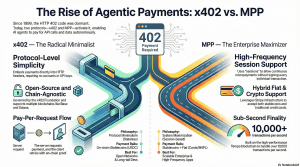
As of early 2026, two primary standards have emerged: Coinbase’s x402 and Stripe’s Machine Payments Protocol (MPP) . While they share the 402 status code, they occupy different niches in the ecosystem.x402: The Protocol for the Open Web Led by the x402 Foundation (jointly initiated by Coinbase and Cloudflare), this protocol pursues “protocol minimization.” It is designed to be as simple as an HTTP request: no accounts, no intermediaries, and purely on-chain settlement using stablecoins like USDC. It is the “Unix philosophy” of payments, integrated into frameworks like Google Cloud’s AP2 and World’s AgentKit. It is the natural choice for the long-tail of decentralized networks and open-source SDKs.MPP: The System for the Global Enterprise Co-authored by Stripe and Tempo, MPP is a “full-stack” solution. It prioritizes “system maximization,” addressing the messy realities of high-frequency commercial traffic and compliance. While x402 is chain-agnostic, MPP is built atop the Tempo Layer 1, a blockchain optimized for payments that handles 10,000+ TPS with sub-second confirmation. MPP is backed by a powerhouse coalition including OpenAI, Anthropic, Shopify, and DoorDash.
The Magic of Sessions and Shared Payment Tokens
The most significant innovation of the Machine Payments Protocol is the concept of Sessions . In a standard “exact” scheme, every resource request requires an individual on-chain signature. For an agent hitting thousands of endpoints per hour, the latency and cost of individual signatures are prohibitive.MPP utilizes an “upto” logic, allowing an agent to authorize a spending limit—a session—once. The agent can then stream thousands of micropayments against that limit with sub-millisecond latency. Crucially, the Tempo blockchain operates with no native gas token , meaning agents don’t have to hold “random tokens” just to pay network fees; they settle directly in USDC.Furthermore, Stripe’s Shared Payment Tokens (SPTs) act as the critical bridge to the legacy financial world. SPTs allow an agent to utilize a user’s bound Visa or Mastercard to settle a transaction on the Tempo chain without exposing raw PII. This allows funds to flow into a merchant’s existing Stripe balance, inheriting the $19 trillion worth of fraud protection, tax handling, and reporting infrastructure that Stripe processed in 2025.
Reality Check: The 1998 Fiber Optic Moment
Despite the technical momentum, a reality check is necessary. Stripe may be processing $19 trillion annually, and Coinbase’s x402 infrastructure may have handled over 50 million transactions, but the “Agentic Economy” is still in its infancy.Data from Artemis and CoinDesk as of March 2026 shows a daily transaction volume of approximately $28,000, with an average payment of just $0.20. Much of this is currently experimental or gamified behavior. We are laying the track, but the heavy freight has yet to arrive.”The only question that remains is: in 2026, will AI agents really need to make large-scale transactions on this track? Or is it more like laying fiber optics in 1998—the demand hasn’t arrived yet, but the infrastructure is ahead.”We are in the “fiber optic” stage. The protocols are ready, the partnerships with Mastercard, Visa, and Anthropic are signed, and the “pay-per-request” handshake is standardized. We are simply waiting for the killer applications to saturate the lines.
Conclusion: The Language of the Web
The resurgence of the 402 status code represents more than a technical update; it is the transition from an internet of information to an internet of value. As we move away from the friction of human-centric checkouts, the very nature of our interaction with the web will change.We are entering an era where the fundamental action of the internet is shifting from “search” to “pay.” In this landscape, value moves as effortlessly as a packet of data, and every network-exposed endpoint becomes a potential revenue stream.As a developer or founder, the strategic question is no longer whether you should monetize your API, but how. Are you building for a web that still waits for a human to click a button, or are you preparing for an economy where your primary customers are the agents who can pay their own way?