
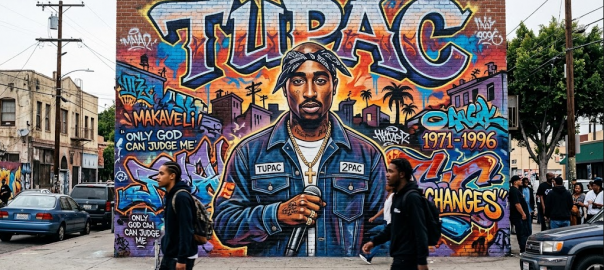
Justice at Last: Duane “Keffe D” Davis Convicted of Tupac Shakur’s 1996 Murder
Tue Sep 01 2026 /Mpelembe Media/ — Nearly thirty years after the drive-by shooting that claimed the life of hip-hop icon Tupac Shakur, a Las Vegas jury has found former South Side Compton Crips leader Duane “Keffe D” Davis guilty of first-degree murder. Deliberating for less than three hours following a weeks-long trial, the panel of twelve jurors delivered the historic verdict in Clark County District Court under Judge Carli Kierny. While prosecutors did not allege that the 63-year-old Davis actually pulled the trigger, they successfully demonstrated that he acted as the “shot caller” who acquired the weapon, assembled the crew, and coordinated the fatal ambush. Under Nevada law, any individual who aids, abets, or orchestrates a murder shares equal criminal liability as the principal shooter.
The prosecution framed the September 7, 1996, slaying near the Las Vegas Strip as a highly premeditated act of gang retaliation. Hours before the drive-by, Tupac Shakur and his Death Row Records entourage—affiliated with the Mob Piru Bloods—had publicly assaulted Davis’s nephew, Orlando “Baby Lane” Anderson, in the lobby of the MGM Grand casino. Seeking retribution for this public humiliation, Davis systematically acquired a .40-caliber Glock, gathered his associates, and “went hunting” for the rapper and Death Row founder Marion “Suge” Knight. The group eventually spotted Shakur riding passenger in Knight’s black BMW at a red light, pulled alongside them in a white Cadillac, and fired multiple rounds. Shakur was struck several times and succumbed to respiratory failure and cardiac arrest six days later on September 13, 1996, after having his right lung surgically removed. Davis is the sole living survivor from the white Cadillac; his nephew Orlando Anderson was killed in an unrelated gang shootout in 1998, and the other passengers are also deceased.
The state’s case was built almost entirely on Davis’s own extensive history of self-incrimination, which cold-case investigators used to revive the long-dormant investigation. Prosecutors played eight hours of recorded confessions and held up Davis’s 2019 tell-all memoir, Compton Street Legend, where he openly bragged about his role in planning the hit. Although Davis had initially detailed the events in a 2008 federal proffer interview under the assumption of immunity, prosecutors successfully argued that he had waived those confidentiality protections by commercializing and repeating his role across various documentaries and public memoirs. In contrast, defense attorney Michael Sanft urged the jury to reject the prosecution’s case as “fiction”, characterizing Davis’s admissions as embellished “braggadocio” meant to profit from the public’s endless fascination with Shakur’s death. Sanft heavily criticized the police investigation and emphasized the total absence of physical or contemporary forensic evidence—such as phone records, receipts, or surveillance footage—that could independently place Davis in Las Vegas or inside the Cadillac that night.
The trial was punctuated by emotional and tense moments that highlighted the lingering trauma of the nearly thirty-year-old murder. Dr. Lisa Gavin, a forensic pathologist, detailed the grim realities of the shooting, showing graphic autopsy photographs of Shakur’s bloated, wounded body that prompted some of his family members to weep and exit the courtroom. Reluctant witnesses from the 1990s gangland scene had to be subpoenaed and compelled by the court to testify. James “Mob James” McDonald, a former Death Row associate, grew heated on the stand under cross-examination, declaring he wanted to be treated as a hostile witness and refusing to identify others who were present, stating directly to Davis that he was not going to help send him to prison. Despite the code of silence and the challenges of a three-decade delay, the jury ultimately aligned with the prosecution’s narrative of a calculated, organized execution.
Following the verdict, Judge Kierny ordered Davis to be held without bail until his formal sentencing hearing, which is scheduled for October 13, 2026. First-degree murder in Nevada carries a penalty ranging from twenty years to life imprisonment, though prosecutors voluntarily dropped a gang enhancement and confirmed they would not seek the death penalty. The reading of the verdict brought tears and a sense of closure to Shakur’s family, including his sister Sekyiwa “Set” Shakur, who wept in the courtroom, while Davis’s son sat covering his face. Davis immediately indicated that he plans to appeal the conviction.
The Vanity of a Legend’s Ghost: How Duane Davis Traded Silence for a Legacy and Found a Life Sentence
- Introduction: A 30-Year Mystery Meets a Modern Verdict
For nearly three decades, the 1996 killing of Tupac Shakur existed in a vacuum of silence and conspiracy—a high-profile drive-by near the Las Vegas Strip that redefined hip-hop culture while leaving investigators with an empty file. The three-decade vacuum of justice finally imploded on August 31, 2026, when a Las Vegas jury delivered a first-degree murder conviction against Duane “Keffe D” Davis.The legal resolution of this case is a study in counter-intuition. In an era of high-definition surveillance and genetic genealogy, Davis was convicted without a single piece of modern forensic evidence. There were no cell site records, no DNA recovered from the 1996 crime scene, and no digital breadcrumbs. Instead, the prosecution relied on the one thing Davis could not withhold: his own ego. The 2026 trial proved that the most famous murder in hip-hop wasn’t solved by a forensic breakthrough, but by a defendant who simply could not stop talking.2. The Witness Who Wasn’t There: How a Memoir Became a Smoking Gun
In the theater of the Clark County District Court, the prosecution’s most devastating witness was the man sitting at the defense table. Duane Davis effectively prosecuted himself by seeking to profit from his proximity to death. His 2019 memoir, Compton Street Legend , provided the state with a roadmap that investigators had lacked for a generation.The defense strategy, led by Michael Sanft, was as blunt as it was desperate. Sanft attempted to frame the book as a work of “fiction vs. fact,” famously using a “Jack and Rose/Titanic” analogy. He argued that while the sinking of the ship was a historical reality, the characters and their actions were fictional embellishments designed to sell copies. Sanft went so far as to tell the jury that his own client was “full of crap,” characterizing Davis’s admissions as the “braggadocio” of a man desperate for relevance. The jury, however, was not entertained; they rejected the “fictional” defense in less than three hours.“Them jumping on my nephew gave us the green light to want to do something to their ass,” Davis wrote in his memoir. “Pac chose the wrong game to play.”3. The “Shot Caller” Reality: Convicted Without Pulling the Trigger
The central legal takeaway of the trial was the lethal clarity of Nevada’s conspiracy and co-conspirator laws. Duane Davis was convicted of first-degree murder despite the fact that every party in the courtroom—including the prosecution—agreed he was not the gunman. In the eyes of the law, the plan is as deadly as the bullet.A gang expert testified to the rigid hierarchy of the South Side Compton Crips, identifying Davis as a “shot caller” whose directives were mandatory for younger members. Prosecutor Binu Palal argued that Davis did not just “ride along”; he acquired the .40-caliber Glock, orchestrated the search, and “went hunting” for Shakur and Suge Knight after the earlier altercation at the MGM Grand. By establishing Davis as the architect of the retaliation, the state proved that providing the weapon and the order is legally indistinguishable from pulling the trigger.4. A Trial Drenched in Circumstance and Vanity
The 2026 trial was a deliberate time capsule. Prosecutors Marc DiGiacomo and Binu Palal navigated the “holes” highlighted by the defense—the missing hotel bill, the lack of surveillance, and the unreliability of thirty-year-old memories—by leaning into the defendant’s obsession with his own notoriety.One of the most damning pieces of evidence was not a forensic report, but a scrapbook Davis kept containing articles about the murder. For a culture critic, this detail is the skeleton key: Davis wasn’t just a participant in the crime; he was a fan of its legacy. Prosecutors played eight hours of recordings from four separate events across different years. Despite minor evolutions in his storytelling, the core fact remained: Davis repeatedly placed himself inside the white Cadillac from which the shots were fired. The jury’s lightning-fast deliberation suggests that the “circumstantial” nature of the case vanished the moment Davis’s own voice filled the courtroom.5. The Burden of Closure: Facing the Physical Truth
The trial’s emotional peak occurred when Dr. Lisa Gavin presented the autopsy photos of Tupac Shakur. The moment highlighted the heavy toll of “delayed justice” on the Shakur family. While some relatives, including Tupac’s sister Sekyiwa “Set” Shakur and another woman, chose to step out of the courtroom to avoid the “grisly” imagery, others remained to face the physical reality of the three bullets that ended a legacy.Zayd Akinyela, Shakur’s cousin, stayed through the entire presentation, viewing the bloated photos and chest tubes as a necessary, if agonizing, step toward reclaiming the truth from decades of conspiracy theories. For the family, the trial wasn’t just about a verdict; it was about the clinical finality that finally allowed them to grieve a human being rather than a mystery.”I think we’ve been waiting 30 years to grieve properly,” Zayd Akinyela told reporters. “A lot of people don’t get to grieve until they understand what happened to their loved one and how it happened.”6. The “Bill Cosby” Shadow: The Failed Immunity Defense
The defense pinned its hopes on the “Bill Cosby” defense, attempting to suppress a 2008 “proffer” statement Davis gave to federal authorities. Sanft argued that Davis only spoke under the belief that he had been granted immunity.The prosecution successfully distinguished Davis’s case from the Cosby precedent, noting the absence of any formal non-prosecution agreement. The irony of Davis’s legal position was profound: in 2008, he told the truth to “thread the needle” and avoid a life sentence in a narcotics case. He was required to be accurate to secure that deal. Eighteen years later, that same requirement for truth became the foundation of his murder conviction. Davis’s attempt to save himself from one prison term provided the state with the roadmap to ensure another.7. Conclusion: The Finality of a Legend’s End
The conviction of Duane Davis brings a sense of clinical finality to a saga that has haunted the justice system since 1996. While Davis has expressed his intent to appeal and requested the return of his personal belongings—including computers and phones—he remains held without bail. In a final shift in the legal landscape, prosecutors voluntarily dropped the gang enhancement following the verdict due to “witness logistics,” though Davis still faces a sentence of up to life in prison on October 13.Ultimately, this trial proved that no amount of time can obscure a crime when the perpetrator insists on narrating it. It wasn’t a “super-detective” or a DNA breakthrough that solved the most famous murder in hip-hop; it was the defendant’s own vanity. Duane Davis traded thirty years of freedom for a memoir and a scrapbook, proving that in the end, his desire for a legacy was stronger than his desire for liberty.Does this conviction finally lay the ghosts of 1996 to rest, or does a 30-year delay for a man who had already confessed suggest that the justice system only moves when the criminal hands it the keys?