
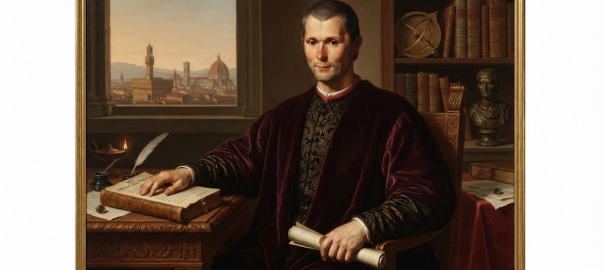
Power, Virtù, and Human Nature: A Multidisciplinary Synthesis of Machiavellian Pragmatism
Thu Oct. 22, 2026 /Mpelembe Media/ — Niccolò Machiavelli’s foundational political thought, articulated in The Prince (1513) and the Discourses on Livy (1517), marks a radical shift from classical teleological ethics and medieval Christian scholasticism toward empirical political realism. Rejecting idealized imaginary republics, Machiavelli sought the “effectual truth” of human behavior, asserting that effective governance must be guided by strategic necessity (necessità) and the preservation of state stability (ragione di stato) rather than abstract moral pieties. He redefined virtù not as moral goodness, but as the dynamic capability, drive, and tactical agility—symbolized by combining the courage of the lion with the cunning of the fox—required to master unpredictable circumstances (fortuna). Although critics historically viewed The Prince as an autocratic handbook and the Discourses as a defence of republican liberty, scholars emphasize that these works are complementary: princely authority is often necessary to establish order in a corrupted state, whereas a mixed republican constitution preserves long-term security, popular freedom, and civic vitality.
Beyond immediate statecraft, Isaiah Berlin highlighted Machiavelli’s deeper philosophical revolution, arguing that his work exposed the fundamental breakdown of Value Monism—the ancient Western assumption that all genuine human virtues can harmoniously coexist within a single rational framework. Machiavelli demonstrated an irreconcilable conflict between two distinct moral systems: Judeo-Christian ethics, which prioritize personal salvation, humility, and unconditional honesty, and Classical Pagan civic ethics, which prioritize strength, collective grandeur, and political self-preservation. Because applying private Christian scrupulosity in an adversarial political arena leads to inevitable subjugation by bad-faith actors, Machiavelli forced a conscious choice between saving one’s soul and saving one’s state. By showing that ultimate human values can directly collide without the possibility of a single harmonizing solution, Machiavelli unintentionally laid the intellectual groundwork for modern value pluralism, empiricism, and political tolerance.
In the 20th century, Machiavelli’s observations were translated into personality psychology by Richard Christie and Florence Geis, who developed the MACH-IV scale to measure Machiavellianism as a quantitative psychometric trait. Defined through three sub-dimensions—a cynical view of human nature, endorsement of manipulative tactics, and flexible, situational morality—Machiavellianism exists on a spectrum across the general population. As a core component of the Dark Triad alongside narcissism and subclinical psychopathy, Machiavellianism is uniquely distinguished by its focus on long-term planning, cold strategic calculation, and the “cool syndrome” of emotional detachment. While high scores can impede close personal relationships built on mutual trust, moderate strategic realism provides a functional, non-pathological advantage in high-stakes bargaining, negotiation, and competitive environments.
6 Counter-Intuitive Lessons from Machiavelli That Will Change How You View Power
1. Introduction: The Myth of “Murderous Machiavel”
Few names in intellectual history carry the visceral, dark weight of Niccolò Machiavelli. In contemporary political speech and culture, “Machiavellian” is used as a sleek, casual insult—a shorthand for sociopathic cunning, ruthless backstabbing, and political gangsterism. This reputation was forged almost immediately after his death, codified by Renaissance English playwrights like William Shakespeare, who decried the “murderous Machiavel,” and by the Catholic Church, which placed his complete works on its Index Librorum Prohibitorum in 1552 as the Devil’s own catechism.
Yet this cartoonish villainy flattens one of the most brilliant and deeply misunderstood minds of Western political thought. Born in Florence in 1469, Machiavelli was neither a sinister court adviser nor a shadowy mastermind of tyrants. He was a hardworking civil servant, diplomat, and unyielding republican patriot. From 1498 to 1512, he served as Secretary to the Second Chancery of the Florentine Republic, traveling on demanding diplomatic missions to France, Germany, and the Papal Court. When the republic collapsed in 1512 under Spanish military force and the Medici dynasty returned to absolute rule, Machiavelli’s world was shattered. Stripped of his office, he was imprisoned, placed in irons, and subjected to brutal torture on suspicion of anti-Medici conspiracy.
Exonerated but exiled from public life, Machiavelli retreated to a modest farm seven miles south of Florence. Miserable in his enforced retirement and yearning for the high-stakes chess match of statecraft, he channeled his frustration into writing. Between 1513 and 1517, he produced his twin masterpieces: The Prince and the Discourses on Livy . Far from an endorsement of senseless evil, Machiavelli’s works offer an unsparing, brilliant, and deeply counter-intuitive analysis of how power actually operates. Stripping away centuries of pious myth reveals six radical lessons that shatter our modern assumptions about freedom, authority, and leadership.
2. Takeaway 1: Machiavelli Wasn’t a “Machiavellian”—He Was a Lover of Liberty
The greatest irony of Machiavelli’s legacy is that the thinker associated with tyranny was, in truth, an ardent defender of popular self-government. While The Prince reads as an emergency manual for absolute rulers navigating a crisis, his longer masterwork, the Discourses on Livy , reveals his core political commitment: civic freedom, republican self-rule, and popular sovereignty. Machiavelli argued explicitly that principalities are fundamentally unstable because the private interest of a prince almost always conflicts with the public interest of the state.
This dual focus between absolute authority in The Prince and republican liberty in the Discourses is not a contradiction, but a cold diagnostic of political life. Machiavelli recognized that when a city becomes thoroughly corrupt—when civic virtue decays and self-interest consumes the populace—free democratic institutions cannot repair themselves. Citizens bogged down in factional degeneracy cannot debate their way back to health. In such moments of profound rot, a single extraordinary authority ( uno solo ) using absolute, unyielding force is required to purge corruption and re-establish institutional order.
However, Machiavelli insisted that while one person is necessary to create a state, a single ruler cannot maintain it. Monarchy inevitably degenerates through weak or tyrannical heirs. Lasting stability requires handing authority back to the people and their institutions. He captured this mechanical balance in his famous maxim: “one to order, many to maintain.” Absolute princely power is an emergency medicine to reset a broken state; republican self-government is the daily nourishment that keeps it alive and free. Once established, Machiavelli placed far more faith in the public than in any monarch, declaring in the Discourses that the collective public (“the voice of a people”) possesses better judgment, greater constancy, and higher wisdom than any individual prince.
“He professed to teach kings, but it was the people he really taught.” — Jean-Jacques Rousseau, The Social Contract
3. Takeaway 2: Moral “Goodness” is a Political Liability—Learn How Not to Be Good
In Chapter 15 of The Prince , Machiavelli committed the ultimate philosophical heresy by declaring that an insistence on acting morally in politics leads directly to disaster. In a world populated by predatory, self-interested, and opportunistic actors, a leader who insists on living up to high-minded ethical professions in every situation will inevitably be destroyed by those who play by no rules at all.
This insight birthed the doctrine of raison d’état (reason of state) and the political problem of “dirty hands.” Machiavelli demanded that analysts discard utopian fantasies and look directly at “how one lives” rather than “how one ought to live.” In the brutal arena of high-stakes governance, traditional moral virtues can become fatal vices, while actions condemned as “vices” or “cruelties” become genuine political virtues if they secure stability, protect the state, and preserve the public peace.
“Hence it is necessary for a prince wishing to maintain his position to know how to do wrong, and to make use of it or not according to necessity.” — The Prince , Ch. 15
To prove this paradox, Machiavelli contrasted the ruthless campaign of Cesare Borgia with the soft-hearted hesitation of the Florentine government. Borgia was widely condemned for his brutal methods in unifying the Romagna. Yet by applying swift, decisive severity, Borgia eliminated local lawlessness, brought peace, and established lasting order for the population. Florence, by contrast, seeking to maintain a reputation for Christian mercy and moral purity, refused to intervene decisively during factional uprisings in Pistoia. The result of Florence’s gentle inaction was widespread violence, plunder, and bloodshed. Borgia’s targeted, disciplined cruelty was ultimately far more merciful than Florence’s moral squeamishness, because widespread civil disorder harms an entire community, whereas a ruler’s strategic executions affect only specific guilty individuals.
4. Takeaway 3: Social Conflict Isn’t a Flaw—It’s the Engine of Freedom
Classical political philosophy, from Plato and Aristotle through medieval scholasticism, treated social harmony as the supreme political good. Internal factionalism and class friction were viewed as diseases that tore the body politic apart. Machiavelli boldly inverted this ancient consensus, delivering one of his most revolutionary insights: social conflict, far from signaling decay, is the primary driver of constitutional strength and civic liberty.
Analyzing the rise of ancient Rome, Machiavelli praised the perpetual “tumults between the nobles and the plebs.” He observed that every state contains two fundamental, irreconcilable psychological forces—the “two diverse humors”:
- The humor of the great (the elites), who possess a strong desire to dominate.
- The humor of the common people, who possess a single overwhelming desire not to be dominated.
Rather than trying to smother this friction, Rome constructed a system that channeled it. The dynamic tension between elite ambition and popular resistance forced the creation of the Tribunes of the Plebs and fostered robust, mixed constitutional checks. Class struggle was not a failure of the state; it was the dynamic friction that generated bad laws’ replacement with good ones, preserving civil freedom.
To keep this friction constructive rather than destructive, Machiavelli stressed the institutional distinction between legal Accusations and secret Calumnies ( Discourses I.7–8). A healthy republic must provide formal, constitutional mechanisms for citizens to publicly accuse powerful elites of overstepping their authority. Public accusations allow popular ill humor to vent legally through established institutions. Without such legal outlets, public resentment curdles into secret calumnies, private slander, and conspiratorial vendettas—toxins that destroy civil trust, fracture the state into private factions, and invite ruinous foreign intervention.
5. Takeaway 4: “Virtue” Has Nothing to Do with Morality
To read Machiavelli correctly, one must understand that when he writes virtù , he does not mean “virtue” in the Christian or Aristotelian sense. Classical and Christian thinkers defined virtue teleologically as a moral perfection—an inner state of grace, justice, and self-restraint aimed at achieving human flourishing ( eudaimonia ) or divine salvation. Machiavelli stripped the concept of all transcendent teleology and moral content, reverting to an older, pagan Roman concept of raw human capacity: energy, drive, courage, cunning, willpower, and martial fighting spirit.
Machiavelli rejected the idea that human affairs are governed by natural law, divine providence, or a cosmic moral order. In his physicalist worldview, human beings exist in an indifferent universe governed by dynamic, unyielding “natural necessity.” In this chaotic arena, human agency is locked in constant struggle with Fortuna —the unpredictable, turbulent river of chance. While Fortuna can sweep away soft, unprepared leaders, a statesman possessing true virtù constructs dykes and embankments through strategic foresight, audacity, and decisive action to harness or tame the raging river.
This break from classical teleology is visible in Machiavelli’s choice of vocabulary:
- The word for “soul” ( anima )—central to classical philosophy and Christian theology as the transcendent moral essence of man—is entirely absent from both The Prince and the Discourses .
- It is replaced by animo , meaning “spirit,” “spiritedness,” or the raw, physical willpower required to defend oneself, one’s family, and the fatherland ( patria ).
For Machiavelli, political principles do not descend from God or an inherent natural law. They are forged under the pressure of physical necessity, where survival in a dangerous world demands adaptability, grit, and raw human will rather than passive piety.
6. Takeaway 5: Rulers Must Master Illusion and Sensational Public Spectacle
Machiavelli was a master psychologist who understood that the vast majority of human beings live in a world of appearances. Most people lack the time, inclination, or political access to evaluate a ruler’s true motives; they judge governance entirely by surface optics and tangible outcomes. Because perception is political reality, a leader must become an expert in managing illusion, spectacle, and public drama.
To navigate political life successfully, Machiavelli famously advised that a ruler must blend the qualities of two beasts: the lion and the fox. The lion possesses brute force but is blind to hidden traps; the fox recognizes traps but cannot fight off wolves. Force alone is insufficient; a leader must be a gran simulatore e dissimulatore —a master dissembler and craftsman of public perception—capable of deploying strategic deception alongside physical power.
“In the actions of all men, and especially of princes, where there is no court of appeal, one judges by the result.” — The Prince , Ch. 18
A crucial element of this political theater is the strategic use of sensational, extraordinary acts of state violence. Drawing on Discourses III.1, Machiavelli argued that states periodically suffer inevitable institutional decay and public cynicism. To halt this decline, a republic or prince must regularly perform dramatic, terrifying public acts—such as spectacular executions of corrupt elites or the sudden imposition of extraordinary dictatorships. These shocking displays of state authority snap citizens out of civic apathy. By renewing the foundational fear, awe, and reverence that existed at the state’s origin, these sensational acts effectively pull a decaying polity back to its “beginnings” ( ritornare ai principii ), refreshing the civic order and restoring respect for the law.
7. Takeaway 6: Christianity Made the Modern World Weak
Perhaps Machiavelli’s most blistering attack was directed at the dominant spiritual institution of his age. While he acknowledged the instrumental value of religion as a vital tool for social cohesion and public discipline, he drew a sharp distinction between utility and truth. Machiavelli aggressively criticized Christian theology for enfeebling the modern world and crippling civic spirit.
Machiavelli argued that Christian doctrine fundamentally inverted human priorities. By glorifying humility, meekness, lowliness, self-abnegation, and the passive endurance of suffering in pursuit of an otherworldly heaven, Christianity drained citizens of civic energy. It left society defenseless, creating a world made weak and handed over as easy prey to unprincipled, predatory men who operate without moral restraints.
He explicitly contrasted this otherworldly ethos with the virile, earthly religions of ancient paganism, which exalted:
- Great military commanders, republican statesmen, and civic founders.
- Physical strength, worldly honor, and heroic earthly glory.
- The fierce, active defense of political liberty and the fatherland.
Compounding this theological critique, Machiavelli leveled a brutal geopolitical indictment against the Roman Catholic Church. He charged the papacy with being the single greatest cause of Italy’s political ruin and humiliation. The Church possessed enough wealth, temporal authority, and diplomatic leverage to block any rival Italian power from unifying the peninsula, yet lacked the military strength to unify Italy under its own banner. Consequently, the papacy kept Italy politically fragmented, leaving it “lawless, crushed, despoiled, torn, overrun,” and perpetually exploited by foreign invaders.
8. Conclusion: The Realist Legacy—Judging Politics by Its Fruits
Machiavelli’s lasting contribution to political philosophy lies in his refusal to construct comfortable, utopian fantasies. By demanding that we evaluate political life through “the effectual truth of things” ( verità effettuale ) rather than abstract moralizing, he forced humanity to confront governance as a hard, empirical discipline grounded in human psychology, structural power, and physical necessity. He proved that high-minded intentions mean nothing in politics if they produce chaotic, ruinous results, whereas hard-headed, dirty-handed decisions can often secure the peace, stability, and freedom of an entire society.
His cold-eyed realism presents modern liberal democracies with an unavoidable challenge. In an era dominated by moralizing rhetoric, media optics, and deep institutional stagnation, Machiavelli’s writings demand that we look past reassuring pieties. We are left with a sharp, enduring question: Can open societies survive purely on high-minded, unyielding ethical ideals—or does Machiavelli’s outcome-driven realism remain an inescapable law of political survival?