
Beyond the Prompt: Building Defensible AI Products in a World of Commoditized Intelligence
Tue, Jun 02 2026 /Mpelembe Media/ — The “idea-to-scale” cycle has been weaponized. In previous tech cycles, the distance between a concept and global execution was measured in years; today, it is measured in weeks. We are witnessing the “Great Compression”—a collapse of the traditional barriers to production that has left many in a state of “AI fatigue.” If you believe AI is just a chatbot in a browser, you’ve already lost the plot.We are transitioning from simple orchestration to the era of “vibe design.” In this new landscape, multi-modal interaction is the baseline, and the ability to describe a vision or feel an outcome is the new coding. For the tech strategist, the goal isn’t just to use AI, but to identify the counter-intuitive shifts rewiring how humans and machines interface.
- The Post-Keyboard Era and New Interfaces: The architecture of human-computer interaction is experiencing a profound realignment, moving away from traditional keyboards toward voice-first technologies, spatial computing, and eventually brain-computer interfaces. As these friction-reducing interfaces become the norm, digital environments are expanding beyond flat screens into multi-sensory experiences powered by generative haptics and spatial acoustics.
- The Transformation of the Creator Economy: Generative AI is democratizing high-fidelity media production, drastically lowering the cost and technical barriers for creating professional video, audio, and gaming content. Because AI automates the technical execution, human creators are transitioning into “creative directors” managing fleets of specialized AI agents. Consequently, the true value of media is shifting; authentic storytelling, unique lived experiences, and human “taste” have become the ultimate competitive advantages against generic AI-generated content.
- Synthetic Coworkers and Employee Digital Twins (EDTs): Enterprises are rapidly shifting from static text communications to interactive, AI-driven video utilizing lifelike digital avatars. The workforce is also seeing the introduction of EDTs—AI systems that replicate a specific employee’s knowledge, communication style, and decision-making mindset. While this offers incredible scalability for training and customer support, it introduces massive new risks regarding identity hijacking, organizational governance, and the legal ownership of an employee’s “digital ghost” post-employment.
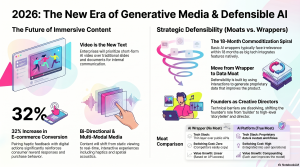
- Strategic Defensibility for AI Startups: The sources highlight a brutal 18-month commoditization timeline for startups functioning as “thin wrappers” (basic user interfaces built over foundation models). To survive inevitable platform updates and price wars, startups must build “thick” wrappers by establishing a three-layered moat: accumulating proprietary data, designing behavioral feedback loops that improve the model with use, and embedding the AI deeply into mission-critical enterprise workflows.
The Rise of the Employee Digital Twin: Navigating the Four Layers of Synthetic Identity
Beyond the Bio-Digital Divide: The Post-Keyboard Evolution
The global workforce is currently navigating a tectonic shift away from the keyboard-centric paradigm toward a “post-keyboard world.” As a workforce futurist, I see the traditional bio-digital divide dissolving. We are moving beyond voice and touch toward neural modalities and brain-computer interfaces (BCI) that intuit needs rather than waiting for articulated commands. In this landscape, the Employee Digital Twin (EDT) is evolving from a technical novelty into a high-utility “second brain”—a digital extension of the employee’s mind and professional persona.The EDT represents a transition from static avatars to autonomous “AI colleagues.” In an era where the marginal cost of video production is approaching zero, these twins are replacing the “ABC” (text-based) communication of slide decks and documents with “A/V” (audio/visual) experiences that are generated just-in-time. This is not merely about representation; it is about scaling human expertise through synthetic identity.
The Anatomy of an EDT: The Four Layers of Identity
To architect a secure and effective digital workforce, leaders must understand the technical benchmarks across four distinct layers of synthetic identity.
1. The Knowledge Layer: The Rise of the Video Agent
The foundational layer of an EDT is its ability to access and process information. Under the Synthesia 3.0 framework—slated for full Enterprise rollout in 2026—EDTs are transitioning into “Video Agents.” These agents are not passive; they enable two-way, real-time visual conversations by connecting directly to proprietary business knowledge bases, including SharePoint, Google Drive, and CRMs. This allows the EDT to serve as a dynamic interface for a company’s collective intelligence.
2. The Personality Layer: Diffusion Transformers and Gestural Fidelity
The visual presence of the twin is powered by “Express-2” technology, utilizing diffusion transformer (DiT) models. This represents a massive leap from earlier “talking head” avatars. These models simulate natural hand gestures, body language, and contextual movements (waving, pointing) that align with the script’s intent. Furthermore, the democratization of this layer allows for high-fidelity Personal Avatars to be generated from a single image, making the creation of a digital clone instantaneous.
3. The Mindset Layer: “Vibe Design” and Communicative Style
The most sophisticated EDTs utilize “vibe design” to replicate an employee’s specific communicative “style.” This moves the employee from a role of “operator” to “creative director.” You no longer need to be a coder or editor; if you can “describe and feel” a perspective, the EDT executes it. This is supported by Express-Voice cloning, which matches tone, rhythm, and dialect across 80+ languages, ensuring the employee’s unique “vibe” is preserved in every interaction.
4. The Trust Layer: The Haptic ROI
Trust in a digital twin is built through sensory precision. We are seeing a move from legacy Eccentric Rotating Mass (ERM) motors to precise Linear Resonant Actuators (LRA) that provide millisecond-level haptic feedback. This is not a gimmick; a 2025 study in the Journal of Consumer Research confirmed that pairing haptic feedback with digital actions increases consumer engagement and items added to carts by 32% . By integrating spatial acoustics and tactile patterns, EDTs build “perceived quality” and emotional resonance that text simply cannot match.
The New Workforce Paradigm: Directing the Fleet
In this new era, the individual employee functions as a Creative Director, managing a “fleet of agents” to multiply their professional output. The shift from “A/V over ABC” allows for hyper-personalized, just-in-time communication.Strategic Use Cases for the Fleet-of-Agents Model:
- Sales Enablement: Video Agents acting as customer prospects in real-time role-play simulations to sharpen sales skills.
- Interactive Governance: AI colleagues that facilitate employee feedback surveys, turning passive data collection into a conversation.
- Global Localization: Using “AI Dubbing” to preserve an employee’s natural voice and lip-syncing while reaching 80+ markets simultaneously.
- Just-in-Time Training: Replacing 50-page manuals with 45-second personalized videos that address an employee’s specific knowledge gap the moment it arises.
The Shadow of the Twin: Cybersecurity and Existential Risks
As a security analyst, I must warn that the current “honeymoon phase” of EDT adoption is masking a brutal reality: The 18-Month Commoditization Cycle. Most EDT startups are currently “AI Wrappers”—thin layers over foundational APIs.
- The Price War Endgame: History shows a predictable timeline: 0–6 months of high margins, 6–12 months of cloning by competitors, and 12–18 months where platform giants (Google, Microsoft) bundle these features for free. If your EDT strategy is built on a “wrapper” with no data defensibility, your ROI will evaporate in less than two years.
- Identity Weaponization: If an EDT’s “proprietary prompt chains” are not secured, they can be reverse-engineered in 48 hours. This allows bad actors to weaponize a “Personal Avatar” or “Voice Clone” for deepfake social engineering or unauthorized corporate approvals.
- The ‘Digital Ghost’ Tension: Enterprises face a unique governance problem. While technology allows a company to “switch the face” of a video library if an employee leaves, this creates a “digital ghost” problem. Without strict identity guardrails and “Secure Editing” protocols, the unauthorized use of a departed employee’s likeness remains a significant legal and ethical liability.
Governance Frameworks: Building Defensive Moats
To survive the coming consolidation, organizations must build “Layer 3” defensibility—network effects that prevent the twin from becoming a commodity.
- Proprietary Data Accumulation: The only true moat is data that competitors cannot scrape. This includes historical interaction patterns and custom training data derived from unique human experiences. Each interaction must make the twin more effective, creating a compounding advantage.
- Deep Workflow Integration: Defensibility is found in “lock-in.” By integrating EDTs into the central nervous system of the company—Slack, project management, and CRMs—the twin becomes “invisible infrastructure.” Individual users switch tools easily; entire teams do not.
- Ethical Moderation and Human-in-the-Loop: In regulated industries, “Secure Editing” is mandatory. Machine translations and AI scripts still struggle with medical or compliance-adjacent nuances. Governance must require human-in-the-loop verification to prevent hallucinated compliance violations.
Conclusion: From Echoes to Experiences
For too long, AI has been an “echo of the past,” simply reconfiguring existing datasets. The future of the Employee Digital Twin lies in its ability to draw on “unique, lived experiences”—the uncopyable elements of human perspective and “earned insight.”As we architect the digital workforce of 2026 and beyond, leaders must prioritize utility over novelty . The “wow factor” of a talking avatar is a temporary distraction. The real value lies in embedding these twins into daily workflows, securing them against the 18-month commoditization cycle, and ensuring they act as true extensions of human creativity. The keyboard is disappearing; the era of the agentic experience has arrived.