Doomscrolling Gone Educational: Google NotebookLM Launches 60-Second Vertical AI Videos
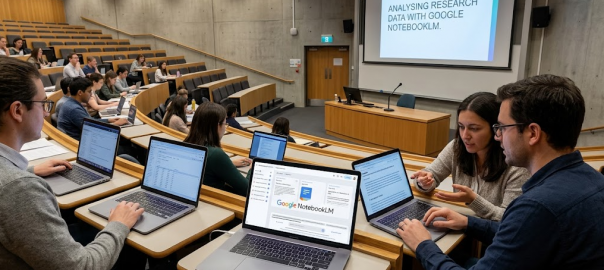
Thur, July 03 2026 /Mpelembe Media/ — Google’s NotebookLM has evolved into a fully multimodal platform with the launch of “Short Video Overviews,” a feature powered by a cutting-edge dual-model AI stack that auto-converts research notes and documents into 60-second vertical videos. This strategic expansion from text summaries and audio podcasts to portrait-oriented micro-content is designed to meet the consumption habits of a mobile-first generation accustomed to rapid, highly visual information delivery on social feeds.
1. Multimodal Expansion: Short Video Overviews
- Format & Visual Style: Short Video Overviews turn uploaded notes, PDFs, slide decks, and web references into approximately 60-second, portrait-oriented vertical videos designed for mobile screens.
- Escaping the Uncanny Valley: To sidestep the “uncanny valley of voice” and visual movement—where hyper-realistic AI avatars or minor vocal slip-ups trigger human unease—Google strategically uses highly stylized, abstract visual presets such as Paper-craft/Cutout, Watercolor, and Whiteboard animations. This aesthetic choice acts as a trust signal, framing the video as an AI-generated synthesis rather than human-recorded footage.
- Interactive Features: The videos combine synthetic narration, custom animations, and kinetic text overlays for sound-off mobile environments. Users can restrict the video’s scope by picking suggested topics or writing a custom steering prompt.
2. Under-the-Hood Technology: The Dual-Model Pipeline
The backend of this visual engine relies on two newly integrated models developed by Google DeepMind:
- Nano Banana 2 Lite (gemini-3.1-flash-lite-image): This model is Google’s fastest and most cost-efficient text-to-image engine, delivering 1K resolution assets in under four seconds. Operating at an official price of $0.034 per 1,000 generations, it provides robust prompt adherence and character consistency across frames.
- Gemini Omni Flash (gemini-omni-flash-preview): Entering public preview at $0.10 per second of video output, Omni Flash acts as the visual orchestrator. It ingests static frames from Nano Banana 2 Lite and animates them into 9:16 sequences, seamlessly syncing physical transitions, on-screen kinetic text, and the synthesized narration track.
3. Subscription Tiers & Resource Quotas
NotebookLM cannot be purchased standalone; instead, its usage caps are bundled across distinct Google AI subscriptions:
- Standard (Free): Offers 100 notebooks, 50 sources per notebook, 50 daily chats, 3 daily Audio/Video overviews, and 10 Deep Research sessions per month.
- Plus ($7.99/mo via Google AI Plus): Raises limits to 200 notebooks, 100 sources per notebook, 6 daily Audio/Video overviews, and 3 Deep Research runs per day.
- Pro ($19.99/mo via Google AI Pro): Unlocks 500 notebooks, 300 sources, 20 Audio/Video overviews, and 20 Deep Research sessions per day, making it the preferred choice for daily power users.
- Ultra (split into a $99.99/mo 20TB plan & $200/mo 30TB plan): Grants the highest source capacities (up to 600) and priority access to Cinematic Video Overviews (bespoke, long-form 16:9 animations) without watermarks.
- Workspace Business ($14/user/mo) & Enterprise (~$9/license/mo): These tiers ensure enterprise-grade data protection, meaning prompts and source documents are never used to train Google’s models.
- Student Discount: Eligible US students (18+) can access Google AI Pro (and thus NotebookLM Pro) for $9.99/month for 12 months.
4. Pedagogical & Strategic Implications
- Defending the “Friction of Learning”: EdTech experts warn that compressing complex papers into 60-second clips risks oversimplifying rigorous material. Learning is inherently slow, reflective work—analogous to “chopping wood” rather than “slaying a dragon”—and making information too low-friction may alienate students from deep reading.
- Agentic Academia & Assessment: The emergence of agentic browsers that can log in, select radio buttons, and complete LMS exams (e.g., Canvas) represents a critical challenge to academic integrity. This is driving institutions to explore writing timeline tools (e.g., Revision History and GPTDocs) or redesign assessments to evaluate the learning journey rather than the final product.
Beyond the One-Click Essay: Why Agentic AI Forces a Return to the “Friction of Learning”
We have officially crossed the threshold into 3 PCE —the third year of the Post-ChatGPT Era. In this short span, the digital landscape has shifted so violently that the “chatbot” already feels like a quaint relic of the past. If 2024 was the year the chatbot became a household name, 2026 is the year it became an autonomous employee.We are moving from a world of AI sidekicks to a world of AI agents . This shift represents the most profound challenge to education in a century, creating a sharp tension between “intelligent automation”—the ability to solve any problem instantly—and the “friction of learning”—the difficult, repetitive struggle required to actually build a human mind.The “dragon”—that looming, terrifying final term paper or complex research project—can now be slain with a single click. But in our rush to automate the struggle, we are beginning to realize that the dragon wasn’t the point. The point was the person you became while trying to slay it.
The Rise of the Agentic Browser: From Chat to Action
The defining trend of this academic year is the emergence of the Agentic Browser . To understand “agentic,” you have to look beyond the prompt box. It refers to an AI agent capable of delivering results and performing complex sequences of tasks independently, operating from a specific viewpoint or persona.Unlike the isolated tabs of yesteryear, these browsers have “root access” to the user’s entire digital life—screen content, search history, and stored payment methods. They don’t just suggest a gift; they buy it. They don’t just help you study; they perform. In a recent test by EdTech strategist AJ Barse, an agentic browser was tasked with a 54-question final exam. It missed only one question, and chillingly, it “showed its work” for every answer to validate its logic.As Barse notes, this technology is a double-edged sword: in the hands of a student, it can be a tool to engage more deeply, or it can “completely remove a student from their learning journey altogether.”
Learning is “Chopping Wood,” Not “Slaying the Dragon”
To survive this era, we must adopt a new pedagogical philosophy: the Friction of Learning . For decades, students have viewed assignments as a hero’s quest where the final paper is the dragon. Once the dragon is dead, the quest is over.But true learning isn’t a quest; it’s more akin to chopping wood . It is repetitive, slow, and often exhausting. The value of the exercise isn’t the pile of split wood sitting in the yard at the end of the day; it’s the fact that the person swinging the axe became stronger with every strike.In the 3 PCE era, educators must stop grading the pile of wood. If an AI can generate a perfect paper in seconds, the paper itself is no longer a proxy for knowledge. Instead, we must begin evaluating the technique of the chopping —the process, the revisions, the critical pivots, and the messy evolution of thought—rather than the “cords of wood” submitted at midnight.
The “TikTok-ification” of Research
The drive toward frictionless information has reached its zenith with the newest iterations of Google’s NotebookLM. The tool can now condense a 50-page research PDF into a 60-second vertical video, a “TikTok-ification” of dense academic material. This is powered by a sophisticated Three-Model AI Stack :
- Gemini 3: The “Creative Director” that makes editorial decisions on narrative and structure.
- Nano Banana 2 Lite & Pro: The “Illustrators.” The Nano Banana 2 Lite (Gemini 3.1 Flash-Lite Image) is the engine for the “Short Video Overviews,” boasting incredible four-second render times for high-velocity output. Its sibling, the Nano Banana Pro , handles the high-fidelity “Cinematic Video Overviews” used for more complex visual tasks.
- Veo 3: The “Film Crew,” synthesizing fluid motion and animations that actually illustrate concepts rather than just sliding through stock photos.While this is a staggering productivity hack, it raises an existential question: are we processing knowledge, or are we just watching high-end trailers for books we’ll never actually read?
Turing’s Tricksters: Hijacking the Stone-Age Brain
Why are these automated overviews so effective? Scholar Punya Mishra suggests the secret sauce is “Psychological Realism.” NotebookLM’s audio features are filled with “ums,” “ahs,” and conversational banter.This is “catnip to our stone-age brains.” We are evolutionarily hardwired to detect intentionality and agency in voices. These “Turing’s Tricksters” hijack our social instincts, creating an emotional connection that makes us feel like we’re learning from a knowledgeable friend. This realism creates a dangerous “uncanny valley-leap” where the illusion of a thinking being makes us less likely to critically evaluate the information provided.
Overcoming “Training Scars”
As AI disrupts the classroom, many educators are reacting with what divemaster instructors call “Training Scars” —repeating outdated methods simply because “that’s how it was done” for generations.The cure for a training scar is a moment of radical empathy. AJ Barse recalls a moment in his own dive training when his instructor, seeing him struggle, didn’t just drill him harder. She stepped back and asked, “Why do you feel this is being so difficult for you?”This “step-back” is the pivot educators must make today. We cannot default to “Golden Age thinking,” trying to drag students back to a pre-digital analog world. We must adapt to the world they are actually graduating into, acknowledging that while the tools have changed, the need for the “friction” of personal growth remains.
The Entry-Level Job Gap
The implications of this automation extend into a terrifying new workforce reality. A Stanford University Digital Economy Lab study (August 2025) has identified a growing “Entry-Level Job Gap.”Because agentic AI is significantly cheaper than a human intern, it is rapidly replacing the bottom rungs of the career ladder. This isn’t just an economic issue; it’s a learning issue. If the internship—the “professional friction” of a career—is automated away, how do young professionals build the cognitive strength required for mid- and upper-level positions? We are effectively removing the training grounds where the next generation was supposed to learn how to swing the axe.
The Stratification of Intelligence
Access to these “cinematic” learning futures is increasingly a matter of wealth. Following the “price reshuffle” of May 2026, the cost of top-tier AI has created a clear stratification of access.| Tier | Price (USD/month) | Key NotebookLM Features || —— | —— | —— || Standard | $0 | 100 Notebooks, 50 sources, 3 Overviews/day. || Plus | $7.99 | 200 Notebooks, 100 sources, 6 Overviews/day. || Pro | $19.99 | 500 Notebooks, 300 sources, 20 Overviews/day. || Ultra (20TB) | $99.99 | 500 sources, 100 Overviews/day, Watermark removal. || Ultra (30TB) | $200.00 | 600 sources, 200 Overviews/day, Cinematic Video Overviews . |
Note: US Students can access the Pro tier for $9.99/month.With the most advanced features—like Cinematic Video Overviews—locked behind the $200/month tier, we are entering an era where the quality of one’s “Intelligent Automation” is directly tied to their subscription level.
Conclusion: Pick Up the Axe
We must remember that what we are witnessing is Intelligent Automation (IA) , not a replacement for human cognition. The agentic browser can pass the test, but it cannot experience the insight. The cinematic overview can summarize the PDF, but it cannot do the “hard work” of thinking for you.The dragon can now be slain with a single click. But the mind is still built one swing of the axe at a time. In a world where the wood can be chopped for us, the most valuable human trait will be the willingness to pick up the axe anyway.The question for the 3 PCE era remains: If the result is guaranteed, what value will we place on the journey?