
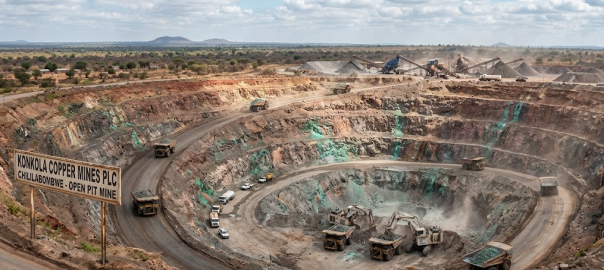
The Restroom Negotiations: How a Canadian Mining Giant Bought a Presidency and Rewrote Zambia’s Laws
Wed, July 22 2026 /Mpelembe Media/ — The provided documents explore the essential role of the mining industry in the global transition toward a low-carbon economy, particularly the rising demand for transition minerals. These sources emphasize that while mineral extraction underpins a vast portion of global wealth, it simultaneously presents significant environmental and social risks, such as habitat loss, water stress, and human rights concerns. To address these challenges, the Global Investor Commission on Mining 2030 outlines a framework for institutional investors to use their financial influence to promote responsible operations. By prioritizing capital allocation and active stewardship, investors can encourage better safety standards, equitable benefit distribution, and the adoption of circular economy principles. Ultimately, the reports argue that a strategic “reset” of the relationship between finance and mining is necessary to ensure the industry leaves a positive legacy for host communities. These materials serve as a roadmap for achieving a sustainable mining sector that balances industrial growth with ecological and ethical boundaries.
Summary of Key Findings
1. The Covert Campaign and Secret Restroom Negotiations
- Decades-long covert influence: A Global Witness investigation has found evidence suggesting that Toronto-based mining multinational First Quantum Minerals (FQM) and its associates have run a decades-long covert campaign to influence Zambia’s democracy. FQM has been the largest financial backer of President Hakainde Hichilema and his United Party for National Development (UPND) across multiple election cycles, reportedly pledging up to $50 million ahead of the upcoming August 2026 election.
- Secret bathroom meetings: During his years in the political opposition, Hichilema’s ties with FQM were kept highly covert to avoid detection by the hostile Edgar Lungu administration. Inside sources claim Hichilema met with FQM Chief Executive Officer Tristan Pascall multiple times in airport restroom facilities in Johannesburg, South Africa, to negotiate the future of Zambia’s mining and tax regulations.
2. Direct Policy Capture and the “FQM-Designed” Tax Regime
- Budget written by the mining lobby: Following Hichilema’s 2021 election, his administration enacted sweeping tax breaks that aligned perfectly with the mining industry’s demands. A former Chamber of Mines member expressed surprise that Hichilema’s first budget incorporated their exact proposals “word for word”, while a former senior civil servant at the Ministry of Mines stated that Zambia now has “a mining fiscal law designed for us by FQM and imposed on the country through Mr. Hichilema”.
- The “healthy cow” justification: A government official recounted Hichilema justifying his light taxation of the mines by stating: “I am not a fan of heavy taxing of the mines because we need to allow the cow to grow healthy before we can talk about having more calves or even milking it”.
3. Massive Revenue Losses to a Fragile Economy
- Tax breaks worth hundreds of millions: Changes to the mining mineral royalty regime alone have saved FQM subsidiaries an average of $155 million annually since 2023, while the mining sector as a whole saves $305 million annually. Furthermore, allowing companies to deduct mineral royalty payments from corporate income tax has saved FQM subsidiaries an average of $69 million annually (and $124 million for the wider sector).
- Severe economic cost: These tax breaks deprive a deeply indebted nation of vital public revenues. Even though copper provides 74% of Zambia’s export earnings, more than 60% of the population continues to live in poverty.
4. Transnational Influence Networks and Media Control
- Billionaire-backed think tanks: The campaign has been actively supported by the Brenthurst Foundation, founded by the Oppenheimer mining family and backed by tech billionaire Larry Ellison, as well as the Tony Blair Institute, which is reportedly working on Hichilema’s 2026 campaign.
- Media manipulation & SLAPP suits: FQM and its associates utilized a network of media sites (such as Open Zambia and Solwezi Today) to publish propaganda promoting FQM and Hichilema. When civil society watchdog Southern Africa Resource Watch (SARW) published a 2019 report highlighting FQM’s toxic water and air pollution, Brenthurst Foundation founding director Greg Mills published aggressive media rebuttals, and FQM launched a 1 million South African rand SLAPP lawsuit against the group (which was later withdrawn).
5. Constitutional Manipulation at a Luxury Safari Lodge
- Bill No. 7 underhand tactics: In December 2025, a group of opposition and independent MPs were flown in secret to the Royal Zambezi Lodge—a luxury safari camp owned by the Pascall family (who run FQM)—to secure their votes for a controversial constitutional amendment (Bill No. 7). This amendment, widely opposed by the public and later declared unconstitutional by the Constitutional Court, sought to expand the National Assembly to secure a legislative majority for the ruling UPND ahead of the August 2026 general elections.
The Green Paradox: 5 Surprising Realities About the Future of Mining
1. Introduction: The Dirt Required for a Clean Future
To achieve a low-carbon economy, the world must look beneath the surface. It is the central irony of the modern ESG landscape: the transition away from fossil fuels relies entirely on a massive, rapid expansion of the extraction industry. There is no wind power without steel and copper, and no electric vehicle revolution without lithium and cobalt. For the sophisticated investor, the “green transition” is not merely a shift in energy sources—it is a shift in upstream dependencies.The Global Investor Commission on Mining 2030 was established to navigate this paradox. This investor-led initiative, inspired by the industry’s response to the Brumadinho disaster, seeks to define a socially and environmentally responsible path for a sector that is simultaneously essential to planetary survival and fraught with systemic risk. Drawing from the Commission’s recent Landscape Report , we explore five realities that challenge conventional wisdom and demand a higher level of fiduciary oversight.
2. The Pyramid Problem: We Mine 1,000 Giza Pyramids Every Year
The physical footprint of the mining industry is a staggering testament to human demand. In 2021, global production reached 17.9 billion metric tonnes—a figure that has doubled since 1985. To visualize this scale, the Commission notes that we are extracting the equivalent of 1,000 Great Pyramids of Giza every single year.For the ESG strategist, this volume is not just a statistic; it represents a profound challenge to “planetary boundaries.” The industry’s expansion increasingly encroaches on sensitive ecosystems. A particularly striking reality found in the Commission’s research is that 29% of mining sites overlapping with Key Biodiversity Areas are for transition minerals , and 67% of those are still in the exploration stage. This suggests a massive wave of upcoming environmental friction as these projects move toward operation. Furthermore, the sector faces acute physical risks: 70% of mining operations for the six largest listed companies are already located in water-stressed countries.”The physical nature of the mining industry means that many of its impacts (whether positive or negative) are inevitably large and long-term… The mining industry also has a massive physical, social and environmental impact.” — Landscape Report, Executive Summary
3. Coal’s Long Shadow: The “Transition” is Smaller Than You Think
While headlines focus on the “green rush” for lithium and copper, the current mining landscape remains dominated by the very fossil fuels it aims to replace. According to Figure 1.1 of the report, coal (both thermal and metallurgical) still accounts for a massive 43% of global mining production by volume.In contrast, transition minerals—the building blocks of the low-carbon future—currently represent a mere 3.2% of total production volume. However, the strategist must distinguish between volume and value. While transition minerals are a “tiny fraction” of the dirt moved today, their capital intensity and growth rate are where the future of investment lies. The “Landscape Report” takeaway is clear: the industry is fundamentally redrawing the global map. We are witnessing a shift away from coal-heavy giants like the US and India toward new critical actors like the DRC and Chile, creating a complex web of new geopolitical and supply chain risks.
4. The 18-Year Waiting Room: Why the “Green Rush” is Moving in Slow Motion
There is a dangerous mismatch between the climate’s ticking clock and the industry’s logistical reality. While policy goals for 2030 and 2050 demand immediate mineral surges, lead times have reached a state of stasis. The average time to move a mine from discovery to active production has stretched to nearly 18 years , up from 13 years in 2009.From a capital allocation perspective, this “slow-motion” reality is a systemic risk. These delays compound the expected shortfall in capital investment required to meet net-zero targets. For instance, Benchmark Minerals estimates that over 300 new mines are needed for battery production alone. When an 18-year lead time meets a 2030 deadline, the result is a massive supply-demand gap that threatens the viability of the entire green technology sector.
5. The Fragility Paradox: Green Energy’s Reliance on Unstable States
The “Green Paradox” is perhaps most visible in the geographic concentration of critical minerals. Unlike traditional commodities, the minerals of the future are often found in the world’s most precarious jurisdictions.The report reveals a startling “fragility paradox”:
- 70% of global cobalt reserves are located in “fragile or very fragile jurisdictions.”
- 73% of global graphite reserves are found in similarly unstable areas.This concentration creates a “Social License to Operate” crisis. Over 50% of the 5,000 transition mineral projects currently in development are located on or near the lands of Indigenous and peasant peoples. In a deteriorating geopolitical environment, these projects face high corruption risks and human rights challenges that can lead to stranded assets. For investors, this means that “responsible mining” is no longer a moral luxury—it is a prerequisite for security of supply.
6. The Investor Reset: From Passive Profit to Active Stewardship
The Commission’s directive is clear: the financial community must move from passive observation to active stewardship. Realizing a responsible mining sector requires what Adam Matthews calls a “reset” of the relationship between investors and the industry. To manage these systemic risks, institutional investors must utilize five primary levers:
- Capital Allocation: Preferentially funding companies that exhibit best practices and supporting the growth of the circular economy.
- Active Stewardship (Mining Companies): Directly engaging with both majors and junior explorers to set social and environmental expectations.
- Active Stewardship (Value Chain): Aligning expectations with downstream players like tech and auto companies to ensure traceability.
- Collaborating with Finance Institutions: Working with banks and stock exchanges to enforce high ESG standards for lending and listing.
- Policy Engagement: Encouraging governments to create regulatory environments that incentivize responsible extraction.”Most importantly, the report provides a direction of travel for investors to collectively address the sector’s systemic risks… It calls for a reset by investors of their relationship with the industry.” — Adam Matthews, Chair, Global Investor Commission on Mining 2030
7. Conclusion: Can We Mine Our Way to Sustainability?
The Global Investor Commission on Mining 2030 has outlined six strategic objectives to steer the industry through this transition:
- Developing long-term investor expectations aligned with global standards.
- Promoting circularity, traceability, and aligned value chain expectations.
- Building regulations and institutional frameworks that reinforce responsibility.
- Generating sustained benefits for local and national communities.
- Reducing mining as a driver of conflict through better risk management.
- Addressing historic legacies and ensuring safe, responsible mine closure.The ultimate question for the global investor remains: can we balance the intense mineral needs of the transition with the finite boundaries of our planet? As we ramp up extraction to save the climate, the industry’s success will be measured not just by the volume of dirt moved, but by the social and environmental legacy it leaves behind.Are we prepared for the mineral intensity of a sustainable future, or is the capital allocation risk of the “Green Paradox” too heavy to carry?