
Tag Archives: Articles

21Oct/26

Art Law and the Architecture of Violence

The Monopoly on Force: Why the Legal Order Prohibits Daggers but Legalizes Poverty

Systemic Violence, Patriarchy, and Bourgeois Law

Wed Oct. 21, 2026 /Mpelembe Media/ — In Me-ti: Buch der Wendungen, Bertolt Brecht exposes a fundamental contradiction in how state jurisprudence defines and penalizes violence. Brecht observes that while the state strictly outlaws direct, interpersonal physical assault—such as stabbing someone with a dagger—it routinely permits, legalizes, and institutionalizes indirect, systemic forms of destruction, including economic starvation, medical neglect, hazardous housing, lethal workplace exploitation, and imperialist war. Though all these mechanisms produce identical fatal outcomes by destroying human life, bourgeois law selectively criminalizes only direct physical trauma. This selective prohibition occurs because overt individual violence threatens public order, disrupts commodity exchange, and challenges the state’s monopoly on legitimate physical force. Conversely, systemic socio-economic lethality is mediated through market contracts, real estate commodification, and state bureaucracy, allowing the legal system to mask systemic mortality as “perpetratorless” or natural market outcomes. Continue reading →

20Oct/26

How Algorithms Act Like Rat Traps

From the Well Trap to the Digital Sphere: The Allegory and Reality of Horizontal Conflict

Mon Oct. 19, 2026 /Mpelembe Media/ — The central narrative across the collection explores how artificial containment and structural coercion alter baseline behaviors, transforming subjects into instruments of self-destruction. This phenomenon is framed through the allegory of trapped rodents—whether in a farmer’s abandoned well or Raoul Silva’s island oil drum in Skyfall—where subjects are confined under extreme scarcity until forced cannibalism fundamentally alters their nature. Once released, these conditioned survivors no longer consume ambient environmental resources; instead, they exclusively hunt their own kind, allowing the external operator to outsource systemic destruction without engaging directly in battle. This allegorical framework parallels ancient East Asian rituals of Gu or Kodoku magic, where venomous scorpions, spiders, and insects were sealed inside a jar to fight to the death so that the sole survivor could be harvested as a concentrated weapon or curse. In Victorian London, actual rodent management trades documented by Henry Mayhew—most famously represented by Queen Victoria’s self-proclaimed rat-catcher Jack Black—similarly relied on spatial containment and an intimate understanding of conspecific aggression, eventually giving rise to both public rat-baiting sports and the breeding of fancy domesticated pets. Continue reading →

19Oct/26

Why AI Math Breakthroughs Panic Mathematicians

The Leiden Declaration and Severe Misalignment: World-Leading Mathematicians Demand Transparency and Human Understanding in AI-Driven Science

Sun Oct. 18, 2026 /Mpelembe Media/ —  The integration of artificial intelligence into mathematics and the broader scientific enterprise presents a stark dual horizon between an unprecedented golden age of discovery and an epistemic dark age. In the golden age scenario, AI functions as a transparent research co-author—an instance of “artificial general cleverness”—that automates routine formalization, checks calculations, and explores vast search spaces, thereby liberating human minds to focus on high-level intuition, conceptual synthesis, and creative theory-building. Conversely, the dark age scenario warns of “knowledge collapse” and alienation, where proprietary, black-box AI models inundate academic literature with uninterpretable, machine-generated proofs and statements. This unchecked influx threatens to sever the human pedagogical transmission chain between generations of scholars and concentrate critical scientific infrastructure within a small group of private technology monopolies. Continue reading →

17Oct/26

Lily Mutamz Takes On the Zambian Government

From Munali to the UK Diaspora: The Evolution of Lillian Mutambo’s Transnational Advocacy

Sat Oct. 16, 2026 /Mpelembe Media/ — Lillian Mutambo’s political career began with direct community-level organizing in Zambia ahead of the 2021 General Election. After returning from the UK, she sought the UPND nomination for the Munali Constituency under the campaign slogan “Shape You Munali,” engaging in local economic empowerment initiatives such as distributing eggs to help youth and women start small businesses. Following intra-party selection disputes and friction within the UPND, Mutambo broke away to contest the seat as an Independent candidate in 2021, marking her formal entry into parliamentary politics. Continue reading →

17Oct/26

Why Couples Therapy Fails Diverse Relationships

Healing Black and Inter-Ethnoracial Partnerships: Bridging Systems Theory, Critical Race Principles, and Emotionally Focused Therapy

Sat Oct. 16, 2026 /Mpelembe Media/ — Standard evidence-based couples therapies, including Emotionally Focused Therapy (EFT), demonstrate high overall efficacy in reducing relationship distress, yet their foundational frameworks were developed almost exclusively around White, middle-class, heterosexual norms. The assumption that adult attachment principles operate universally without regard to race, power, and cultural context fails to account for how chronic exposure to structural racism, microaggressions, and systemic oppression creates cumulative racial stress that directly impairs intimate relationships. When clinicians apply unadapted Western models to African American or inter-ethnoracial couples, they risk pathologizing culturally socialized protective behaviors or misinterpreting coping strategies as individual deficits or treatment resistance. Culturally responsive therapy requires moving beyond a purely dyadic attachment lens to integrate a network-oriented, socioculturally attuned framework that explicitly acknowledges how external societal hostility intersects with internal relational dynamics. Continue reading →

17Oct/26

Why America Is Losing Global Talent

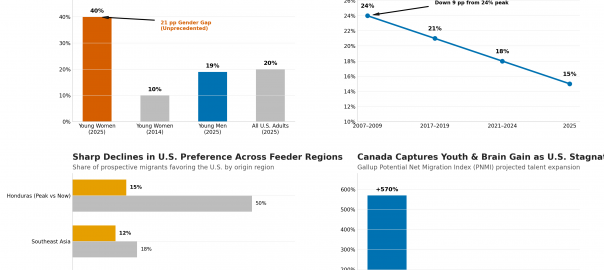
America’s Gendered Exit: Why 40% of Young Women Want to Leave the U.S.

Sat Oct. 16, 2026 /Mpelembe Media/ — Global migration aspirations have entered a period of structural recalibration, as the proportion of adults worldwide desiring to relocate permanently dipped to 15% in 2025 after sustaining a record peak of 16% between 2021 and 2024. Although the United States remains the single most desired destination globally, its attraction has fallen to a nearly two-decade low of 15% in 2025, down from 24% in the 2007–2009 period. This cooling demand is particularly striking in traditional feeder corridors such as Latin America and the Caribbean (dropping from 33% to 28%) and Southeast Asia (falling from 18% to 12%), with Honduras recording a dramatic 35-percentage-point collapse in U.S. preference. Instead of defaulting to North America, potential migrants are turning toward multipolar regional networks—favoring Japan in Southeast Asia, Germany in the Middle East, and Spain in Europe—while Canada solidly maintains its position as the second most preferred global destination at 9% (representing ~85 million adults). Continue reading →

05Oct/26

AI Sales Agents and Server Side Tracking

Turn Natural Prompts into Production-Ready CRM Assets

Mon 05 Oct 2026 /Mpelembe Media/ — AI Studio is a conversational, prompt-powered builder embedded directly within HighLevel sub-accounts that enables users to generate complete digital web assets through natural language instructions. Rather than building isolated frontend pages that rely on third-party webhooks or external integration layers, AI Studio constructs web assets natively within the platform’s operational CRM database. This architecture eliminates integration failure vectors and data loss during multi-domain redirects, providing a rapid path from concept to live deployment. Continue reading →

21Sep/26

Ancient blueprints for living well

Beyond Consumerism: Ancient Blueprints for Tranquility in a Restless World

Mon 21 Sept 2026 /Mpelembe Media/ — Epicurus constructed a comprehensive, materialistic philosophy rooted in atomism to liberate humanity from psychological anxiety. By asserting that the universe consists solely of indestructible atoms moving and randomly swerving through empty space, he replaced mythological explanations with mechanistic natural laws. This physical worldview served a direct therapeutic purpose by demonstrating that divine beings do not interfere in human affairs or inflict punishment, and that the human soul—composed of fine physical particles—disperses entirely upon bodily death. Because consciousness ends permanently at death, Epicurus reasoned that death is nothing to us, freeing individuals from the existential dread that fuels irrational ambitions. Continue reading →

20Sep/26

Your kindness matters more than you think

A Little Good Goes an Unexpectedly Long Way: The Hidden Value of Everyday Kindness

Sun 20 Sept 2026 /Mpelembe Media/ — Extensive behavioral research demonstrates that people systematically underestimate the positive emotional impact their random acts of kindness have on recipients. Across a wide array of field and laboratory experiments—ranging from handing out hot chocolate at an ice-skating rink and distributing cupcakes in public parks to writing supportive notes and paying for coffee—performers consistently predicted that recipients would feel less positive and perceive the act as less significant than receivers actually reported. While givers recognize that prosocial acts generate positive feelings, they reliably fail to anticipate the true magnitude of that emotional boost. This cognitive miscalibration persists across diverse contexts, whether the gesture involves a material item or a practical action, whether it is large or small, and whether the recipient is a complete stranger, a classmate, or a long-time partner. Continue reading →

19Sep/26

Agrippa the Skeptic and the concept of the Muse

Because each modern theory must choose which of Agrippa’s three “horns” to address or reframe, philosopher Victor Brochard described Agrippa’s formulation as one of the most radical and irresistible statements of philosophical skepticism ever devised

Sat 19 Sept 2026 /Mpelembe Media/ —In this interdisciplinary synthesis, Agrippa’s logical tropes and the artist’s muse serve the same fundamental purpose: creative and cognitive breakthroughs require the willingness to destabilize absolute certainty. Rather than offering an artist neat answers or passive ideals, the muse acts as a skeptical catalyst who disrupts dogmatic habits, forces an aesthetic impasse, and opens the space necessary for radical artistic transformation. Continue reading →