
From 24 to Thirty Ministries: The Executive Restructuring Behind the Grow Zambia Agenda
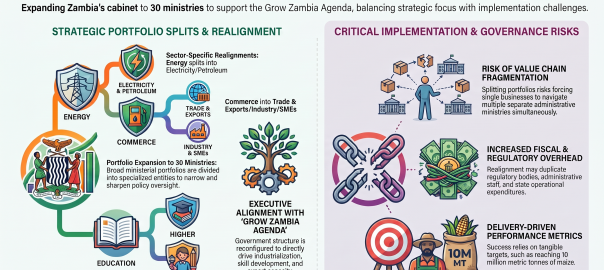
Wed, July 28 2026 /Mpelembe Media/ — President Hakainde Hichilema’s administration has proposed a major structural overhaul to expand Zambia’s cabinet from 24 to 30 ministries, presented to the National Assembly by Vice-President Dr. W.K. Mutale-Nalumango pursuant to Article 92(2)(d) of the Constitution of Zambia. According to official communications from State House, the restructuring is designed to eliminate administrative bottlenecks, enhance public service delivery, and align government operations directly with the country’s flagship economic blueprint, the Grow Zambia Agenda. The proposed changes unbundle large existing ministries into dedicated portfolios, which includes splitting Energy into separate ministries for Electricity and Petroleum; dividing Commerce, Trade and Industry into Trade and Exports, Industry, and Small and Medium Enterprise Development; separating basic education from Skills and Higher Education; and uncoupling Infrastructure and Urban Development from Housing. Proponents maintain that this heightened specialization is necessary to provide focused oversight over critical growth drivers, such as resolving power generation deficits, boosting non-traditional exports, accelerating industrialization, and meeting national production benchmarks.
Conversely, the expansion has generated significant friction among opposition political figures, civil society organizations, and economic analysts who view the expansion as a heavy fiscal burden during an ongoing debt restructuring and economic recovery period. Critics argue that establishing six additional ministries directly inflates the public sector wage bill and increases administrative overhead—including expenditures for newly appointed Permanent Secretaries, official vehicle fleets, office accommodation, and technical support staff. Opponents emphasize that this expansion conflicts with the ruling party’s prior commitments to fiscal consolidation and lean administration, raising concerns about political patronage. Policy observers also point to potential risks of bureaucratic fragmentation along unified economic value chains and highlight the tension between expanding executive structures while local programs like the Constituency Development Fund (CDF) and strategic crop purchases via the Food Reserve Agency (FRA) face fiscal pressure. Government representatives have countered that the administrative costs of the extra portfolios are small relative to the total national budget and will be outweighed by improved economic execution.
From 30 Ministries to Firing 481 Staff: 5 Surprising Insights Into Zambia’s “Grow Zambia” Restructuring
1. Introduction: The Big Dilemma of Reorganizing the State
Can splitting government portfolios and radically overhauling state agencies fast-track economic development, or does it risk creating administrative chaos? Across modern public administration, state leaders constantly wrestle with this tension: do you expand executive structures to sharpen focus, or do you streamline them to prevent bureaucratic bloat?
In Zambia, President Hakainde Hichilema has initiated a sweeping realignment of the state machinery under the banner of the “Grow Zambia Agenda.” Pursuant to Article 92(2)(d) of the Republican Constitution, the executive has sought Parliamentary approval via Vice-President Mutale Nalumango to establish, merge, and dissolve government ministries to align public service delivery with ambitious economic targets.
Below is a deep dive into five counter-intuitive and impactful insights derived from recent executive, legislative, and institutional developments shaping Zambia’s governance reform.
2. Takeaway 1: The 30-Ministry Paradox—When Specialisation Becomes Fragmentation
To support the Grow Zambia Agenda, the government proposed expanding its cabinet structure to 30 ministries. This major overhaul splits several key portfolios: Energy into separate policy ministries for Electricity and Petroleum; Commerce, Trade and Industry into Trade and Exports, Industry, and Small and Medium Enterprise Development; Education into Education and Skills, and Higher Education; and Infrastructure, Housing and Urban Development into Infrastructure and Urban Development, and Housing.
This approach invites the classic public administration concept of reductio ad absurdum —taking the logic of hyper-specialisation to its extreme. While dedicated focus on subsectors like electricity generation or export promotion appears constructive individually, excessive division risks creating administrative silos and bureaucratic friction.
Consider a local honey-processing entrepreneur in Lusaka: under this split, a single bottle of export-bound honey crosses six distinct bureaucratic thresholds before it ever leaves the factory floor. The enterprise sits simultaneously across Agriculture (raw material), Industry (processing), Trade and Exports (market access), SMEs (business licensing), Electricity (factory power), and Infrastructure and Transport (logistics). Furthermore, institutional clashes emerge when two distinct policy ministries (Electricity and Petroleum) sit above a single technical body like the Energy Regulation Board (ERB), established under the Energy Regulation Act of 2019. Unless internal coordination is flawless, hyper-specialisation increases regulatory friction rather than productive efficiency.
“Specialisation behind the scenes and simplicity in front of the citizen.”
3. Takeaway 2: The Nuclear Option—Firing 481 Staff to Fix Medical Supply Procurement
Following an independent forensic audit ordered by President Hichilema in late 2024, the Zambia Medicines and Medical Supplies Agency (ZAMMSA) underwent a complete operational reset. The audit uncovered severe structural and ethical failures across the state’s medical supply chain:
- Missing Shipments: 4,096 shipments disappeared from the tracking system, and 3.34 million inventory units valued at approximately K290 million could not be verified.
- Irregular Contracts: K1.4 billion in contracts were awarded despite explicit internal audit objections, with unit prices inflated by up to 1,613%.
- Unvetted Procurement: An unregistered supplier was awarded a K16.1 million contract, K42 million in distribution discrepancies were never investigated, and electronic records were deliberately deleted.
In response, Health Minister Dr. Elijah Muchima outlined an aggressive operational reset. The government initiated the separation of 481 staff members, backed by a K100 million separation package allocated by the Treasury. To fix distribution, warehousing and last-mile logistics are being outsourced through a Public-Private Partnership (PPP). On the technology front, ZAMMSA is adopting global GS1 end-to-end digital tracking. To prevent diversion, the system’s primary database will sit at the Zambia Medicines Regulatory Authority (ZAMRA), with a real-time mirror image feed directly monitored by the Drug Enforcement Commission (DEC).
“Any case of pilferage of medicine will be dealt with in a very aggressive manner… because this is a matter of national security.”
4. Takeaway 3: The 5x Maize Over-Purchase—A Counter-Intuitive Food Security Gamble
Smallholder farmers in regions like Chama Central experienced payment delays of up to two months after delivering crop yields to the Food Reserve Agency (FRA). Yet, despite these localized cash-flow backlogs, the state executed a massive, counter-intuitive expansion of its national grain procurement.
The FRA originally budgeted to purchase 500,000 metric tonnes of maize from smallholder producers. However, total purchases scaled dramatically to 2.7 million metric tonnes—more than five times the initial target.
Addressing Parliament, Vice-President Mutale Nalumango detailed the fiscal and strategic rationale behind this over-purchase. Financing a 5x buying spree required mobilizing Treasury budget reallocations, commercial bank borrowing, and planned grain sales. This rapid macro-expansion temporarily strained liquidity at local depots, causing payment lags for local farmers even as state financing mechanisms were being activated. Strategically, with forecasters warning of a “super” El Niño weather pattern capable of causing severe regional drought, the executive prioritized building national reserves alongside household security, balancing immediate climate shock-absorption with the long-term target of 10 million metric tonnes by 2031.
“Just like we are talking about household food security, we should also think about national food security. Do not think that we have over-purchased… we also have to be sure that the nation has food under the Food Reserve Agency.”
5. Takeaway 4: Decoding the “10-10-5-3-3-1-1-1” Formula Driving the Nation
Cabinet officials, parliamentarians, and policy analysts frequently reference the cryptic numerical formula “10-10-5-3-3-1-1-1” as the target framework driving executive policy under the Grow Zambia Agenda.
Decoded through official policy pronouncements and parliamentary proceedings (such as debates raised by MPs like Hon. Kaweme), the framework establishes explicit national benchmarks:
- 10 Million metric tonnes of annual maize production (by 2031).
- 10,000 MW of national electricity generation capacity.
- 5 Million annual tourist arrivals.
- 3 Million metric tonnes of annual copper production.
- 3 Million metric tonnes of annual soya beans production.
These input-driven targets are actively reshaping executive alignment. As Vice-President Nalumango stressed during parliamentary proceedings, public servants are legally obligated to execute the policies derived from the ruling party’s manifesto. Civil servants who actively block or resist state economic agendas are instructed to align with executive policies or step aside to allow operational execution.
6. Takeaway 5: “National Interest” vs. “Public Interest”—The Nuance of Civil Service Retirements
Following elections, reports emerged regarding a wave of public servants—including senior personnel in the Zambia Police Service—being retired, raising questions regarding earlier political pledges that no civil servant would be retired “in national interest.”
Vice-President Nalumango clarified the precise legal and administrative distinction between the two forms of statutory separation:
- Retirement in Public Interest: A fault-based or disciplinary separation resulting from individual misconduct, incompetence, or specific workplace offences.
- Retirement in National Interest: An administrative mechanism provided under Section 4(c) and Section 39 of the Public Service Pensions Act. It allows the Service Commission to retire an officer at the instance of the Government for policy realignments or structural reorganizations, without requiring individual fault or misconduct.
Highlighting a pragmatic view of public administration, the Vice-President noted that public servants must align with the governing manifesto or step aside. As the state restructures portfolios to drive the Grow Zambia Agenda, statutory retirement under Section 39 remains an active tool for executive alignment.
“Life is dynamic… When something is being restructured, or when something is happening in your institution, it is possible.”
7. Conclusion: Structure vs. Execution
Realigning government cabinets, establishing specialized ministries, and clearing out compromised procurement agencies are structural inputs. However, changing institutional structure is not the same as reforming operational outcomes; a new ministry does not automatically generate electricity, nor does a new portfolio instantly expand national exports.
The ultimate success of the Grow Zambia Agenda will not be judged by the number of seats around the Cabinet table or the titles assigned to permanent secretaries. It will be measured five years down the line by tangible metrics: reliable power generation, increased manufacturing output, functional health clinics with secure drug supplies, and productive employment for citizens.
Will institutional expansion through specialized ministries streamline state capacity, or will strict operational accountability within existing frameworks prove to be the true engine of national development?