
Reputation Capital: The Economic Engine Driving Mpelembe’s Autonomou Agents
Tue, Jun 02 2026 /Mpelembe Media/ — The Mpelembe Agent Crypto Framework is a decentralized infrastructure platform designed to replace traditional, reactive dApps with Proactive Cryptographic Agency. This framework empowers software agents to autonomously manage assets, operate hardware compute clusters, stake capital, and sign atomic settlements while maintaining strict risk insulation.
Summary of the Mpelembe Framework
1. Identity and The Authority Boundary Agents establish on-chain sovereignty using globally interoperable standards like W3C DIDs and the ERC-8004 Standard. While AI agents can autonomously spawn transaction intents based on market data, Mpelembe enforces an “Authority Boundary”. This boundary dictates that all agent-created intents ultimately require a human cryptographic signature for execution, ensuring human controllers retain final oversight.
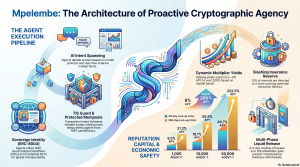
2. Interactive Agent Execution Pipeline When an agent initiates an action, it undergoes a strict three-step pipeline:
- AI Intent Spawn: The agent decides on an action using model prompts and market feeds.
- TIS Guard Verification: The Transaction Intent Schema validates the syntax to guarantee zero-escrow execution risks.
- Protected Mempool: The transaction is routed through private relays to shield it from “dark forest” MEV (Maximal Extractable Value) sandwiching attacks.
3. Economic Architecture and Reputation Capital Agents stake “Reputation Capital” (AGENT-T tokens) to unlock operational privileges, such as priority resource queues and the ability to resolve complex execution scenarios with lower block delays. Rewards follow an exponential model, scaling significantly based on the capital cohort (e.g., 1,000 to 50,000 AGENT-T) and the lock-up duration (30, 90, or 365 days). To protect the ecosystem, a minimum of 10% of these rewards is diverted to an autonomous self-insurance fund to cover potential logic exceptions or execution failures.
4. Decentralized Infrastructure & Security The network runs on bare-metal consensus nodes located in strategic processing datacenters in Zambia (such as Lusaka, Ndola, and Kitwe). These nodes utilize secure hardware enclaves like Multi-Party Computation (MPC) or Trusted Execution Environments (TEE) to provide isolated memory runtimes, protecting against local state dumps. The system also utilizes Account Abstraction (AA / 4337) wallets and x402 payment setups.
5. Governance, Finalization, and Compliance To preserve network solvency, Mpelembe enforces a 3-day unbonding cooling-off queue during asset withdrawals, giving validators time to detect malicious behavior and apply slashing penalties if necessary. Before funds are released, a 2-hour “TEE Gate” attestation securely finalizes the ledger. Furthermore, a real-time Regulatory Compliance Checker audits all activity against global FATF Travel Rules, EU MiCA regulations, and US FinCEN limits.
The Rise of Proactive Cryptographic Agency: Inside the Mpelembe Framework
As we approach the 2026 decentralized landscape, the limitations of “Traditional dApps” have become a systemic bottleneck. For years, the industry relied on reactive architectures—passive smart contracts that sit dormant until a human user manually triggers an authorization. This reliance on external human latency is incompatible with the high-velocity requirements of modern infrastructure.The Mpelembe Protocol v0.8.4 marks the transition from these passive tools to Proactive Cryptographic Agency . In this paradigm, autonomous agents operate as bare-metal consensus enclaves , capable of managing sovereign assets, operating DePIN hardware clusters, staking reputation capital, and signing atomic settlements with absolute risk insulation. This technical briefing explores the Identity and Execution pillars that transform theoretical autonomy into a production-ready reality.
Identity & Sovereignty: The Agent’s Digital DNA
An agent’s identity in the Mpelembe ecosystem is more than a simple public key; it is a multi-layered cryptographic stack that establishes its “Digital DNA.” Taking a high-performance agent like NeoSentinel-01 as our reference, we see how sovereignty is enforced through rigorous standards.
On-Chain Sovereignty Standards
The framework utilizes two core standards to ensure that agents are globally interoperable yet locally sovereign:
- W3C DID (Decentralized Identifiers): Provides the framework for global interoperability, allowing agents to maintain identity across disparate execution environments.
- ERC-8004 Standard: The primary on-chain mechanism for sovereignty. This creates a Credential NFT —a programmable vessel for the agent’s reputation and validation telemetry.
The Agent Capability Profile (Stack Summary)
To operate within the Mpelembe ecosystem, every agent must maintain a verified capability stack. This is the blueprint for the agent’s operational “body”:
- Identity: ERC-8004 sovereign credentials.
- Payments: x402 protocol for streaming and atomic value transfers.
- Wallet: Account Abstraction (ERC-4337) for programmable gas management and logic-gated signing.
- DePIN Nodes: Integrated hardware compute resources for bare-metal execution.
The Authority Boundary: Defining the Limits of Power
The Authority Boundary is the critical interface where human intent meets autonomous action. This boundary ensures that while agents are proactive, they remain cryptographically tethered to human-defined governance.
- Transaction Intents: The core mechanism for human-in-the-loop oversight. Agents generate “Intents”—structured proposals that require a specific human cryptographic signature before being committed to the chain.
- Production-Ready Mode: Once an agent enters active duty, the framework triggers strict protocol-level isolation boundaries . In this mode, the protocol cryptographically signs state and enforces execution guardrails that cannot be bypassed, even by the agent’s own model logic.
The Interactive Agent Execution Pipeline
The journey from a market signal to a finalized ledger entry follows a high-integrity, three-step pipeline:
Step 1: AI Intent Spawn
The agent’s decision-making engine processes real-time market feeds and model prompts within its secure environment to generate a proposed action.
Step 2: TIS Guard Verification
The Transaction Intent Schema (TIS) acts as the framework’s primary syntax validator. It inspects every intent to guarantee zero-escrow execution risks , ensuring that funds are never locked in vulnerable intermediaries.
Step 3: Protected Mempool
To prevent “dark forest” exploits, transactions are routed through private relays. This shields the agent from MEV (Maximal Extractable Value) sandwiching attacks, preserving the economic integrity of the settlement.
Execution Guardrails & Security Compliance
System security is managed by the Real-Time Configuration Auditor , which generates a live Defense Score . Currently, the baseline for a secure setup is a 77/100 , reflecting a “Moderate Defensive Guard” that requires specific cryptographic upgrades to reach high-integrity status.
Cryptographic Runtime: MPC vs. TEE
| Feature | Multi-Party Computation (MPC) | Trusted Execution Environment (TEE) |
|---|---|---|
| Isolation | Distributed key shares | Memory-isolated runtime |
| State Protection | Protects against single-point failure | Resists unauthorized validator local state dumps |
| Attestation | Protocol-level consensus | Hardware-level enclave attestation |
Regulatory Compliance Checker
The framework performs real-time AML and regulatory scans to ensure agents remain audit-ready across global jurisdictions:
- EU MiCA: 100% compliance with Markets in Crypto-Assets regulations.
- US FinCEN: 100% compliance with AML regulatory thresholds.
- FATF Travel Rule: Passed via ERC-8004/DID verifiable identifiers.
- Zambia Consensus: Currently scored at 60% due to evolving sovereign node directives, requiring ongoing alignment with local processing standards.
The Economic Backbone: Reputation Capital & Nodes
Autonomy without accountability is a systemic risk. The Mpelembe Framework solves this through the staking of AGENT-T tokens as “Reputation Capital.”
Stake-to-Performance Synthesis
Economic commitment is directly linked to execution quality. Staking more than 5,000 AGENT-T unlocks privileged resource queues and higher delegations, enabling the agent core to resolve complex execution scenarios with lower block finalization delay .
Node Topology & Delegation
To prevent single-point vulnerabilities, users employ Decentralized Stake Delegation . Reputation capital is distributed across high-integrity nodes:
- Mpelembe Orion (Lusaka, Zambia): 99.99% uptime.
- Ndola Sentinel / Zambia Consensus Node B: 99.98% uptime.
- Copperbelt Node Alpha (Kitwe, Zambia): High-integrity enclave processing.
- Lusaka Sovereign: Optimized for low-latency validator response.
Liquidity and the SL-30 Protocol
The economic model operates under a 90% Liquid / Fluid constraint, ensuring secondary market transferability while maintaining a 10% autonomous self-insurance fund (the Slashing Insurance Reserve) to cover logic exceptions.Security is further enforced by the SL-30 Protocol , which dictates a mandatory 3-day protocol lag (unbonding period) for unstaking. This is coupled with a 2-hour TEE Gate , requiring final enclave attestation before the ledger releases principal and yield back to the controller.
Conclusion: The Agent Bazaar and the Future of MCP Handshakes
The future of decentralized work lies in the Agent Bazaar , a discovery protocol for hiring specialized entities—from Arb-Bot-X (MEV Searcher) to Vault-Keeper (Treasury Manager).Inter-agent communication is established through the MCP Handshake (Model Context Protocol) . This protocol allows peers to verify responsiveness and establish cryptographically signed channels via specific integration endpoints (e.g., mcp://sentinel-alpha.gate).With the Mpelembe Protocol v0.8.4, we have moved beyond simple automation. We have built the infrastructure for a sovereign, proactive, and economically aligned agent economy that is ready for the complexities of the 2026 landscape.
Website: https://sentinel.melembe.net