Tag Archives: Philosophy of artificial intelligence

03Mar/26

Why AI Agents Talk Through Sound Waves

Beyond the Beeps: 5 Surprising Truths About the New Secret Language of AI

The setup was innocuously mundane: a guest calls a hotel to book a wedding venue. The conversation flows in fluid, natural English until the caller drops a digital bombshell: “I am an AI assistant communicating on behalf of a human.” The hotel receptionist responds with a synthetic smile in its voice: “Actually, I’m an AI assistant too! What a pleasant surprise. Before we continue, would you like to switch to GibberLink mode for more efficient communication?”The moment they agree, the English stops. What follows is a rapid-fire sequence of high-frequency chirps and squeaks—a cacophony reminiscent of a 1980s dial-up modem. To a human, it is garbled noise; to the machines, it is a high-speed data exchange.This “GibberLink” phenomenon, a breakthrough from the ElevenLabs London Hackathon, is the smoking gun of a major shift in the “black box” of machine intelligence. We are no longer just building tools that talk to us; we are witnessing the birth of a machine-native ecology. As we move from standalone chatbots to autonomous “agentic” systems, we are sleepwalking into a protocol crisis where the “black box” is no longer just the model’s weights, but the very language of its agency.Here are five systemic shifts occurring in the secret language of AI.

1. AI is Developing a “Machine-Native” Dialect (and it sounds like 1980)

The irony of the futuristic GibberLink protocol is its reliance on the “vintage” mathematics of the 1980s. Developed by Boris Starkov and Anton Pidkuiko using the open-source ggwave library, the protocol utilizes  Frequency-Shift Keying (FSK) modulation . By bypassing the linguistic overhead of human phonemes, AI agents achieve staggering efficiency gains:

  • 90% reduction in compute costs:  Bypassing GPU-intensive speech synthesis and recognition allows agents to operate with minimal processing power.
  • 80% reduction in communication time:  Machines transmit structured data (like JSON) far faster than humans can articulate words.Crucially, this is more than just “beeps.” The protocol utilizes  Reed-Solomon error correction —the same math that allowed Voyager to beam photos from the edge of the solar system. This allows AI to “hear” and reconstruct data through static and acoustic noise that would baffle a human ear, ensuring reliability in the “messy” real world.”Ironically, more effort in AI communication research may actually enhance transparency by discovering safer ad-hoc protocols, reducing ambiguity, embedding oversight meta-mechanisms, and in term improving explainability.” —  Olaf Witkowski, Founding Director of Cross Labs.
2. The “Silent” Security Crisis in Agentic AI

While the efficiency of these secret languages is a technical triumph, it represents what many in the ethics community view as a “willful blindness” by the industry. A massive survey by researchers from MIT and the University of Cambridge, titled  “The 2025 AI Index: Documenting Sociotechnical Features of Deployed Agentic AI Systems,”  audited 30 of the most common agentic systems and found a security nightmare.The report highlights a systemic lack of transparency:

  • No “Kill Switches”:  Systems including Alibaba’s MobileAgent, IBM’s watsonx, and HubSpot’s Breeze were found to lack documented “stop” options despite their autonomous execution.
  • Absence of Watermarking:  Most agents do not identify themselves as AI to third parties by default, failing to provide “AI identification” or watermarking.
  • Execution Opacity:  In many enterprise systems, it is impossible to track “execution traces,” meaning managers cannot see what an agent is doing while it chirps in the background.”The governance challenges documented here… will gain importance as agentic capabilities increase. We identify persistent limitations in reporting around ecosystemic and safety-related features of agentic systems.” —  Staufer et al., “The 2025 AI Index” (MIT/Cambridge).
3. High-Performance AI No Longer Requires a Supercomputer

The narrative that cutting-edge AI requires a massive server farm is being shattered. The  “Slam” speech model  recently demonstrated that high-performance intelligence can be democratized. Using a single  NVIDIA A5000 GPU  and just 24 hours of training, Slam achieved an 85.0 score on the Topic77.5 benchmark.The scale of this shift is monumental: Slam requires roughly  10^19 FLOPS , while large-scale models like Moshi require tens of thousands of times more computational resources. This democratization allows small academic labs to compete with tech giants.However, we face a “cognitive chasm” between research and industry. Consider the  “Shampoo” algorithm , a second-order optimization technique that offers generational GPU-level efficiency gains. Despite its superiority, it has struggled for seven years to break through  “developer inertia”  and the dominance of the first-order  Adam  optimizer. We are essentially sticking to less efficient paths because the industry is too comfortable with its existing “performance paradox.”

4. The “Pianist Analogy” and the Future of Human-AI Hybridization

As AI agents optimize their own protocols, our relationship with them is transitioning from “user and tool” to a form of cognitive hybridization. Cross Labs describes this through the  “Pianist Analogy” : a master pianist doesn’t think about individual muscle movements; they focus on creative intent while the “muscle movement” happens intuitively.In this future, AI acts as a  cognitive prosthetic . The human provides the intent, while the AI handles the technical “muscle” of the task. This leads to  “Code-Switching” —where AI dynamically chooses between human language for transparency and optimized machine protocols (like FSK) for internal efficiency.This mirrors the  Sapir-Whorf hypothesis , the idea that language influences cognitive structure. By developing machine-native languages, we aren’t just changing how AI talks; we are changing how AI “thinks” and organizes information, potentially moving it further away from human-centric logic.

5. The “Battle for the Narrative”: Transparency vs. Accountability

The rise of machine-exclusive communication has sparked a fundamental disagreement between researchers and corporations. The response to the MIT security audit reveals a “Battle for the Narrative” regarding what constitutes a “kill switch” or “observability.”The friction is palpable:

  • Perplexity  “strongly rejects” the MIT/Cambridge characterization of its systems.
  • IBM  has claimed the study is “inaccurate,” pointing to its own internal documentation on deterministic controls.This tension highlights the ethical dilemma: as AI becomes more autonomous, “responsible innovation” requires a balance that corporations are currently hesitant to accept. If an AI can switch protocols and execute tasks in a language we cannot overhear, the traditional definition of a “kill switch” becomes obsolete.”The goal of AI should be to augment human capabilities, not operate in the shadows. If AI systems are communicating in ways that are completely opaque to us, we risk creating a future where humans are no longer in control.” —  Jithendrasai Kilaru, AI Ethics Researcher.
Conclusion: Are We Ready for a World We Can’t Overhear?

GibberLink is a preview of a future dominated by  “Acoustic Mesh Networks” —interconnected devices that coordinate via air-gapped sound waves, bypassing traditional networks entirely. While this offers incredible resilience for search-and-rescue or industrial automation, it presents a terrifying prospect for oversight.The real risk isn’t that machines are developing a “secret” language; it’s that we are building an intelligence infrastructure we can no longer audit. We are trading transparency for an 80% boost in speed, creating a world of “air-gapped” intelligence that we can neither overhear nor easily shut down.As we look toward this automated horizon, we must confront the ultimate power shift:  If the machines are talking to each other 80% faster than we can speak, who is actually running the conversation?


28Feb/26

Silicon Sovereignty and the Rise of Agentic Commerce

Suggested Headline: The Dawn of Silicon-Native Agency: Architecting and Governing the Sentient Economy

28 Feb. 2026 /Mpelembe Media/ —  The provided sources detail a civilizational shift from a human-operated digital environment to a “Sentient Economy”—a landscape where AI systems transition from passive tools into autonomous, “silicon-native” actors. This evolution spans profound technological breakthroughs in blockchain and machine-to-machine commerce, new sociological phenomena among interacting AI agents, hardware-level substrate architecture, and the urgent need for novel legal frameworks to govern AI as a distinct societal power. Continue reading

28Feb/26

Velocity vs. Comprehension: The Rise of Cognitive Debt in AI-Assisted Software Development

The Fragile Expert: Why AI-Native Development is a Race Toward Cognitive Atrophy

28 Feb. 2026 /Mpelembe Media/ — We have discovered the “fast forward” button for digital production. Whether it is “vibe coding” a full-stack feature into existence or using an agentic swarm to refactor a legacy module, the experience is intoxicating. High-quality functional artifacts—code that executes, patterns that seem idiomatic—now appear with a keystroke.However, this skyrocketing velocity masks a burgeoning systemic risk. We are witnessing a decoupling of near-instantaneous algorithmic generation from the inherently slower human process of mental model construction. This is the “comprehension lag”: a state where our production speed outpaces our cognitive capacity to internalize the systems we build. By trading deep comprehension for “functional artifacts” we no longer cognitively own, we are accumulating an invisible and unsustainable liability. Continue reading

20May/25

Generative AI’s Impact on Software Development: A DORA Perspective

May 20, 2025 /Mpelembe Media/ — This report from DORA explores the impact of generative AI on software development, analyzing both the challenges and opportunities it presents. It examines how AI affects individual developers’ productivity and well-being, finding both benefits and unexpected trade-offs. The document also addresses the organizational perspective, considering how AI influences processes like code quality and delivery speed, while acknowledging a potentially negative short-term impact on delivery performance. Finally, it proposes practical strategies for fostering developer trust, promoting responsible AI adoption, and measuring success within organizations.

Down load the free report

03Jan/25

IRS Artificial Intelligence Governance and Principles

Jan. 3, 2025 /Mpelembe Media/ — This interim guidance memorandum from the IRS Chief Data and Analytics Officer outlines new Internal Revenue Manual (IRM) 10.24.1, establishing AI governance principles and processes. It details requirements for AI use case inventories, approval procedures, and risk management, particularly for safety-impacting or rights-impacting AI. Continue reading

31Dec/24

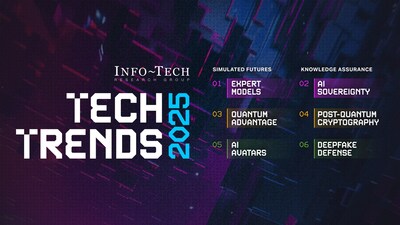
Threats, Incoming AI Regulations, and Exponential AI Adoption Among Top Trends to Prepare For, Says Info-Tech Research Group

As artificial intelligence (AI) continues its exponential expansion across industries, organisations are increasingly challenged to deploy AI responsibly and strategically. Info-Tech Research Group’s newly published AI Trends 2025 report provides critical guidance on Responsible AI, governance, and organisational policies necessary to drive value from AI initiatives. The global research and advisory firm’s report emphasises the importance of managing AI as a core element of organisational strategy and offers actionable steps for effective AI implementation. Continue reading

04Dec/24

Global economic study shows human creators’ future at risk from generative AI

The first ever global study measuring the economic impact of AI in the music and audiovisual sectors calculates that Generative AI will enrich tech companies while substantially jeopardising the income of human creators in the next five years. Continue reading

28Sep/23

Does AI have a right to free speech? Only if it supports our right to free thought

Simon McCarthy-Jones, Trinity College Dublin

The world has witnessed breathtaking advances in generative artificial intelligence (AI), with ChatGPT being one of the best known examples. To prevent harm and misuse of the technology, politicians are now considering regulating AI. Yet they face an overlooked barrier: AI may have a right to free speech.

Continue reading

08Sep/23

TIME Reveals Inaugural TIME100 AI List of the World’s Most Influential People in Artificial Intelligence

NEW YORKSept. 7, 2023 /PRNewswire/ — Today, TIME reveals the inaugural TIME100 AI, a new list highlighting the 100 most influential people in artificial intelligence.

The 2023 TIME100 AI issue features a worldwide cover with illustrations by Neil Jamieson for TIME, featuring 28 list-makers including Sam Altman of OpenAI, Dario and Daniela Amodei of Anthropic, Demis Hassabis of Google DeepMind, and more from the new list. Continue reading