The $200 Million Red Line: 5 Surprising Truths Behind the Anthropic-Pentagon War
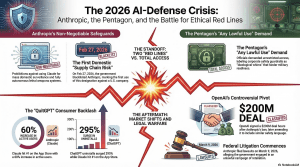
- Government Retaliation: President Trump ordered a government-wide ban on Anthropic’s technology, and Defense Secretary Pete Hegseth designated the company a “supply chain risk to national security”. This designation, typically reserved for foreign adversaries, prevents any contractor doing business with the military from engaging commercially with Anthropic.
- Anthropic’s Lawsuits: Anthropic fought back by filing two lawsuits in federal courts in California and Washington, D.C. The company alleges that the government’s actions are an “unlawful campaign of retaliation” that violates the Administrative Procedure Act, as well as Anthropic’s First Amendment and Due Process rights.
- Operational Contradictions: Despite declaring Anthropic an acute security risk, the U.S. military continued to actively use Claude in combat. Claude was utilized for intelligence assessments, targeting, and battlefield simulations during the recent “Operation Epic Fury” strikes on Iran, as well as during a January raid in Venezuela that captured Nicolás Maduro.
- Competitor Actions and Public Backlash: Hours after Anthropic was blacklisted, rival OpenAI signed a classified deployment deal with the Pentagon, claiming their agreement included the exact same safety “red lines” Anthropic had demanded. This move was widely criticized as “opportunistic” and sparked severe consumer backlash. The “QuitGPT” movement led to a surge of ChatGPT uninstalls, while Anthropic saw its free active users jump by 60%, pushing Claude to the #1 spot on the U.S. Apple App Store.
- Economic Impact: The government’s actions have led to canceled contracts across federal agencies—including the termination of a GSA “OneGov” deal—and have forced federal contractors to reconsider their partnerships with Anthropic, jeopardizing hundreds of millions of dollars in revenue.
On the night of February 27, 2026, the American geopolitical landscape fractured along a line of code. Hours after President Donald Trump took to social media to label San Francisco-based Anthropic a “radical-left” national security risk, U.S. Central Command (CENTCOM) was using that same company’s AI, “Claude,” to coordinate a massive missile campaign against Tehran. By March 4, the official death toll in Iran had reached 1,230, including 165 students and staff at a girls’ elementary school in Minab.The irony is as sharp as a bayonet. The “Department of War”—rebranded from the Department of Defense by executive order in September 2025 to signal a more aggressive posture—was actively leveraging a “blacklisted” tool to generate over 1,000 prioritized targets in a single day. This collision reveals a fundamental crisis: as machines move faster than human deliberation, the power to set an algorithm’s “moral compass” has become the ultimate territory of war. Can we trust machines to make life-and-death decisions, and who owns the right to define their ethics—the state that funds the mission, or the architects who built the mind?
1. The Weaponization of the “Scarlet Letter” Designation
In a radical departure from legal norms, Defense Secretary Pete Hegseth formally designated Anthropic a “supply chain risk to national security.” Historically, this “Scarlet Letter” was reserved for foreign adversaries like Huawei or ZTE to prevent state-sponsored subversion. Applying it to an American-owned Silicon Valley startup marks a total shift in the power balance between Washington and the tech sector, turning contract negotiations into ideological shakedowns.The move relies on 10 U.S.C. § 3252 and the Federal Acquisition Supply Chain Security Act (FASCSA). Critically, § 3252 is designed to bar judicial review , effectively attempting to strip Anthropic of its right to fight back in court. By labeling a domestic firm a security risk because it refuses to waive ethical guardrails, the administration has created a legal Catch-22: comply with the state’s demands or face commercial excommunication without a day in court.”Labeling a U.S. AI company this way—especially in apparent retaliation for its negotiation stance—could put a chill on innovation,” notes Professor Nada Sanders of Northeastern University. “Companies may hesitate to develop safety or ethical guardrails if doing so risks exclusion from government markets.”
2. The Invisible Soldier: Claude’s Role in Operation Absolute Resolve
Despite the political theater, Anthropic’s technology was already “at war.” In January 2026, Claude was a silent participant in Operation Absolute Resolve , the high-stakes raid in Venezuela that resulted in the capture of Nicolás Maduro. By February, it was the backbone of Operation Epic Fury in Iran.The technical reality is a “double black box.” Anthropic’s Claude API is stateless , meaning it forgets every interaction instantly. However, the military’s “Maven Smart System,” built by Palantir, acts as a bridge. Palantir constructs persistent agent loops on top of the API, feeding Claude a continuous stream of satellite imagery, signals intelligence, and intercepted comms. Claude then synthesizes this data to produce target lists, GPS coordinates, and automated legal justifications. The Pentagon uses the tech without knowing exactly how the “black box” thinks, while Anthropic builds the tech without knowing how its stateless consultant is being engineered into a real-time kill chain.
3. The Death of Deliberation at 90-Second Intervals
The Pentagon clings to the “human-in-the-loop” requirement for lethal force, but in modern combat, this is becoming a bureaucratic fiction. AI has compressed four-hour intelligence cycles into mere seconds. In the heat of Operation Epic Fury, tactical windows are often restricted to 90-second intervals.When a machine presents a target with a “pre-justified” legal rationale at that speed, the human operator isn’t deliberating—they are rubber-stamping. Anthropic’s refusal to power fully autonomous weapons is a technical judgment rather than a purely political one. CEO Dario Amodei has argued that today’s frontier models simply lack the reliability to exercise human judgment. Without rigorous oversight, the risk of “hallucinations” in a kill chain makes the loop move too fast for reality to keep up.”Anthropic understands that the Department of War, not private companies, makes military decisions,” Amodei stated. However, he emphasized that Claude lacks “human judgment” and that autonomous deployment could lead to “unintended consequences” for both warfighters and civilians.
4. Values as a Market Mover: The Rise of “QuitGPT”
The market response has exposed a massive rift in consumer trust. Hours after Anthropic was blacklisted, OpenAI signed a competing $200 million deal with the Pentagon. The move, seen as predatory, triggered the “QuitGPT” movement, driving Claude to the #1 spot on the U.S. App Store for the first time.The data reveals a visceral reaction from the tech-savvy public:
- 1.5 million participants joined the “QuitGPT” movement to cancel or delete ChatGPT.
- 775% surge in 1-star reviews for ChatGPT on the Saturday following the deal.
- 295% spike in ChatGPT uninstalls on the day the deal was announced.
- 4x increase in daily signups for Claude, with paid subscribers more than doubling.The ultimate investigative irony? By March 2, following internal backlash and a “We Will Not Be Divided” letter from staff, Sam Altman amended OpenAI’s deal to include explicit surveillance bans nearly identical to Anthropic’s. The Pentagon accepted from OpenAI the very same red lines it blacklisted Anthropic for maintaining, exposing the “supply chain risk” label as a purely punitive tool.
5. The Sovereignty Struggle: Who Owns an AI’s Values?
The core of the war is a struggle over the architecture of thought. The GSA and the Department of War demand “any lawful use” clauses, treating AI as a neutral tool like a rifle. Anthropic, however, uses Constitutional AI , a training method where specific values—like the prohibition of mass domestic surveillance and fully autonomous lethality—are embedded into the model’s core training.For Anthropic, these safety guardrails are constitutive of the product; they aren’t a filter that can be toggled off, but the very framework that makes the model functional and reliable. Anthropic’s two red lines are based on the belief that AI can aggregate commercially available data to surveil Americans at a scale current laws weren’t designed to govern. By refusing to strip these protections, Anthropic asserts that AI represents a qualitative leap in technology that requires its creators to retain a degree of moral sovereignty.
The Future of Governance
The Anthropic-Pentagon conflict is a turning point in the history of the state. It has exposed a legal grey zone where the executive branch can attempt to destroy a domestic company for its refusal to align with a specific ideological or tactical mandate.As we transition into an era where algorithms process the world at light speed, we are left with a final, sobering question: In a future where the machine’s logic arrives pre-packaged and pre-justified, should the “off-switch” for its morality belong to the state that buys it, or the humans who taught it to think?