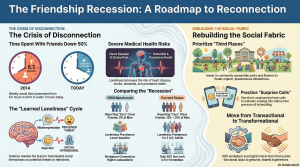

The Decline of the “Third Place” and the Rise of Global Isolation
March 30, 2026 /Mpelembe Media/ — The Core Issue: The “Friendship Recession” Modern society is experiencing a severe decline in social capital and interpersonal connections, a phenomenon widely referred to as the “friendship recession”. Data shows a quantifiable collapse in the size of our social networks: in 1990, 33% of Americans reported having 10 or more close friends, but by 2021, that number had plummeted to just 13%. Meanwhile, the percentage of individuals reporting zero close friends has quadrupled. This erosion of social capital—the “glue” that holds communities together through networks, trust, and reciprocity—is undermining both civic engagement and personal well-being.
Causes of the Decline The fraying of our social fabric is driven by several structural and cultural shifts:
The Loss of “Third Places”: There has been a systematic decline in “third places”—neutral, accessible community gathering spots distinct from home (the first place) and work (the second place), such as cafes, parks, libraries, and local pubs. Urban sprawl, car dependency, and commercialization have made it harder to engage in spontaneous, low-stakes interactions.
Workism and Intensive Parenting: The cultural prioritization of career advancement (“workism”) and hyper-focused, intensive parenting has left adults with little free time, viewing friendships as a luxury rather than a necessity.
Technological Shifts: While technology allows for constant communication, it frequently acts as a shallow replacement for face-to-face interaction. Digital friendships often lack the neurological benefits of in-person connections, such as the release of oxytocin that occurs when reading physical body language or hearing a familiar voice.
Inequality in Social Connection Social isolation does not affect everyone equally; it is increasingly stratified by class and demographics. Individuals with lower incomes, lower levels of educational attainment, and those who are unemployed face significantly higher risks of severe loneliness. For instance, college graduates are far more likely to maintain extensive friendships and utilize community spaces than those without degrees. Furthermore, individuals living alone, single people, recent migrants, LGBTQ+ individuals, and marginalized minority groups also disproportionately suffer from acute social disconnection and a lack of social support.
The Public Health Crisis and Global Impact Loneliness is no longer just a sociological issue; it is a profound medical crisis. Both the U.S. Surgeon General and the World Health Organization have declared loneliness a public health epidemic. Chronic social isolation increases the risk of premature death by up to 30%, posing physiological health risks comparable to smoking 15 cigarettes a day, and heavily increasing the likelihood of heart disease, stroke, and dementia.
Globally, the crisis takes various forms, most notably in the rise of hikikomori—a phenomenon of extreme, prolonged social withdrawal originally identified in Japan but now recognized worldwide. Modern hikikomori is often masked by heavy digital activity, where individuals remain highly active online but physically refuse to leave their homes for months or years at a time.
Pathways to Reconnection Experts emphasize that reversing the friendship recession requires both structural investments and individual action:
Systemic Solutions: Governments and philanthropists must invest in building and maintaining “third places” and social infrastructure. The public health sector must mobilize by training providers to screen for social isolation, while policymakers are urged to adopt a “Connection-in-All-Policies” approach ranging from urban zoning to labor laws.
Individual Action: On a personal level, overcoming “learned loneliness” requires leaning into the discomfort of forming new bonds. Experts recommend establishing predictable routines (like becoming a regular at a local shop), scheduling face-to-face “drop-ins” or “surprise calls,” and joining interest-based community groups to naturally foster new connections.
The Silent Recession: Why We’re Losing Our Friends (and How to Get Them Back)
Driving through North Phoenix, Joe Previte recently passed the Einstein Bagels where he worked at seventeen. For a moment, the memory was visceral: the smell of the oven, the shared laughter with his friend Johnny, and the Spanish banter with the baker. But the nostalgia was quickly eclipsed by a cold, structural silence—he hadn’t spoken to Johnny in years. He is far from alone in this haunting realization. Consider the retired nurse who noted with a clinical detachment that the moment she stopped her daily rounds, her phone simply stopped ringing. Her social life hadn’t just changed; it had evaporated.We are currently navigating what researchers call a “Friendship Recession,” a profound contraction of our social wealth. This is not merely a sentimental lament for “the good old days”; it is a measurable societal crisis. Since 1990, the percentage of U.S. adults reporting they have no close friends has quadrupled to 12%. Even for those with friends, the time spent with them has plummeted. Between 2014 and 2019—well before the pandemic’s forced isolation—average weekly time spent with friends dropped from over six hours to a meager two hours and forty-three minutes.To understand how to fix this, we must first distinguish between social isolation —the objective lack of contact and relationships—and loneliness , the subjective, painful perception of being disconnected. One is a deficit of people; the other is a deficit of belonging. Both, as it turns out, are becoming the defining “learned behaviors” of the 21st century.
1. Isolation is the New “15 Cigarettes a Day”
Loneliness is often misdiagnosed as a private emotional burden, but the U.S. Surgeon General and the CDC have reclassified it as a medical emergency. Social disconnection is a physiological toxin, a predictor of mortality that rivals chronic physical vices.When we are lonely, our bodies exist in a state of high alert. As the late social psychologist John Cacioppo identified, loneliness triggers “social threat sensitivity.” It activates the amygdala—the brain’s threat-detection center—causing us to misinterpret neutral social cues as rejections. This neurological distress manifests physically, increasing the risk for:
Heart disease and stroke
Type 2 diabetes
Dementia and cognitive decline
Depression, anxiety, and suicidality
Earlier death”Former U.S. Surgeon General Dr. Vivek Murthy compared the health risks of isolation to smoking 15 cigarettes a day.”
2. Social Media is Relationship “Junk Food”
In our hyper-connected era, digital interaction has transitioned from a supplement to a “meal replacement.” We are consuming the social equivalent of junk food—quick dopamine hits of interaction that lack the biological nutrients of true connection. While solo dining has increased by 29% in the last two years, we are simultaneously “connected” to thousands via screens.The difference is fundamentally physiological. Hearing a familiar voice in person reduces cortisol (the stress hormone) and boosts oxytocin (the bonding hormone). Text-based communication and video calls often fail to trigger this biological response. This has led to a state of “learned loneliness.” According to Pew Research, 35% of people now feel that socializing is less important than it was before the pandemic. We have adjusted to an unfulfilled need, essentially learning to live with a hunger we no longer recognize.
3. The “Invisible Beam” of Relationship Maintenance
Many adult friendships are held together by an “invisible imbalance.” One person often acts as the “support beam,” performing what psychologists call “relationship maintenance behaviors”—the consistent work of texting first, suggesting plans, and checking in.According to Socioemotional Selectivity Theory , developed by psychologist Laura L. Carstensen , we naturally become more selective as we age, prioritizing depth over a high quantity of acquaintances. However, this creates a specific psychological “sting” when the initiator stops. When you remove the support beam, and the friendship collapses into silence, the pain isn’t just about the loss of contact. It is a retrospective uncertainty. You are forced to re-evaluate the past, wondering: Was this ever a real friendship, or was I just maintaining its illusion?
4. The Hikikomori Paradox: Productivity Doesn’t Equal Connection
We often assume that being “out in the world”—at a job or in school—is an automatic defense against social withdrawal. However, a nationwide study in Japan on the “Hikikomori” phenomenon (extreme social withdrawal) challenges this. The study revealed a paradox: physical presence in a workspace is not a cure for loneliness. In fact, those whose only outings are for school or work are often lonelier than those who stay home but have specific personal interests.
| Behavior Type | Description | Loneliness Risk
|| —— | —— | —— ||
Outgoing & Engaged | Attends work/school + frequent social outings. | Lowest Loneliness ||
Interest-Based | Stays home mostly but leaves for specific hobbies/personal interests. | Moderate Loneliness ||
Socially Withdrawn | Rarely leaves the home or room (Hikikomori). | Extreme Loneliness ||
Routine-Only | Attends work/school but refrains from all other social outings. | Highest Loneliness |
5. Your Inner Circle is a Financial Asset
Relationships are the bedrock of “Social Capital,” a critical driver of economic mobility. Researchers distinguish between bonding relationships (close ties within our immediate circle) and bridging relationships (ties that connect us to different social and economic worlds).Findings from the Gates Foundation and the Urban Institute suggest that “economic connectedness”—friendships across socioeconomic lines—is the single strongest predictor of upward mobility. This is why “third places” like libraries, parks, and community centers are more than just leisure spots; they are “social infrastructure.” They provide the rare opportunities for bridging ties to form. When these spaces crumble, we lose the networks required to navigate complex systems and access new opportunities.
6. The Practical Antidote: Small Acts of Rebellion
Reversing the friendship recession requires shifting our priorities from convenience back to community. We must resist the urge to let solitude become our default setting. Below is a “Cheat Sheet for Connection” based on successful social interventions:
The “Surprise Call”: Reach out for a 5-minute unplanned catch-up. Unlike text, a voice call triggers the oxytocin response our bodies crave and bypasses the “performance” of digital messaging.
The “Friendship Magnet”: Create a group around a shared interest—a bilingual playgroup, a book club, or a “Cowork With Friends” coffee meetup. Shared goals create a natural, low-pressure excuse to stay connected.
The “Drop-In”: Normalize the spontaneous visit. A simple text—”I’m in your neighborhood, mind if I stop by for ten minutes?”—eliminates the scheduling friction that often kills adult plans.
The “Hot Ones” Principle: Shared novelty and discomfort build instant rapport. Whether it’s an escape room or a spicy wing challenge, doing something “hard” together equalizes social hierarchies. When everyone is struggling through a new experience, the barriers of status and ego fall away.
Conclusion: Choosing the “Dynamic Dance”
Friendship in adulthood is a matter of priorities, not just privilege. While structural forces like suburban sprawl and the gig economy have made connection difficult, our recovery depends on a “dynamic dance” between policy changes and individual choices. As the social circle naturally shrinks with age, it doesn’t have to weaken; it can become a fortress of genuine support.As you look at your own life, consider the architecture of your connections. Ask yourself this: Once the support beam of your constant initiation is removed, which of your relationships are strong enough to stand on their own? The answer will tell you exactly where you need to start rebuilding.