
How Modern Dictators Hold Absolute Power
Sun, Nov 01 2026 /Mpelembe Media/ —A dictatorship is a system of governance where a single individual or political party wields absolute power, typically emerging during periods of severe social unrest or economic instability. Within these regimes, personal autonomy, political choice, and human rights are heavily suppressed, and democratic institutions as well as opposition parties are dismantled. Rulers maintain authority through coercion, intimidation, unlawful imprisonment, violence, and state apparatuses such as secret police or indefinite detentions. Furthermore, autocrats frequently manipulate legal frameworks to preserve control; for instance, constitutional amendments in Russia altered presidential term limits to allow Vladimir Putin to remain in power through 2036. While autocracies concentrate unchecked authority strictly within an individual—a category that historically encompassed benevolent rulers—dictatorships can disperse authority across a governing party or ruling circle and inherently feature severe abuses of power.
Authoritarian governance takes several distinct forms, categorized by scholars into five primary types: military regimes, dynastic monarchies, personalistic rules driven by charismatic authority and patronage, single-party dominant states, and hybrid models blending multiple structures. International monitors track these systems by cross-referencing political participation, electoral processes, and civil liberties; regimes scoring low on the Democracy Index or classified as “Not Free” by Freedom House reflect severe restrictions on fundamental liberties.
Geopolitically, the source identifies 52 nations governed by authoritarian regimes or dictatorships as of 2020, with 27 located across Asia and the Middle East, 22 in Africa, and 3 in Latin and South America. Dictators rarely self-identify as such, instead adopting conventional titles like “President” or “Prime Minister”. Prominent global cases include Equatorial Guinea under Teodoro Obiang Nguema Mbasogo, who has ruled since 1979 amid widespread state-sanctioned abuses, and China, where Xi Jinping consolidates authority across the state, military, and Communist Party under a framework designated constitutionally as a “people’s democratic dictatorship”.
Report Overview & Analytical Focus
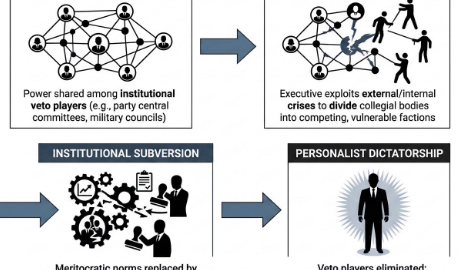
Grounding itself in the theoretical frameworks of Barbara Geddes, Joseph Wright, Erica Frantz, Milan Svolik, and Jeroen Van den Bosch, the report examines the institutional mechanisms through which authoritarian regimes shift across structural categories:
- Intra-Regime Personalization: How the initial collegial power-sharing dynamics of single-party committees and military juntas degrade as supreme leaders centralize discretionary authority.
- Elite Bargaining & the “Precariat” Shift: The tactics rulers use to dilute collective veto power—purging institutional rivals, replacing meritocratic party or military hierarchies with kin and loyalists, and inducing cutthroat competition within the inner circle.
- Institutional Erosion & Parallel Apparatuses: The creation of private patronal pyramids, personalized paramilitary forces, and the subordination of legal, constitutional, and term-limit constraints.
- Vulnerabilities & Exit Trajectories: Why personalization reduces long-term regime durability, distorts strategic decision-making, and significantly increases the likelihood of violent overthrow or state collapse during succession crises.
Below is the structured visual comparison matrix synthesizing the five primary dictatorial and authoritarian regime types established across the scholarly frameworks of Geddes, Wright, and Frantz (GWF) and Ezrow and Frantz:
Visual Comparison Matrix: The Five Kinds of Dictatorships
| Regime Type | Primary Institutional Foundation | Power Acquisition & Retention Mechanism | Succession & Elite Management | Durability & Longevity | Primary Vulnerabilities & Failure Triggers | Prominent Historical & Modern Examples |
|---|---|---|---|---|---|---|
| Military Regime | Armed forces officer corps and military junta. | Seizes power via direct military coups; retains control through military force, security forces, and armed coercion. | Governed collegially by high-ranking officers; promotions follow professional military rank or junta consensus. | Lowest average historical duration among authoritarian typologies. | Internal officer splits: Senior officers prioritize corporate unity over governance, often negotiating an exit back to barracks during crises rather than risking civil war. | Myanmar (1962–1988, 1988–2010), Nigeria (1966–1979, 1983–1999), Argentina (1976–1983). |
| Dynastic Monarchy | Royal dynasty, customary constitutional norms, and dynastic lineage. | Inherited through family connections; sustained via elite dynastic consensus, rent distribution, and traditional legitimacy. | Institutionalized hereditary succession pipelines negotiated within the extended royal family. | Very High; the most durable and long-lasting form of non-democratic rule. | Anti-monarchical coups, external invasion, or popular revolutions triggered by severe legitimacy breakdown. | Oman, Saudi Arabia, UAE, Swaziland/Eswatini. |
| Personalist Dictatorship | Supreme individual ruler and discretionary private security apparatus. | Power concentrated in a single individual; relies on personality cults, informal patron-client networks, and secret police. | Arbitrary appointments based strictly on personal loyalty; formal state institutions and succession rules are deliberately weakened. | Moderate; stable during the dictator’s lifetime, but brittle and volatile overall. | Succession vacuum & violent ouster: Highly prone to coups, popular overthrow, state collapse, or foreign pressure; outgoing rulers frequently face exile, imprisonment, or assassination. | Idi Amin (Uganda), Muammar Gaddafi (Libya), Jean-Bédel Bokassa (Central African Republic). |
| Single-Party State | Monopolistic ruling party apparatus and central committee. | Party controls all nominations, elections, rules, and state propaganda; opposition is outlawed or subsumed. | Institutionalized party pipelines and nomenklatura resolve intra-elite competition and facilitate orderly multi-generational successions. | High; second only to monarchies in long-term institutional survival across leader transitions. | Widespread elite defection, catastrophic economic collapse, or systemic mass uprisings during severe structural crises. | Soviet Union (CPSU), China (CCP), Mexico under the historic PRI. |
| Hybrid / Electoral Autocracy | Managed multi-party framework and tilted legislative arena. | Blends formal democratic facades with autocratic practices; executive uses state resource abuse, regulatory harassment, and media control. | Incumbents maintain power by heavily slanting the electoral playing field rather than banning elections outright. | Variable; prone to prolonged equilibrium in the institutional “grey zone”. | Democratic breakthrough: Mobilized, unified opposition coalitions winning elections despite unfair conditions, or executive overreach triggering backlash. | El Salvador (1948–1982 single-party/military hybrid), Pakistan (1977–1988 military/personal hybrid). |
Core Comparative Takeaways
- Durability and Succession: Regimes with institutionalized corporate structures (Monarchies and Single-Party states) far outlast individualized regimes because they provide regularized mechanisms to resolve internal rivalries and manage leadership successions across generations.
- Exit Costs: Because personalist dictators systematically dismantle formal institutions to prevent rivals from organizing, their departures are overwhelmingly irregular, often ending in imprisonment, exile, or death. By contrast, military officers frequently negotiate safe returns to the barracks with legal immunities intact.
- The Modern Shift: While 20th-century autocracies frequently emerged through sudden military seizures of power, contemporary authoritarianism predominantly takes the form of electoral autocracies and hybrid regimes, relying on incremental executive manipulation rather than outright military rule.
Why Everything You Think You Know About Dictatorships Is Wrong: 5 Surprising Insights from Political Science
1. Introduction: The Modern Autocracy Puzzle
For decades, Western commentary operated on a remarkably comfortable premise: that authoritarian regimes are brittle, outdated political relics bound to crumble under the forward march of human freedom, or that social media would inevitably hand citizens the digital sledgehammers needed to tear down autocratic walls.
Modern political science research paints a far more sober—and fascinating—picture. Comparative political scientists have long abandoned the teleological “end of history” framework popularized by Francis Fukuyama in the immediate aftermath of the Cold War. Returning to foundational regime concepts pioneered by scholars like Juan Linz—who classified political systems into the classical triad of democracy, authoritarianism, and totalitarianism—researchers increasingly recognize that nondemocratic regimes are not merely transit stops waiting to break down. Modern autocracies persist, innovate, and adapt with sophisticated agility.
Why do autocracies not only survive in the modern digital era, but often thrive using the very tools designed to undermine them?
2. Takeaway #1: Dictators Love “Democratic” Institutions—Because They Help Them Stay in Power
When a dictator builds a national parliament, writes a constitution, establishes courts, permits political parties, and holds regular multiparty elections, Western observers often dismiss the display as mere superficial “window dressing” designed to pacify foreign donors. However, institutionalist scholarship by Ellen Lust-Okar, Jennifer Gandhi, Beatriz Magaloni, and Oliver Schlumberger reveals a far more strategic reality: autocrats invest heavily in formal institutions because those institutions serve vital nondemocratic functions.
Rather than undermining dictatorial control, pseudo-democratic structures function as critical regime-maintenance machinery. Parliaments and controlled elections act as opinion barometers to gauge public dissatisfaction before it boils over into revolt, co-optation mechanisms to neutralize ambitious political rivals, and arenas for managing power-sharing among regime elites. As Michael Miller notes, even unfree electoral processes can incentivize autocrats to establish selective policy responsiveness without relinquishing ultimate authority.
“having discovered that ‘institutions matter’ in understanding authoritarian regimes, the next step for scholars is to unpack exactly how they do.”
Crucially, understanding autocratic institutions requires looking beyond formal constitutional architecture to the informal institutions operating beneath the surface. In many rentier and neopatrimonial states, the true engine of power consists of informal patron-client networks, elite cartels, and deeply ingrained “economies of favors”—what sociologist Alena Ledeneva famously analyzed in the post-Soviet context as blat .
As Schlumberger emphasizes, autocrats do not hold elections to foster genuine representation; they hold them to regulate and channel these informal patronage flows. By forcing elites to compete for access to state resources through official electoral channels, regimes convert potentially destabilizing informal networks into disciplined, manageable structures that reinforce authoritarian persistence.
3. Takeaway #2: The Internet Isn’t Liberating Us—It’s Become a Dictator’s Favorite “Repression Technology”
Early digital commentary celebrated the rise of global network communications as an unalloyed “liberation technology,” to borrow Larry Diamond’s memorable phrase. Yet, as scholars Espen Geelmuyden Rød and Nils Weidmann demonstrate, digital media possesses a distinctly “Janus-faced nature.” In the hands of an autocratic state, the open internet rapidly morphs into a high-precision “repression technology.”
Autocrats systematically deploy digital networks for three tactical imperatives:
- Targeted Dissident Tracking: Monitoring digital footprints to pinpoint, isolate, and neutralize opposition leaders before collective action mobilizes.
- Surveillance Signaling: Transmitting pervasive signals of digital omnipresence to induce psychological deterrence and self-censorship across society.
- Propaganda Inundation: Flooding online spaces with state-sanctioned narratives, coordinated distraction, and synthetic noise to shatter public consensus.
“If democratic governments know how to take advantage of it, it might be naïve to think that autocratic governments do not.”
This digital containment strategy extends directly into civil society. Rather than banning non-governmental organizations outright—which draws international condemnation—autocrats pursue imitative institution-building by creating Government-Organized Non-Governmental Organizations ( GONGOs ). These state-backed look-alikes mimic genuine civic groups, monopolizing public funding, surveilling grassroots movements, and crowding out authentic autonomous organizing.
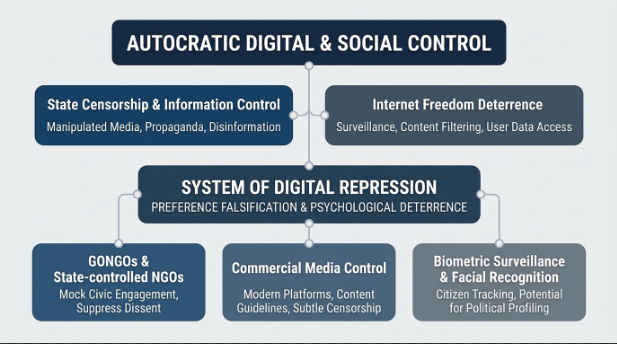
Underpinning these structural mechanics is the subtle psychological warfare of symbol politics. As Lisa Wedeen observed in her classic study of Syria under Hafiz al-Assad, grotesque personality cults and compulsory public rituals do not exist to generate genuine adoration. Everyone knows the regime’s propaganda is absurd. Instead, forcing citizens to publicly act as if they believe generates a systemic culture of preference falsification (as detailed by political scientists like Jiang & Yang and Kirill Kalinin). When citizens routinely disguise their true political opinions to avoid social and physical costs, collective action becomes almost impossible—enforcing daily habits of obedience that solidify regime control.
Even the commercialization and privatization of media, once thought to be an engine of openness, has been co-opted. Studies on media landscapes in China (Stockmann & Gallagher) and historical East Germany (Kern & Hainmueller) show that privatized, highly commercialized entertainment platforms offer citizens an illusion of modern choice. By satisfying consumer appetite for slick, modern programming while leaving core political censorship untouched, regimes subtly elevate public satisfaction and entrench their own legitimacy.
4. Takeaway #3: Not All Dictatorships Fall Equally: Single-Party Regimes Outlast Military Juntas by Decades
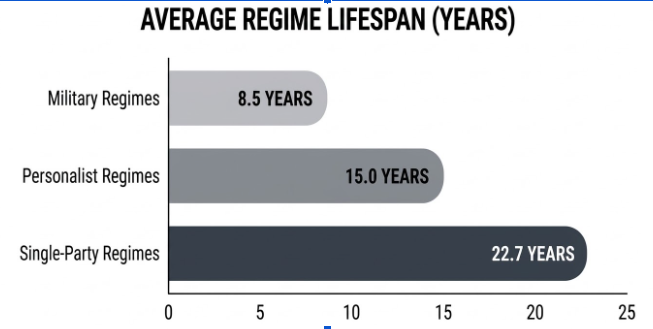
Authoritarian regimes are not uniform monoliths. How a dictatorship is organized internally determines how long it survives, how it handles economic shocks, and how it eventually meets its end. Groundbreaking empirical research by Barbara Geddes classifies autocracies into distinct institutional subtypes, revealing stark divergences in their structural resilience.
Authoritarian Subtype,Average Lifespan,Key Vulnerabilities & Characteristics
Military Regimes,~8.5 years,”Shortest lifespan; highly vulnerable to internal officer factionalism, military cohesion concerns, and economic downturns.”
Personalist Regimes,~15.0 years,”Medium lifespan; reliant on narrow clientelist networks; leaders face high risks of post-exit imprisonment, exile, or death.”
Single-Party Regimes,~22.7 years,”Longest lifespan; bound together by strong party organization, mass elite co-optation, and career discipline.”
Party structures function as an organizational “iron cage.” Unlike military juntas—which prioritize internal army unity above political dominance and often negotiate a return to barracks when economic crises hit—or personalist dictators who rule via brittle inner circles, single-party regimes bind ambitious elites to the state. They offer structured career ladders, broad patronage distribution, and institutionalized succession mechanisms that absorb societal shocks without triggering systemic collapse.
Standing alongside party regimes in historical durability are monarchies —a distinct autocratic subtype highlighted in research by Russell Lucas, Thomas Demmelhuber, and André Bank. During the regional turbulence of the Arab Spring, dynastic monarchies demonstrated extraordinary resilience compared to personalist presidential republics. Because a monarch positions themselves above daily legislative bickering, the throne remains exempt from direct political contestation. When public outrage boils over, monarchs can dismiss prime ministers, shuffle cabinets, and disavow unpopular economic policies without endangering the crown itself.
5. Takeaway #4: “Authoritarianism” Can Exist Inside a Democracy Without Changing the Regime Title
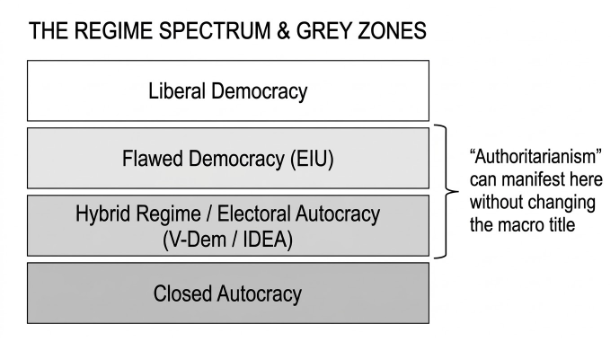
Comparative politics draws a vital distinction between an Authoritarian Regime (a macro-level political system) and Authoritarianism (a broad mode of governing or set of social and institutional behaviors). As political theorist David Beetham notes, an “authoritarian mode of governing”—characterized by executive overreach, low tolerance for public dissent, and systemic erosion of opposition rights—can actively take root inside a democratic system. Such a polity remains technically democratic on paper only so long as core constitutional mechanics persist, multiparty elections remain competitive, and basic civil liberties survive.
To capture the complex “grey zone” where democratic forms and autocratic practices overlap, major quantitative indices employ nuanced classification taxonomies:
- Flawed Democracies ( Economist Intelligence Unit ): Systems with free elections and respected basic liberties, but plagued by governance friction, weak political culture, or low civic participation.
- Electoral Autocracies ( Varieties of Democracy / V-Dem ): Systems that hold de jure multiparty elections for the executive and legislature, but systematically fail to meet basic standards of free and fair competition.
- Hybrid Regimes ( International IDEA / Freedom House / V-Dem ): Persistent polities positioned between autocracy and democracy that combine formal democratic procedures with illiberal governing practices.
However, as Oliver Schlumberger highlights, these “grey zone” concepts reflect a deeper methodological tension in political science. Comparative scholars frequently struggle with “regimes with adjectives” (e.g., competitive authoritarianism , liberalized autocracy ) because blending regime categories can violate basic rules of taxonomy building, such as mutual exclusivity and joint exhaustiveness. Contemporary research emphasizes that hybrid regimes should not be viewed merely as temporary pitstops on a teleological road to democracy; they represent distinct, stable political arrangements that challenge traditional regime models.
6. Takeaway #5: Autocrats Don’t Just Hide the Truth—They Practice “Agnotology” (The Manufacturing of Ignorance)
Investigating nondemocratic regimes presents scholars, journalists, and intelligence analysts with a profound epistemological trap. Autocrats do not merely conceal secrets or censor independent newspapers; they actively engage in agnotology —the deliberate, institutionalized production of ignorance, false data, and post-factual opacity (a concept explored by Robert Proctor, Londa Schiebinger, and Michael Betancourt).
Because nondemocratic regimes are fundamentally “information-shy” —a term famously coined by political economists Clement Henry and Robert Springborg—applying standard social science methodologies designed for open societies yields dangerously distorted conclusions.
As scholars Andreas Schedler, Ariel Ahram, and Paul Goode forcefully warn, when Western analysts uncritically run quantitative regressions on official economic figures, or conduct public opinion surveys inside repressive polities, they risk acting as unwitting agents who validate and legitimize regime propaganda.
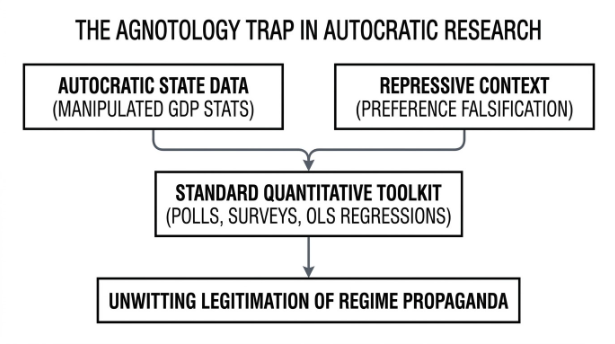
Under authoritarian conditions, public opinion polling does not capture authentic popular sentiment; it captures the structural impact of preference falsification. Official GDP growth metrics, employment statistics, and electoral turnout records are routinely falsified to project economic competence and invincibility. Recognizing agnotology requires social scientists to treat state data not as empirical baseline facts, but as strategic artifacts engineered for political control.
7. Conclusion: The Future of Nondemocratic Power
Modern autocracies are neither decaying vestiges of the 20th century nor clumsy regimes reliant solely on brute force. They are highly dynamic, adaptive political orders. Internationally, dictatorships no longer operate in isolation. Through institutional frameworks studied by the GIGA Institute and researchers like Gero Erdmann, André Bank, and Mirjam Edel, contemporary autocracies engage in active transnational authoritarian learning and diffusion . They share surveillance technologies, coordinate diplomatic protection, swap legal strategies for neutering civil society, and export mechanisms of state control across regional borders.
By co-opting formal institutions, converting digital networks into tools of surveillance, manipulating economic perceptions, and institutionalizing post-factual agnotology, contemporary dictatorships have built resilient engines of power calibrated for the 21st century.
As non-democratic systems master the art of subverting open mechanisms to secure illiberal control, free societies are forced to confront an existential question:
How can open democracies effectively defend their institutional integrity when modern autocrats have learned to master and deploy democratic tools against them?