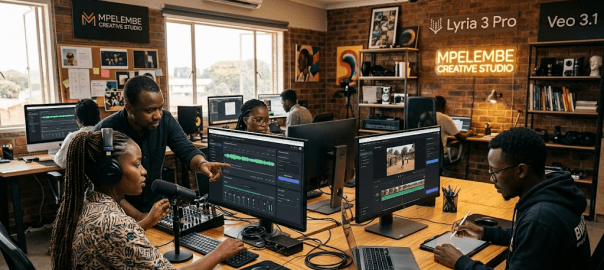
April 8, 2026 /Mpelembe Media/ — This is a comprehensive overview of the 2026 generative AI landscape, heavily focusing on Google’s latest media models, enterprise orchestration, and the broader impacts of AI on industry and regulation. This article analyses a report from Google Cloud titled “Transformation Today,” which highlights new generative media tools available on Vertex AI. The primary focus is the launch of the Lyria 3 Pro and Veo 3.1 Lite models, designed for advanced music and video creation. It categorizes the Veo 3.1 family into three tiers—standard, fast, and lite—to help developers balance visual quality, processing speed, and cost. Additionally, the text offers a specific prompting formula to help users achieve better control over cinematic elements and subject actions. Technical experts contribute to the guide, providing frameworks for applying these AI innovations to professional workflows. Overall, the document serves as an educational resource for engineers looking to integrate high-volume video generation into their applications.
Continue reading
Richmond as a demographic time machine
Aging Well in Richmond: Healthcare, Extra Care Housing, and Social Wellbeing
April 6, 2026 /Mpelembe Media/ — Demographics and the Housing Market Richmond upon Thames is an affluent borough characterized by an aging population and some of the highest property values in London. The median age has risen to 41, and projections indicate that the 80+ age group will be the fastest-growing demographic over the next decade. In the housing market, average house prices saw a slight year-on-year correction, dropping 2.4% to £795,000 in early 2026, while private rental costs surged by 5.7% to an average of £2,276 per month. To address the specific needs of the aging demographic, there is a strategic local push to expand “Extra Care” housing, which enables older adults to live independently while receiving flexible, on-site support. Continue reading
The Rules of Attraction: Why Mosquitoes Target Your Head and Shoulders
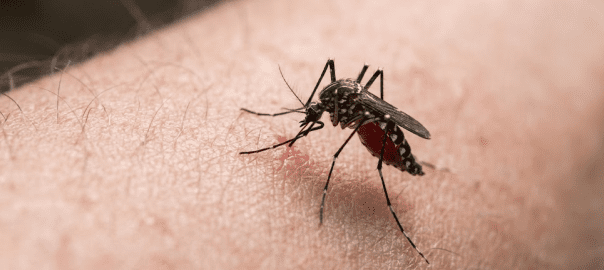
April 5, 2026 /Mpelembe Media/ — Recent research from Georgia Tech and MIT, published in Science Advances, explores how Aedes aegypti mosquitoes utilize different sensory signals to target their victims. Through experiments tracking the insects with 3-D infrared cameras, scientists discovered that mosquitoes are most strongly attracted to the combination of dark colors and carbon dioxide. Continue reading
Why Friction Prevents Escalation
U.S. politicians across the political spectrum have reacted with intense alarm to the President’s recent expletive-laden threats toward Iran, with several questioning his mental fitness for office.
April 6, 2026 /Mpelembe Media/ — The current conflict between the United States, Israel, and Iran began in late February 2026 with joint U.S.-Israeli “preemptive” military strikes on Iran, aiming to either eliminate the country’s nuclear capabilities or force regime change. In retaliation, Iran launched drones and ballistic missiles against Israel, as well as U.S. military targets located in the Gulf States and Jordan. Now in its sixth week, the war has severely destabilized the Middle East, killing over 3,500 people across the region—including more than 1,900 in Iran and 1,400 in Lebanon—while displacing millions. Continue reading
From “Artful Dodger” to Algorithm: The Hidden Power of AI Nicknames in Corporate Governance
April 5, 2026 /Mpelembe Media/ — The practice of naming AI agents in corporate governance—such as appointing an AI observer named “Aiden Insight” or “NOVA”—is a sophisticated sociological tactic designed to accelerate trust, lower intimidation, and make algorithms feel more like collaborative teammates than static tools. However, the nicknames and personas assigned to AI carry significant psychological, ethical, and governance implications for the boardroom.
Never Wrestle with a Pig
April 1, 2026 /Mpelembe Media/ — Let us explore the dynamics of conflict, toxicity, and reputation management across both interpersonal relationships and macro-level societal structures.
Continue reading
How Street Codes Survive the AI Era
Decoding the Dance: How the Crip Walk Transformed from a Secret Gang Code to Global Entertainment
April 3, 2026 /Mpelembe Media/ — The C-Walk, originally known as the Crip Walk, was developed in 1970s Compton by gang member Robert “Sugar Bear” Jackson as a complex, non-verbal “secret code”. It utilized precise footwork to spell out gang identifiers like “C-R-I-P” and visually cross out the names of rival gangs. During the 1990s, West Coast hip-hop artists like Snoop Dogg and WC popularized the dance, transforming it from a localized ritual into a mainstream symbol of regional pride.
From AI Yes-Man to Critical Partner: Inside the Vionde Studio Workflow
April 1, 2026 /Mpelembe Media/ — Vionde Studio represents a category of bespoke, cloud-native AI solutions—typically hosted on platforms like Google Cloud Run—that function as centralized command hubs for deploying custom AI agents. Its primary goal is to prioritize the preservation of human “soul,” voice, and intention through sophisticated technical workflows, avoiding the generic, flat content often produced by traditional AI. Continue reading
Artemis II: A 10-Day Journey Around the Moon
Artemis II Launch Day: NASA Ready to Send First Crew to the Moon in Over 50 Years
April 1, 2026 /Mpelembe Media/ — NASA is currently in the final countdown for the historic launch of the Artemis II mission, scheduled to lift off today, April 1, 2026, at 6:24 p.m. EDT from the Kennedy Space Center in Florida. This 10-day mission will send four astronauts around the Moon, marking the first time humans have left low-Earth orbit since the Apollo 17 mission in 1972. Continue reading
April Fools’ in the Science Classroom: Using Pranks to Build Media Literacy
From Moon-Bats to Deepfakes: How Scientific Hoaxes Expose the Flaws in Our Information Ecosystem
April 1, 2026 /Mpelembe Media/ — The Evolution and Impact of Scientific Deception Throughout history, scientific hoaxes and misinformation have challenged our epistemological frameworks and tested the limits of institutional authority. While these deceptions have occasionally caused public harm, they also paradoxically serve as vital catalysts for improving methodological rigor, journalistic standards, and public media literacy. Continue reading