Tag Archives: Tanzania

08Jan/26

2026 Risk Report: Zambia’s Economic & Political Outlook

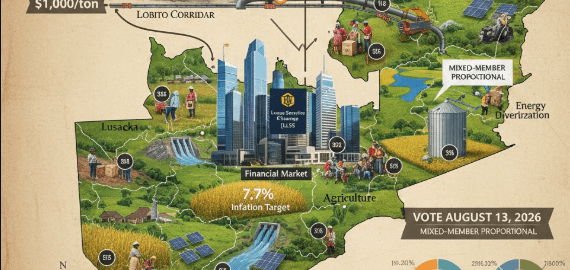
Jan. 8, 2026 /Mpelembe Media/ — In 2026, Zambia is positioned at a critical crossroads, transitioning from a period of climate-induced shocks (2024–2025) into a high-growth phase. The economy is projected to expand by 6.4%, a “rebound” driven primarily by a resurgence in the mining sector as copper production targets 1 million metric tons. This growth is supported by a more stable agricultural season and a strategic pivot toward renewable energy to mitigate future power deficits. Continue reading

22Dec/25

2025 Africa Cup of Nations

Dec. 22, 2025 /Mpelembe Media/ — The 2025 Africa Cup of Nations, a premier football tournament hosted by Morocco will span from 21 December 2025 to 18 January 2026, the competition features 24 national teams divided into six distinct groups. The document lists specific match dates, kick-off times, and various stadium locations across the country, starting with the opening group stages and concluding with the final in Rabat.
Continue reading

18Mar/25

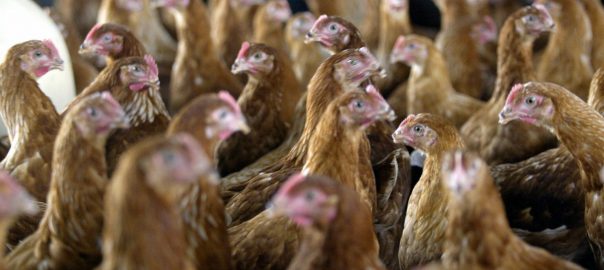
High soybean prices in Zambia and Malawi may make chicken costly too: lack of competition is to blame

Arthur Khomotso Mahuma, University of Johannesburg and Namhla Landani, University of Johannesburg

Poultry is one of the cheapest protein sources for the growing population of the east and southern Africa region. That makes soybeans critical to food security in the region, as they are an important input in chicken feed.

Continue reading

16Jan/24

Zambia and Gambia explained

Jan. 16, 2024 /Human Interest/ — Zambia and Gambia, despite their similar-sounding names, are quite different countries in Southern and West Africa, respectively. Here’s a breakdown of their key differences: Continue reading

13Jan/24

The Africa Cup of Nations (AFCON) 2024 analysis

Jan. 9, 2024 /Sports/ –The Africa Cup of Nations (AFCON) kicks off today, 13th January 2024! Here’s the breakdown: Continue reading

30Nov/23

History of Congolese Rumba

Nov. 30, 2023 /Music/ — Congolese rumba, also known as Congolese soukous, is a genre of popular music that originated in the Democratic Republic of the Congo (DRC) in the early 20th century. It is a fusion of traditional African rhythms and melodies with influences from Cuban and Caribbean music. Rumba quickly became popular in the DRC and spread to other African countries, particularly Kenya, Tanzania, and Zambia. In the 1960s, rumba gained international recognition and became popular in Europe and the Americas. Continue reading

05Sep/23

We are UK Zambians investing in the Diaspora

Sept. 6, 2023 Social/ — Zambians are not proud to be British. Zambia is an independent country, and its citizens are proud to be Zambian. However, there is a history of mutual respect between Zambia and Britain, which may explain why some Zambians may have positive feelings towards Britain. Continue reading

19Jul/23

Anglo American in Zambia Explained

July 18, 2023 /Politics/ — Hakainde Hichilema, the current president of Zambia, has been criticized for selling the country’s natural resources to Anglo American, a British mining company. In 2022, Hichilema’s government signed a $1.5 billion deal with Anglo American to mine copper in Zambia. The deal has been met with protests from environmental groups, who argue that it will damage the country’s natural resources. Continue reading

07Jul/23

How holidaying in developing countries affects local inequality

A few years ago, one of us (Alex) went for a vacation to the Dominican Republic. The motivation was similar to millions of other tourists every year: escape the daily routine, enjoy the sun and beaches, and gather some strength to face another cold winter.

Unfortunately, a few things weren’t very conducive to a happy break. The staff at the mammoth hotel were making as little as US$1 (£0.79) for a 12-hour shift. Worse, most of them lived in a shanty town nearby. They had no sewers and no reliable electricity.

The hotel also exploited its power over local farmers to procure food exceedingly cheaply. Schools were overcrowded and many children dropped out to work in businesses like these hotels and farms, perpetuating the cycle.

Continue reading