
Beyond Consumerism: Ancient Blueprints for Tranquility in a Restless World
Mon 21 Sept 2026 /Mpelembe Media/ — Epicurus constructed a comprehensive, materialistic philosophy rooted in atomism to liberate humanity from psychological anxiety. By asserting that the universe consists solely of indestructible atoms moving and randomly swerving through empty space, he replaced mythological explanations with mechanistic natural laws. This physical worldview served a direct therapeutic purpose by demonstrating that divine beings do not interfere in human affairs or inflict punishment, and that the human soul—composed of fine physical particles—disperses entirely upon bodily death. Because consciousness ends permanently at death, Epicurus reasoned that death is nothing to us, freeing individuals from the existential dread that fuels irrational ambitions.
At the heart of Epicurean ethics is a refined form of ethical hedonism that defines true pleasure not as sensory indulgence, but as aponia (the absence of physical pain) and ataraxia (unshakable mental tranquility). Rather than recklessly chasing fleeting, kinetic pleasures that often lead to later distress, Epicureans cultivate static pleasures derived from bodily health and a quiet mind. To maintain this equilibrium, Epicurus established a precise taxonomy of desires. Natural and necessary desires, such as simple food, basic shelter, and friendship, must be satisfied to remove pain, whereas natural but unnecessary luxuries require cautious moderation. Vain and empty desires for status, extreme wealth, or political power must be eliminated entirely because they lack natural limits and breed perpetual anxiety.
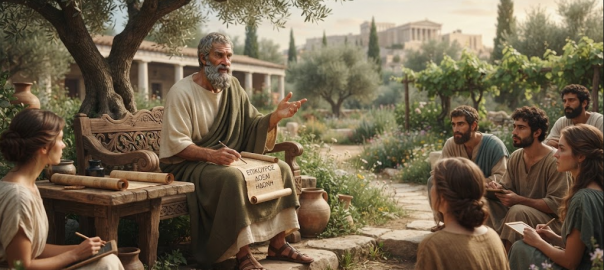
In his intentional community outside Athens known as “The Garden,” Epicurus put his philosophy into practice by living modestly on bread and water while welcoming women and enslaved individuals into intellectual fellowship. Central to this communal lifestyle was the cultivation of deep friendship (philia) and radical self-sufficiency (autarkeia), which protected practitioners from civic instability and artificial needs. The core of his psychological wisdom is captured in Vatican Saying 35, which cautions against spoiling present blessings by fixating on unfulfilled wants, reminding individuals that what they now possess was once merely hoped for. In a modern world driven by consumerism and the hedonic treadmill, Epicurus’s subtractive approach—finding true wealth by reducing internal cravings rather than expanding external possessions—offers an enduring blueprint for sustainable contentment.
🌿 Would you like to explore a specific theme further, such as Epicurus’s taxonomy of desire or how Epicureanism contrasts with Stoic ethics?
The Ancient Guide to the Modern Soul: 5 Surprising Lessons from the Greek Masters
Introduction: The “Happy” Misunderstanding
In our high-velocity digital age, we treat happiness like a fleeting dopamine hit—a transitory mood to be engineered through curated experiences and “likes.” We have become obsessed with the performative wellness of Instagram, chasing the feeling of contentment as if it were a consumer product. Yet, despite this optimization, we are plagued by an undercurrent of anxiety. The ancient Greek masters approached this problem from a radically different angle. To them, happiness was not a transient emotion, but a structural achievement of the soul; it was less about a “good mood” and more about a life worth living.While we view happiness as something that happens to us—a reward for hitting a milestone or a result of the right “life hack”—the ancients viewed it as an essential human activity. They didn’t seek to manipulate their feelings; they sought to master the art of functioning well. By shifting the focus from the fleeting to the foundational, these “dusty” theories provide radical interventions for our modern dopamine-loop architecture. If you find the modern pursuit of happiness exhausting, these lessons from antiquity offer a blueprint for a soul that is resilient, tranquil, and fundamentally free.
Takeaway 1: Happiness is an Activity, Not a Feeling (The Aristotle Flip)
Happiness is a Verb, Not a Noun
In the modern vernacular, “happiness” is a noun—a destination we hope to reach. However, for Aristotle, Eudaimonia was closer to “functioning well.” To explain this, he used the ergon (characteristic activity) analogy: just as a flutist’s excellence is found in playing the flute and a carpenter’s in building, the human “good” is found in our characteristic activity: the exercise of reason.This “Aristotle Flip” reduces the immense pressure of modern emotional performance. If happiness is a craft you practice rather than a mood you must maintain, you regain agency. However, Aristotle warned that this is not a quick fix or a weekend retreat; he famously noted that “one swallow does not make a spring,” meaning Eudaimonia is a project that spans a complete lifetime. It is the steady, excellent exercise of the soul, not a singular peak experience.”For ancient philosophers eudaimonia is closer to the secondary sense of our own term. Happiness means not so much feeling a certain way… but rather carrying out certain activities or functioning in a certain way.”By viewing happiness as an activity, we stop asking “How do I feel?” and start asking “How well am I functioning?” This shifts our focus from the internal vacuum of our moods to the tangible quality of our actions.
Takeaway 2: The Radical Simplicity of True Pleasure (The Epicurean Rebrand)
Why the World’s Most Famous Hedonist Preferred Simple Fare
“Epicurean” has become a lazy synonym for luxury, but Epicurus himself would have been horrified by modern “grind culture” and its material excess. Living in “The Garden,” an inclusive community, Epicurus argued that the ultimate goal was ataraxia (tranquility) and aponia (the absence of pain).He revolutionized pleasure by distinguishing between kinetic pleasure —the jolts of excitement we get from consumption—and katastematic pleasure , which is the stable state of being free from distress. For Epicurus, real pleasure is a “negative” achievement; it is the peace found when pain is subtracted. To reach this, he categorized desires into:
- Natural and Necessary: Such as drinking when thirsty.
- Natural but Unnecessary: Such as the desire for expensive, gourmet food.
- Empty/Groundless: The pursuit of crowns, statues, and limitless wealth.Epicurus lived on simple fare because luxurious desires are difficult to satisfy and create mental turbulence. He even introduced the “atomic swerve”—the idea that atoms can randomly veer—to prove we aren’t just cogs in a mechanistic universe. In an age of algorithmic determinism, Epicureanism is a radical call to subtract the “empty” desires of status and return to the simple pleasure of existing without pain.”If thou wilt make a man happy, add not unto his riches but take away from his desires.”
Takeaway 3: Your Character Matters More Than Your To-Do List (Agent vs. Action)
Ancient Ethics is About Being, Not Just Doing
Modern ethics is “action-centered,” treating morality like a checklist of “good deeds” or a series of life hacks to optimize our social capital. We calculate consequences like accountants. Ancient ethics, however, was “agent-centered,” focused on the internal state of the person.The ancients compared a just person to a physician. Being a doctor isn’t just about following a predefined list of medically effective actions; it requires “practical knowledge” and a form of judgment that is not always definable in a manual. This is a direct assault on our obsession with “productivity systems.” You cannot hack your way into being a good person; you must cultivate a “settled disposition” (virtue).Crucially, the Socratic tradition introduces Socratic Intellectualism : the radical idea that “no one knowingly desires what is bad.” This means our “bad habits” aren’t failures of willpower, but “glitches” in our vision—errors in what we think will lead to our well-being. By focusing on being rather than just doing , we stop worrying about our “to-do list” and start refining the internal map that guides our lives.
Takeaway 4: The Stoic Power of “Preferred Indifferents”
Wealth, Health, and Beauty Don’t Actually Make You Happy
The Stoics offered a psychological immunity to the fragility of the digital reputation economy. They argued that the only true “good” is virtue. Everything else—health, wealth, and status—is “indifferent.” These are “preferred indifferents”; it’s natural to prefer health over sickness, but your happiness does not depend on it.To illustrate this, they used the analogy of the archer. An archer does everything in their power to hit the target, but a sudden gust of wind—the vicissitudes of life—might blow the arrow off course. Therefore, the archer’s true goal is not hitting the target, but the art of trying everything in their power to hit it.In our world of material excess, this is a radical intervention. When you internalize that wealth and reputation are “indifferent” to your fundamental worth, you become bulletproof. If the “government of the universe” dictates you lose your health or your status, your virtue—and thus your happiness—remains intact.
Takeaway 5: Peace Through “Suspension of Judgment” (The Skeptic’s Zen)
The Quiet Joy of Admitting You Don’t Know
In an era of polarized takes and “doomscrolling,” the Pyrrhonian Skeptics found tranquility ( ataraxia ) through the “suspension of judgment.” They observed that for every argument, there is a counter-argument, and we can never truly know if things are “naturally” good or bad.We often suffer “double suffering”: once from the physical hardship, and a second time from the dogmatic belief that the hardship is “naturally bad.” The Skeptic is “guided by nature and compulsion… but undogmatically.” They still eat when hungry and follow local customs, but they do so without the “mental burden” of labeling their experiences. For example, a Skeptic may feel the cold, but they achieve a “moderate state” because they don’t add the extra layer of distress that comes from believing being cold is an inherent evil.”The end of life is freedom from disturbance in matters of belief, plus moderate states in matters of compulsion.”Skepticism isn’t about being a shut-in; it’s about participating in life while refusing to let dogmatic opinions disturb your internal peace.
Conclusion: The Ancient Future of Well-Being
The core thread connecting these schools is that happiness is an internal, psychological good rather than a material one. From Aristotle’s excellent activity to the Skeptic’s detached peace, the message is clear: true well-being is sheltered from the noise of the external world. These ideas remain durable because human nature has changed far less than our technology. In a world of digital excess and “wellness capitalism,” the ancient masters remind us that we cannot find peace by adding more to our lives, but by refining the souls we already have.If happiness is an activity you perform rather than a destination you reach, what is the “characteristic activity” of your life today?