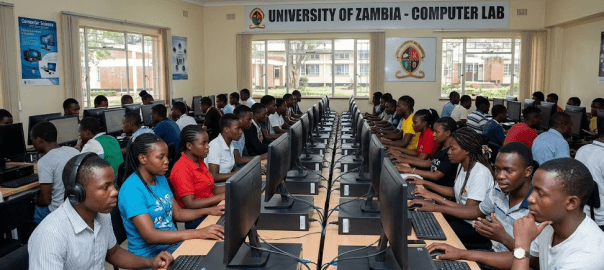
Dec. 14, 2025 /Mpelembe Media/ — The FST journal, Volume 24, Number 2, published by the Foundation for Science and Technology in December 2025 focuses on several critical topics in science and technology policy within the UK and globally. Key themes include an event report on R&D collaboration in Africa, emphasizing shared growth and mutual benefit, and an in-depth conversation with Dame Ottoline Leyser, the recently retired Chief Executive of UKRI, discussing the future and function of UK research councils and funding. Continue reading
Category Archives: Technology
Google is relying on its own chips for its AI system Gemini. Here’s why that’s a seismic change for the industry
Alaa Mohasseb, University of Portsmouth
For many years, the US company Nvidia shaped the foundations of modern artificial intelligence. Its graphics processing units (GPUs) are a specialised type of computer chip originally designed to handle the processing demands of graphics and animation. But they’re also great for the repetitive calculations required by AI systems.
Fraud’s New Frontier: AI, Deepfakes, and Global Networks
Dec. 02, 2025 /Mpelembe Media/ — The Sumsub Fraud Report 2025-2026 focuses on the “Sophistication Shift,” which describes the fundamental change in identity fraud from high-volume, basic attempts to fewer, more targeted, and financially damaging AI-enabled operations. This shift is driven primarily by the industrialisation of deception via generative AI, leading to an explosion in deepfakes and highly realistic synthetic identities across all major digital ecosystems. The analysis provides comprehensive regional breakdowns for Europe, Asia-Pacific, Latin America, Africa, and North America, demonstrating that even in markets where overall fraud rates are stabilising, the remaining attacks are significantly more complex and harder to detect. Continue reading
Dynamic Agent Orchestration: The Puppeteer Paradigm
Dec. 02, 2025 /Mpelembe Media/ — The academic paper introduces a novel framework for coordinating complex problem-solving in Large Language Model (LLM)-based multi-agent systems. To address the inherent inefficiencies of traditional static agent structures, the authors propose a “puppeteer-style” paradigm where a central orchestrator dynamically selects and sequences agents based on the evolving task state. This centralised orchestrator policy is continuously optimised using reinforcement learning (RL), leveraging a tailored reward function that explicitly balances solution quality with computational efficiency. Empirical results across various closed- and open-domain scenarios demonstrate that this adaptive approach achieves superior performance compared to existing methods while concurrently reducing token consumption. Finally, analysis of the evolving collaboration patterns confirms that the RL-driven policy leads to the emergence of highly compact and cyclic reasoning structures. Continue reading
The Regulatory Burden on Mobile Cyber Defenses
This report details the findings of a new GSMA report concerning the regulation of mobile network cybersecurity. The report warns that fragmented and inconsistent policy requirements across global markets are proving counterproductive, driving operator costs—projected to reach up to $42 billion by 2030—and diverting essential resources away from actual threat mitigation toward burdensome compliance tasks. To counteract these inefficiencies, the GSMA advocates for effective policy frameworks that are risk-based, outcome-focused, and collaborative, built upon six core principles for better global security. Ultimately, the source materials function as a call for international governmental coordination to minimize unnecessary burdens and ensure a more resilient and secure mobile ecosystem. Continue reading
Critical Thinking: There is a thin line between genius and insanity
Nov. 25, 2025 /Mpelembe Media/ — This phrase, “There is a thin line between genius and insanity,” is a compelling and long-standing stereotype that suggests a close connection between exceptional creativity and mental illness.
While it’s a popular idea, modern research indicates that it’s an oversimplification. There isn’t a single “thin line,” but rather a complex, non-linear relationship where certain traits and genetic factors are sometimes shared between highly creative individuals and those with specific mood disorders. Continue reading
Trump Launches Genesis Mission AI Initiative
Nov. 25, 2025 /Mpelembe Media/ — The provided text details the inauguration of the “Genesis Mission”, a significant artificial intelligence (AI) initiative launched through an executive order signed by President Donald Trump in November 2025. This federal effort is aimed at dramatically accelerating American AI research, development, and application, particularly in scientific fields, and has been compared to the historical Manhattan Project in its urgency and ambition. The mission intends to leverage vast federal datasets and expand computational resources to create sophisticated AI models, with goals including strengthening national security and accelerating scientific discovery. This initiative builds upon existing frameworks like the National Artificial Intelligence Research Resource (NAIRR) and involves partnerships with key figures and agencies, such as the Department of Energy, to establish essential infrastructure like the “American Science and Security Platform.” Continue reading
NATO Partners with Google Cloud for Sovereign AI Security
Nov. 25, 2025 /Mpelembe Media/ — A multi-million-dollar contract between NATO and Google Cloud for a secure, AI-enabled sovereign cloud solution involves the NATO Communication and Information Agency (NCIA) selecting Google Distributed Cloud (GDC) air-gapped to modernise its infrastructure, specifically supporting the Joint Analysis, Training and Education Centre (JATEC). The purpose of using GDC air-gapped is to ensure uncompromised data residency, operational control, and high security for classified workloads, as this technology operates in completely disconnected environments. Both parties emphasise that this collaboration will significantly accelerate NATO’s digital modernisation efforts and enable the organisation to securely harness advanced AI and cloud capabilities. The Chief Technology Officer of NCIA confirmed that partnering with industry is vital for NATO’s digital transformation, allowing them to create a resilient and scalable cloud environment for highly sensitive data. Continue reading
Vodacom and Google Cloud: Africa’s AI Advancement
The is an excerpt from a press release distributed via PR Newswire and the Mpelembe Network, announcing a multi-year strategic collaboration between Vodacom Group and Google Cloud. This partnership is designed to accelerate Vodacom’s digital transformation and significantly advance the use of artificial intelligence (AI) across Africa. Vodacom, a major pan-African telecommunications company, plans to use Google Cloud’s secure, scalable infrastructure and advanced generative AI models, such as Gemini, to unify its data assets and improve operational efficiencies. The core goals of this alliance include achieving real-time data insights, accelerating AI adoption for services like network optimisation and customer care, and developing new, innovative products tailored for the African market, particularly in fintech and enterprise solutions. This agreement builds upon an existing relationship between Vodafone, Vodacom’s parent company, and Google Cloud. Continue reading
Accelerating Enterprise Data Migration with AI
Nov. 25, 2025 /Mpelembe Media/ — The document, titled “Accelerating enterprise data migration,” is a Google Cloud resource promoting the migration of corporate data platforms to their cloud environment, primarily using BigQuery and Vertex AI. The central argument is that legacy systems are inadequate for modern AI-driven success, while cloud migration provides substantial benefits like faster insights, cost efficiency, and AI readiness. Multiple case studies from diverse industries, including financial services (PayPal, DBS Bank, Intesa Sanpaolo), logistics (J.B. Hunt), and healthcare (Quest Diagnostics), illustrate how major companies modernised their infrastructure from systems like Teradata, Oracle Exadata, Hadoop, and Snowflake. These examples highlight key migration learnings, such as the importance of FinOps for cost control, strategic data cleanup, and full organizational alignment, demonstrating that Google Cloud offers an AI-enabled migration solution that simplifies and accelerates the transformation process. Continue reading