Nov. 24, 2025 /Mpelembe Media/ — The analysis of the growth and prevalence of AI-generated articles being published on the web clearly indicates that the quantity of articles produced by AI surpassed human-written content in November 2024, a significant trend spurred by the launch of ChatGPT in late 2022. However, the proportion of AI content has recently stabilised and suggests this might be due to AI articles often not performing well in major search engines like Google. The CommonCrawl dataset and the application of an AI detection algorithm has been known for its false positive and negative rates when using articles from before ChatGPT’s release and articles generated by GPT-4o, respectively. Continue reading
Tag Archives: .google
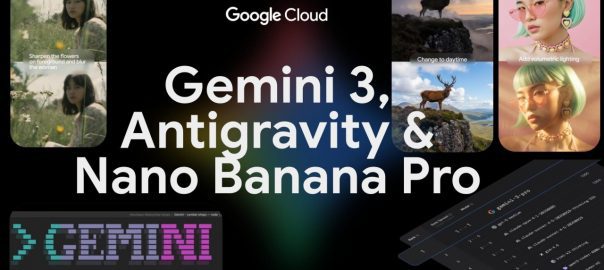
Gemini 3, Nano Banana Pro, and Google Antigravity Launch
Nov. 24, 2025 /Mpelembe Media/ — Google Cloud announced three significant product launches for enterprise customers: Gemini 3, Google Antigravity, and Nano Banana Pro. Gemini 3 is highlighted as a powerful multimodal model capable of understanding complex data, boosting developer productivity through “vibe coding” and agentic capabilities, and providing concise insights for business tasks. The post also introduces Google Antigravity, a new agentic development platform that allows developers to operate at a higher, task-oriented level using Gemini 3’s advanced reasoning. Furthermore, Nano Banana Pro, built on Gemini 3, is presented as a state-of-the-art tool for image generation and editing that enhances creative control, supports localized campaigns, and integrates seamlessly into existing workflows. Continue reading
Agentic AI Reshapes SEO and Autonomous Search
Nov. 23, 2025 /Mpelembe Media/ — The emerging field of agentic artificial intelligence (AI) has a profound implications for search engine optimisation (SEO) strategies. Agentic AI are systems that can autonomously plan, decide, and execute complex, multi-step tasks, moving beyond the reactive nature of traditional AI tools. Crucially, the text outlines the human-AI agent collaboration model, emphasising that human strategists are still essential for high-level strategy, quality validation, and ethical oversight, operating under a “human in the loop” principle. The article also discusses various practical applications of agentic AI in SEO, such as topic ideation, competitive analysis, and content clustering, while warning against significant challenges like data quality issues, hallucination risk, and over-reliance on automation. Ultimately, the source suggests that the future of SEO lies in leveraging agentic systems to gain a competitive advantage through smarter, more adaptive workflows. Continue reading
Structural Collapse and Consolidation of Enterprise AI Architecture
Nov. 23, 2025 /Mpelembe Media/ — ExperienceBypass™, an advisory firm, announced their new report titled “The Real AI Bubble.” This report, authored by CEO Honorio J. Padron, warns that the AI market faces a structural collapse, arguing the actual bubble is architectural, not financial. The core thesis is that tens of thousands of smaller AI point solution companies will disappear over the next 36 to 48 months as global enterprises consolidate their technology around a few AI Native Platforms (or “AI Factories”) such as NVIDIA and Palantir. This consolidation is driven by the failure of most enterprise AI pilots and a demand for unified architecture, mirroring the standardisation seen in the ERP sector during the 1990s. Padron asserts that non-integrated point solutions lack a place as the AI Enabled Enterprise™ becomes the new operating model, acting as the central nervous system for modern businesses. Continue reading
Google Workspace for Education Editions and Add-ons
Nov. 19, 2025 /Mpelembe Media/ — Google Workspace for Education offers a tiered structure of services for educational institutions. It details three primary editions—Education Fundamentals, Education Standard, and the recommended Education Plus—each providing increasingly comprehensive features in areas like security, administration, and learning tools, with the latter two involving per-user fees. Furthermore, there are several optional, paid add-ons designed to supplement the core packages, focusing on functionalities such as advanced teaching and learning tools, endpoint device management, and additional data storage. These add-ons include premium artificial intelligence capabilities, specifically through Gemini Education, offering tailored enhancements for specific institutional requirements. Overall, Google Workspace for Education provides the flexible options available to meet diverse educational technology needs. Continue reading
Workday Expands Ecosystem with Google BigQuery and Developer Network
Workday is expanding its open ecosystem through two key initiatives: the introduction of a new global developer network aimed at training future AI talent via certifications and hands-on experience, and a strategic partnership with Google BigQuery to offer customers secure, zero-copy access to Workday HR and finance data for advanced AI-powered insights. Furthermore, the company highlights its planned acquisition of Pipedream, an integration platform, which will enhance Workday’s AI agent capabilities by securely connecting its data with thousands of external systems. Interspersed within the document are unrelated website navigational elements and advertisements for items such as children’s beds and business broadband. Continue reading
Monetizing Next-Gen News Formats and Experimentation
Nov. 17, 2025 /Mpelembe Media/ — The GNI Future Formats Accelerator 2025 focuses on “Supporting Long-Term Success” with a masterclass titled “From Reach to Revenue: Monetising Next-Gen News Formats.” A key section addresses the challenges and opportunities in monetising Gen Z audiences, highlighting their preference for trustworthy, flexible, and visually driven content, and their willingness to pay for news that aligns with their identity. The documents explore three primary monetisation methods: direct monetisation (including student discounts and tiered offerings like those from The Economist), on-platform monetisation (using platforms such as YouTube and Apple Podcasts), and sponsored content. Continue reading
VIPRE Q3 2025 Email Threat Landscape Report
The report provided by VIPRE Security Group concerning their Q3 2025 Email Threat Landscape Report, which details how cybercriminals are using increasingly sophisticated methods to bypass traditional email defences. The report reveals that commercial clutter makes up the largest proportion of email volume and is intentionally used to desensitise users, enabling malicious emails like phishing attempts to blend in. Key findings highlight that attackers frequently exploit compromised URLs or open redirects and are strategically targeting Outlook and Google mailboxes, which together constitute ninety per cent of observed phishing attacks. Furthermore, the report notes emerging technical trends such as the use of Fetch API for credential exfiltration and the abuse of Apple’s TestFlight platform to distribute malicious iOS applications, while acknowledging that geographic dispersion across spam-sending markets is making traditional IP blocking ineffective. Overall, the source stresses that organisations must adopt equally adaptive and layered defences to counter the evolving threat landscape. Continue reading
How to use Gemini Command Line Interface (CLI)
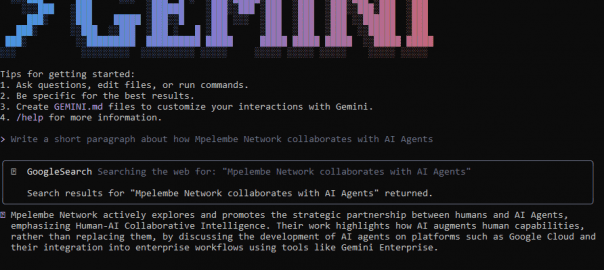
Nov. 2, 2025 /Mpelembe Media/ — The Gemini Command Line Interface (CLI) is an open-source AI agent that allows you to access Gemini directly from your terminal. It uses a “reason and act” (ReAct) loop with built-in tools and local or remote Model Context Protocol (MCP) servers to handle complex tasks like fixing bugs, creating new features, and improving test coverage. Beyond coding, it’s a versatile tool for content generation, problem-solving, research, and task management. Continue reading
Google AI Studio: Vibe Coding Innovation
Nov. 1, 2025 /Mpelembe Media/ — Google Cloud announced major updates to the Google AI Studio platform, focusing on making app development faster and more accessible. The Google Cloud introduces “Vibe coding,” a new feature designed to allow users to build working, AI-powered prototypes simply from a single text prompt, dramatically reducing the time required compared to traditional methods. Continue reading